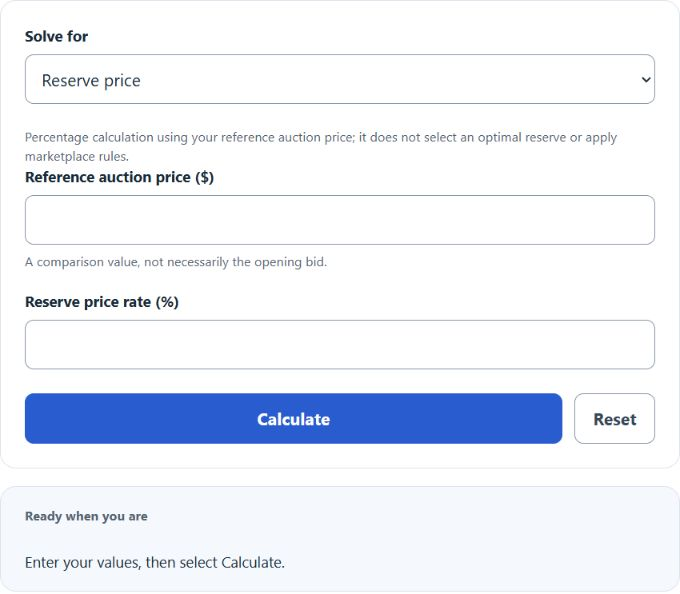
Select reserve price, reserve price rate, or reference auction price, enter the two known values, then select Calculate.
Reserve Price Formula
The reserve price is the lowest price a seller is willing to accept in an auction. Here auction set price means a positive reference price, not necessarily the opening bid. Select the value to solve and enter the other two values. This percentage calculation does not choose an optimal reserve or apply marketplace rules.
- RP = Reserve Price, in dollars
- ASP = Auction Set Price, in dollars
- RPR = Reserve Price Rate, as a percent
If you enter the auction set price and the reserve price rate, the calculator finds the reserve price.
If you enter the reserve price and the auction set price, the calculator finds the reserve price rate.
If you enter the reserve price and the reserve price rate, the calculator finds the auction set price.
Illustrative Reserve Price Rate Examples
The percentages below illustrate arithmetic relative to a reference price; they are not measured typical rates or recommendations. Actual reserve choices depend on the item, seller and marketplace rules.
| Reserve Price Rate | Meaning | Example on $10,000 Auction Set Price |
|---|---|---|
| 50% | Reserve is half the reference price. | $5,000 |
| 70% | Reserve is 70% of the reference price. | $7,000 |
| 85% | Reserve is 85% of the reference price. | $8,500 |
| 100% | Reserve equals the full auction set price. | $10,000 |
Example Problems
Example 1: Find the reserve price
You set an auction price of $8,000 and want the reserve price to be 75% of that amount.
The reserve price is $6,000.
Example 2: Find the reserve price rate
The auction set price is $12,500 and the reserve price is $10,000.
The reserve price rate is 80%.
FAQ
What is a reserve price?
A reserve price is the minimum amount the seller will accept in an auction. If bidding does not reach the reserve price, the seller usually does not have to sell the item.
Is the reserve price the same as the starting bid?
No. The starting bid is the amount where bidding begins. The reserve price is the minimum acceptable sale price. A seller may set a low starting bid to attract bidders while keeping a higher reserve price for protection.
Can the reserve price rate be more than 100%?
Mathematically, yes. A reserve price rate above 100% means the reserve price is higher than the auction set price. In practice, this may make the item harder to sell unless the auction set price is only a reference value and not the expected sale price.