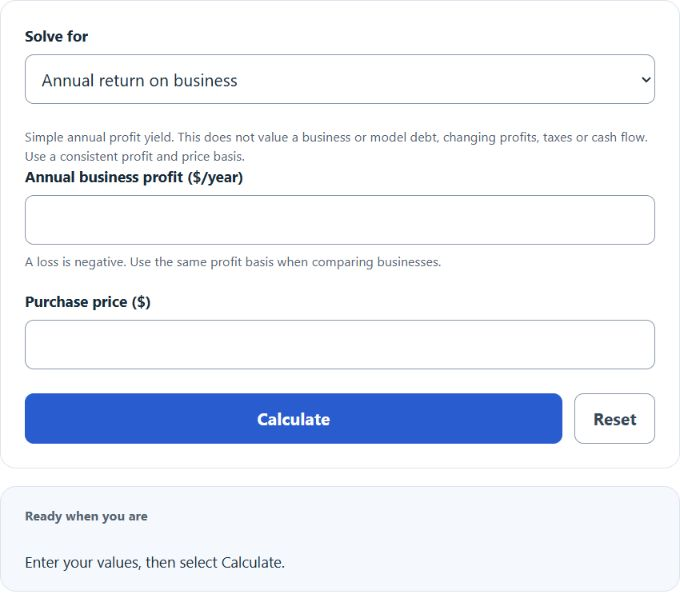
Calculate return on business, annual business profit, or purchase price from any two values and find the missing yearly ROI percentage.
Related Calculators
- Cost Benefit Analysis Calculator
- QBI Deduction Calculator
- Gross Margin Calculator
- Required Rate of Return Calculator
- Hurdle Rate Calculator
- All Business Calculators
Return on Business Guide
Return on Business (ROB) shows how much annual profit a business produces relative to the price paid to buy it. It is a fast screening metric for comparing acquisitions, estimating how efficiently capital is being used, and judging how quickly the purchase price may be recovered from profit.
Core Formula
- ROB = return on business (% per year)
- AP = annual business profit
- PP = purchase price of the business
Rearranged Equations
Select the value to solve for, then enter the other two:
What Each Input Should Include
| Field | What It Means | Best Practice |
|---|---|---|
| Annual Business Profit | The profit the business is expected to generate in one year. | Use a normalized annual figure instead of an unusually good or bad year. Remove one-time gains or losses where possible. |
| Purchase Price | The amount paid to acquire the business. | For a more realistic result, include closing costs, assumed obligations, and required upfront investment if they are part of the deal. |
| Return on Business | The annual profit expressed as a percentage of the purchase price. | Use it to compare opportunities on the same profit basis, such as pre-tax to pre-tax or after-tax to after-tax. |
How to Interpret the Result
A higher ROB means the business produces more annual profit for each dollar invested. If annual profit stays positive and equals cash available to recover the purchase price, ROB gives a rough undiscounted payback estimate. Accounting profit alone need not equal that cash flow.
| ROB | Approx. Payback Period | General Interpretation |
|---|---|---|
| 5% | 20 years | Lower annual yield relative to purchase price. |
| 10% | 10 years | Annual profit equals 10% of the purchase price. |
| 15% | 6.67 years | Stronger profit generation for the capital invested. |
| 20% | 5 years | Fast recovery if profit is sustainable and risk is controlled. |
Quick Example
If a business earns $48,000 in annual profit and costs $600,000 to purchase, then:
An 8% return on business means the annual profit is equal to 8% of the acquisition price.
What ROB Is Good For
| Use Case | Why It Helps |
|---|---|
| Comparing multiple businesses | Puts annual profit and price into one percentage for fast side-by-side screening. |
| Initial acquisition review | Helps identify whether a deal appears expensive or efficient before deeper analysis. |
| Setting target purchase price | Lets you solve backward from a desired return to the acquisition cost implied by that chosen simple annual yield. |
| Estimating payback speed | Provides a quick approximation of how long it may take for profits to recover the purchase price. |
What ROB Does Not Capture
| Limitation | Why It Matters |
|---|---|
| Debt and financing terms | Borrowing costs can materially change the real return to the buyer. |
| Taxes | Pre-tax and after-tax returns can look very different. |
| Capital expenditures | High ongoing reinvestment needs can reduce actual owner benefit. |
| Working capital needs | Cash tied up in inventory or receivables can affect true returns. |
| Growth or decline | ROB is a snapshot and does not model future changes in profit. |
| Risk and earnings quality | A higher percentage is not automatically better if profits are unstable or highly concentrated. |
Practical Tips
- Use the same definition of profit across every business you compare.
- Adjust for owner perks, non-recurring expenses, and one-time income before calculating ROB.
- Include all acquisition-related costs if your goal is a true investment return estimate.
- Use ROB as a screening metric, then validate the deal with cash flow, debt service, and risk analysis.