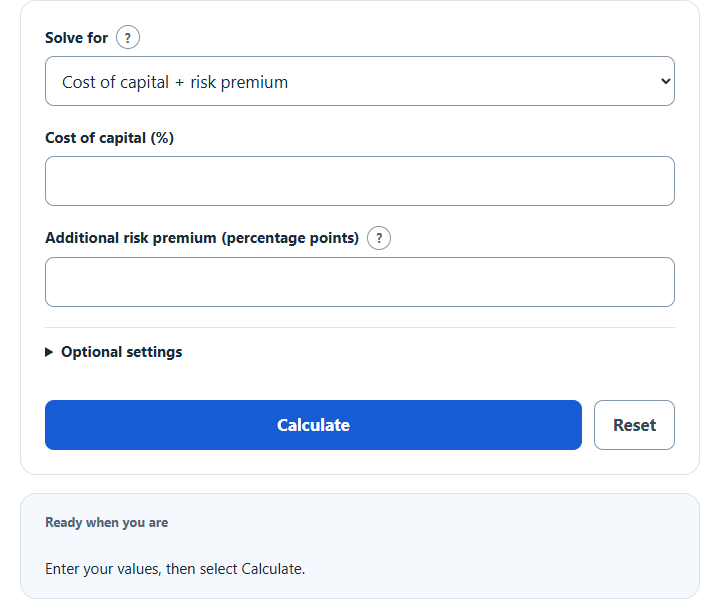
Calculate hurdle rate from cost of capital and risk premium, then compare expected project return to see if it meets the required return.
- All Rate Calculators
- Risk Premium Calculator
- Cost of Capital Calculator
- All Business Calculators
- WACC Calculator (Weighted Average Cost of Capital)
Hurdle Rate Formula
The following examples use the calculator’s default Cost of capital + risk premium mode. CAPM and simple-premium modes are also available; CAPM uses risk-free rate + beta × market risk premium, with optional explicit adjustments.
- Where HUR is the Hurdle Rate (%)
- CC is the cost of capital (%)
- RP is the risk premium (%)
For the direct model, sum cost of capital and an additional risk premium that is not already included. Match currency, period and real/nominal assumptions. CAPM estimates a cost of equity, not WACC; adding an inflation adjustment to already nominal rates can double-count inflation.
How to Calculate Hurdle Rate?
The following example problems outline how to calculate Hurdle Rate.
Example Problem #1:
- First, determine the cost of capital (%).
- The cost of capital (%) is given as 3.
- Next, determine the risk premium (%).
- The risk premium (%) is provided as 5.
- Finally, calculate the Hurdle Rate using the equation above:
HUR = CC + RP
The values provided above are inserted into the equation below and computed.
HUR = 3 + 5 = 8.00 (%)
Example Problem #2:
For this problem, the variables required are provided below:
cost of capital (%) = 5
risk premium (%) = 6
Use the direct model: 5% + 6 percentage points = 11%. Compare an expected return only when its period and cash-flow basis match the hurdle rate.
HUR = CC + RP = ?