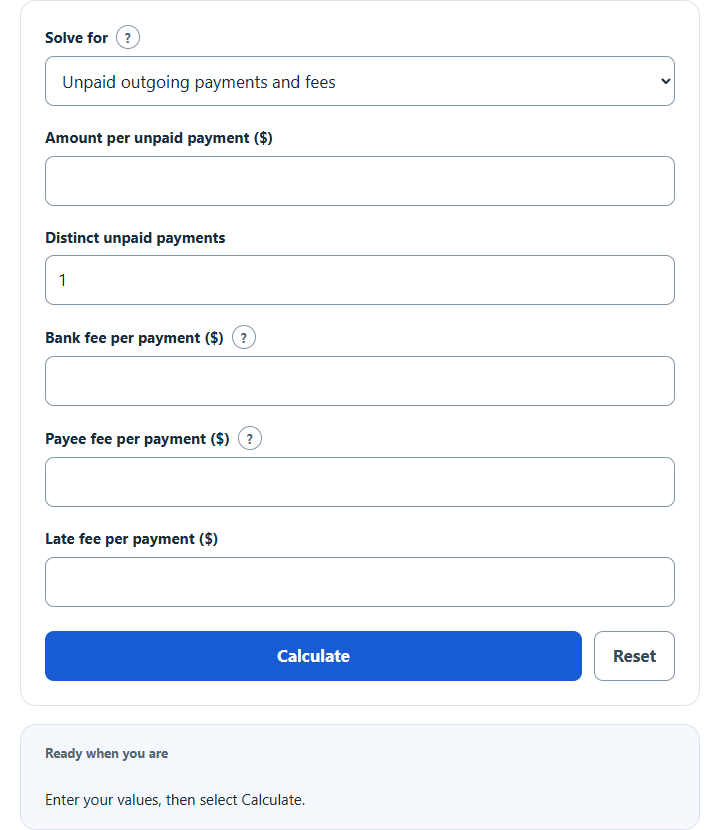
Calculate the total cost of a returned check or NSF payment, including bank, payee and late fees, or your balance after a deposited check bounces.
Returned Check and NSF Fee Formula
When an outgoing payment is returned, the original obligation usually remains due. The combined outstanding amount can include the unpaid principal, a bank fee, a payee fee, and a late fee. These amounts may be owed to different parties. Enter actual applicable charges; the calculator does not determine which fees are permitted.
Outstanding Payments and Fees = N * (Amount per Unpaid Payment + Bank Fee + Payee Fee + Late Fee)
When a deposited check is returned, the bank removes the provisional credit and can charge a deposited-item return fee:
Balance After Reversal = Balance Including Provisional Credit - Returned Check Amount - Return Fee
Variables:
- N is the number of distinct equal-amount unpaid payments, not the number of times the same payment is presented
- Amount per Unpaid Payment is the principal owed for each separate payment. Count the same debt only once; for repeated presentments, enter its combined actual fees with N = 1
- Bank Fee is the account holder's NSF or returned-item charge
- Payee Fee is a separate charge from the merchant, lender, landlord, or other payee
- Return Fee is the bank fee for a deposited check that fails
A returned item differs from an overdraft. In an overdraft, the bank may pay the transaction and leave the account negative. With an NSF return, the bank declines or reverses the item, so the underlying bill is still unpaid.
Returned-Item Cost Reference
Illustrative amounts only: the examples use a $425 outgoing payment with one distinct unpaid item. Enter your actual applicable charges, including $0.
| Bank fee | Merchant fee | Late fee | Total fees | Total still owed |
|---|---|---|---|---|
| $0 | $0 | $0 | $0 | $425 |
| $25 | $0 | $0 | $25 | $450 |
| $25 | $30 | $0 | $55 | $480 |
| $25 | $30 | $15 | $70 | $495 |
Example Problems
Example 1: Outgoing payment returned.
A $425 payment is returned. The bank charges $25, the merchant charges $30, and a $15 late fee applies. Total fees are $70, and the estimated amount still owed is 425 + 70 = $495.
Example 2: Deposited check returned.
An account balance is $1,200 after a $650 check was provisionally credited. The check is returned and the bank charges $15. Estimated balance after reversal is 1200 - 650 - 15 = $535.
Frequently Asked Questions
Is an NSF fee the same as an overdraft fee?
No. An NSF or returned-item fee is associated with a payment that is not completed. An overdraft fee or interest charge can apply when the bank pays a transaction despite insufficient funds.
Can both the bank and merchant charge a fee?
Yes. Applicable charges depend on the institution, contract, and law. Enter only actual unpaid fees, and avoid counting a fee twice. The combined total may include charges payable to the bank and separately to the payee.
What if a returned deposited check makes the account negative?
The reversal can create an overdraft and cause later transactions to fail or generate additional costs. Contact the bank promptly, stop spending against the provisional credit, and seek repayment from the check issuer.