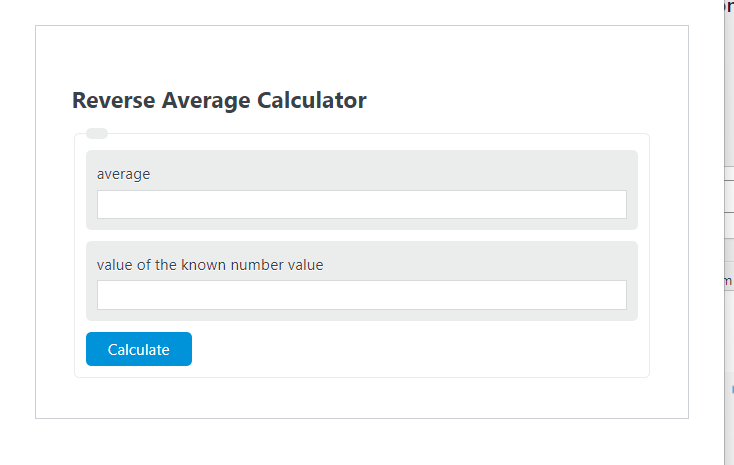
Calculate a missing number from an average and known value, or work backward from a target mean for a larger data set with clear calculation steps.
- All Math and Numbers Calculators
- All Reverse Calculators
- Reverse Paycheck Calculator
- Reverse Tip Calculator
- Reverse Conversion Rate Calculator
Understanding the Reverse Average Calculator
A reverse average calculation finds an unknown number when you already know the average of two values and one of those values. Instead of computing the mean from two known numbers, you rearrange the average equation to solve for the missing value directly. This is useful for test scores, prices, measurements, game stats, and any two-number average where one entry is missing.
Reverse Average Formula
The average of two numbers is:
Solving for the missing number x gives:
- A = average
- k = known number
- x = missing number
How to Calculate Reverse Average Manually
- Take the average.
- Multiply it by 2.
- Subtract the known number.
- The result is the missing number.
In short, double the average, then remove the value you already know.
Why the Formula Works
For two numbers, the average is the midpoint between them. That means the distance from the average down to one number must match the distance from the average up to the other number.
Rearranging that relationship leads to the same reverse-average formula:
This also means:
- If the known number is below the average, the missing number must be above the average.
- If the known number is above the average, the missing number must be below the average.
- If the known number equals the average, the missing number also equals the average.
Examples
| Given Values | Setup | Missing Number |
|---|---|---|
| Average = 30, known number = 20 | x = 2(30) - 20 |
x = 40 |
| Average = 12.5, known number = 9 | x = 2(12.5) - 9 |
x = 16 |
| Average = -4, known number = -7 | x = 2(- 4) - (- 7) |
x = - 1 |
Quick Check for Your Answer
After finding the missing number, plug both values back into the average formula to verify the result:
For the first example:
If the equation is true, your reverse-average calculation is correct.
When This Calculator Is Useful
- Finding a missing test or quiz score from a two-score average
- Determining an unknown price from the mean of two prices
- Recovering a missing measurement in a pair of readings
- Checking whether one value offsets another around a target average
- Solving simple algebra problems involving means
Important Notes
- This calculator applies to an average made from two numbers.
- Both values must use the same units such as dollars, points, inches, or kilograms.
- Decimals and negative numbers work normally.
- Keep extra decimal places until the final step if precision matters.
Common Mistakes
- Subtracting the average from the known value instead of subtracting the known value from double the average
- Using the formula for a data set that has more than two numbers
- Mixing units, such as averaging pounds with kilograms
- Rounding too early and creating a small verification error
Reverse Average for More Than Two Numbers
If you are solving for one missing value in a larger set, the same idea extends to a more general form:
Here, n is the total number of values, and the summation is the total of all known values. For this specific calculator, that general formula simplifies to the two-number version:
Reverse Average vs. Regular Average
A regular average problem starts with the numbers and asks for the mean:
A reverse average problem starts with the mean and one value, then asks for the missing value:
That makes reverse-average calculators especially helpful when you are reconstructing missing data rather than summarizing known data.