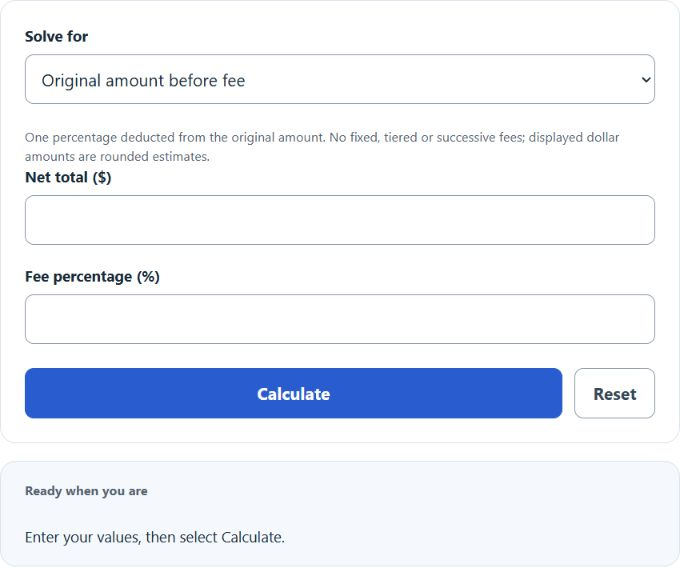
Calculate the original amount, net total, or fee percentage from two known values with this reverse fee calculator for payment fees.
Related Calculators
- Inclusive Price Calculator
- Processing Fees Calculator
- Finder’s Fee Calculator
- Late Fee Calculator
- All Business Calculators
Reverse Fee Formula
The following equation is used to calculate the Reverse Fee.
- Where RA is the required amount ($)
- ND is the net desired total ($)
- F is the fee rate (in decimal form)
To calculate the reverse fee, divide the net desired total by (1 - fee rate).
What is a Reverse Fee Calculator?
Definition:
A Reverse Fee Calculator determines the original amount required to achieve a desired net total once applicable fees are deducted. Rather than calculating the fee added on top of a base price, it “reverses” that process by starting with the net goal and working backward to show how much needs to be charged before fees are subtracted.
How to Calculate Reverse Fee?
Example Problem:
The following example outlines the steps and information needed to calculate the Reverse Fee.
First, determine the net desired total. In this example, the net desired total (ND) is $100.
Next, determine the fee rate (F). In this example, the fee rate is 5% or 0.05.
Finally, calculate the required amount (RA) using the formula above:
RA = ND / (1 - F)
RA = 100 / (1 - 0.05)
RA ≈ 105.263158
The unrounded result is about $105.263158. A cent-denominated charge of $105.26 is slightly below this mathematical amount. Choose a charge using the processor’s fee and rounding rules; if the fee is an exact unrounded 5%, rounding the charge upward to $105.27 reaches at least $100.
FAQ
Is a Reverse Fee Calculator the same as “grossing up” an amount?
Yes. Grossing up generally means adjusting an amount so that after a particular deduction or fee, the net remains at a desired level. A Reverse Fee Calculator similarly determines how much to charge initially to achieve a specific net total.
Can this formula be used for various fee structures?
Yes, as long as the fee is expressed as a fixed percentage of the original amount. For variable or tiered fee structures, the basic approach remains the same, but you may need to adjust the formula if fees are applied in multiple stages.
When is a Reverse Fee Calculator most commonly used?
It is commonly used in fundraising platforms, online payment systems, and any scenario where you need to ensure that a final net amount is reached once processing fees or other charges have been subtracted.