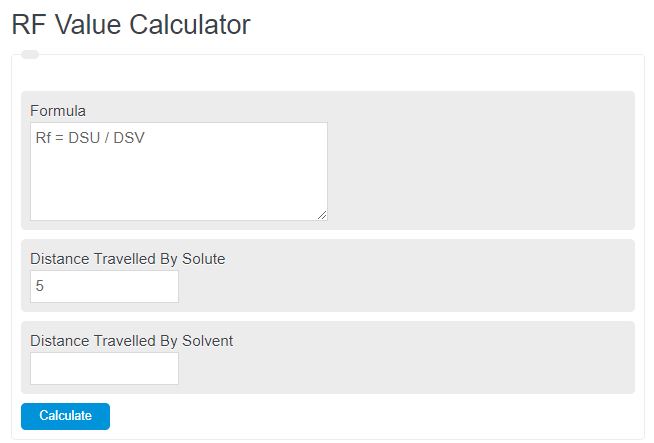
Calculate chromatographic Rf value, compound travel distance, or solvent-front distance from any two known values, with common laboratory distance units.
- All Chemistry Calculators
- Relative Retention Time (RRT) Calculator
- Retention Factor Calculator
- Partition Coefficient Calculator
- Concentration from Absorbance Calculator
- Absorbance to Transmittance Calculator
RF Value Calculator Guide
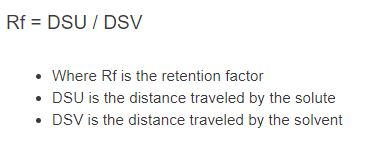
The RF value, or retention factor, compares how far a solute travels relative to the solvent front during chromatography. This calculator is useful when you know any two of the three values and want to solve for the missing one. Because RF is a ratio, it has no unit, and the distance units cancel as long as both measurements are entered in the same unit.
If you need to solve for a distance instead of the RF value, rearrange the equation like this:
| Quantity | Meaning | Measurement Tip |
|---|---|---|
| Distance traveled by solute | The distance from the baseline to the center of the compound spot | Measure from the same starting line used for the solvent front |
| Distance traveled by solvent | The distance from the baseline to the solvent front | Mark the solvent front immediately after development |
| RF value | The ratio of solute movement to solvent movement | Use the same unit for both distances so the ratio is valid |
How to Calculate RF Value Correctly
- Mark the baseline where the sample was originally placed.
- After the chromatogram develops, mark the solvent front before it evaporates.
- Measure the distance from the baseline to the center of the solute spot.
- Measure the distance from the baseline to the solvent front.
- Divide the solute distance by the solvent distance.
The calculator can also work in reverse. If you already know the RF value and one distance, it can compute the missing distance automatically.
Example Calculations
If a solute travels 3.6 cm and the solvent front travels 9.0 cm, the RF value is:
If the RF value is 0.65 and the solvent front traveled 8 cm, the solute distance is:
If the solute traveled 4.5 cm and the RF value is 0.50, the solvent distance is:
What the RF Value Tells You
- Low RF value: the solute stayed closer to the baseline, which usually indicates stronger interaction with the stationary phase.
- High RF value: the solute moved farther with the solvent, which usually indicates greater affinity for the mobile phase.
- Similar RF values under identical conditions: compounds may have similar chromatographic behavior.
- Different RF values under identical conditions: compounds are separating differently and are easier to distinguish.
In most standard chromatography setups, RF values usually fall between 0 and 1. If a result is greater than 1, the distances may have been measured incorrectly, the solvent front may have been recorded improperly, or the wrong reference points may have been used.
Important Measurement Rules
- Always measure both distances from the same baseline.
- Measure the solute to the center of the spot, not the leading edge.
- Use the same unit for both distances, such as inches, feet, centimeters, or meters.
- The solvent distance must be greater than 0, or the calculation is undefined.
- For reliable comparison, RF values should be taken under the same experimental conditions.
Factors That Can Change RF Value
- Solvent composition
- Type of stationary phase
- Plate or paper thickness
- Temperature and humidity
- Sample concentration and spot size
- Chamber saturation and development time
This means RF values are most meaningful when comparing samples developed on the same system. A compound can show a different RF value if the solvent, adsorbent, or environmental conditions change.
Common Uses of RF Value
- Comparing separated compounds in thin-layer or paper chromatography
- Checking whether a sample may contain multiple components
- Comparing an unknown sample against a reference run under the same conditions
- Monitoring reaction progress by observing movement of spots
- Documenting separation behavior in lab records
Common Input Errors
- Entering distances in different units without converting them first
- Measuring from the sample spot instead of the baseline
- Using the edge of a broad spot instead of its center
- Forgetting to mark the solvent front before it fades
- Entering a solvent distance smaller than the solute distance in a standard setup
Frequently Asked Questions
- Is RF value a unit-based measurement?
- No. RF is a ratio, so it is dimensionless as long as both distances use the same unit.
- Can this calculator solve for distance instead of RF?
- Yes. If you know the RF value and one distance, the missing distance can be found by rearranging the formula.
- Why should both distances be measured from the same baseline?
- Using the same reference point keeps the ratio accurate and prevents distorted RF results.
- Can RF values be compared between different experiments?
- Only with caution. RF comparisons are most reliable when the solvent system, stationary phase, and development conditions are the same.
- What does an RF value near zero mean?
- It means the solute moved very little compared with the solvent front.