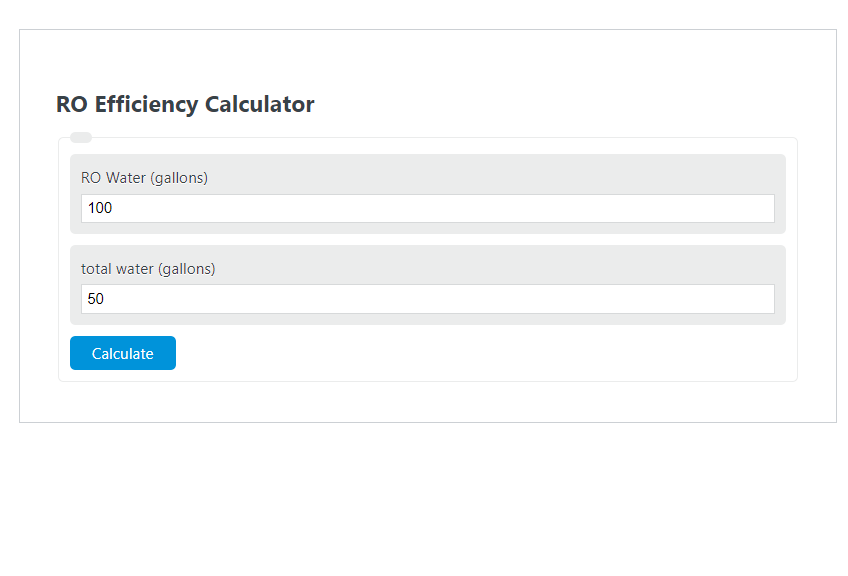
Calculate reverse osmosis recovery by finding RO water, total feed water, or efficiency from any 2 values in gallons, liters, or cubic meters.
- All Chemistry Calculators
- All Efficiency Calculators
- Water Flow Rate Calculator
- Water Pressure Calculator
- Conductivity to TDS Calculator
- Water Softener Hardness Calculator
RO Efficiency (Recovery) Formula
RO efficiency in this calculator means recovery: the percentage of total feed water that becomes RO product water, also called permeate.
- ROE = RO efficiency or recovery, as a percentage
- RO = RO water, product water, or permeate volume
- TW = total water or feed water volume
If you want to calculate the missing RO water amount, the formula is rearranged as:
If you want to calculate the missing total water amount, the formula is rearranged as:
The calculator accepts any two values and solves for the third. If you enter RO water and total water, it calculates recovery percentage. If you enter total water and recovery percentage, it calculates RO water. If you enter RO water and recovery percentage, it calculates the required total feed water.
Volumes can be entered in US gallons, liters, or cubic meters. The calculator converts volume units internally before applying the formula, so the RO water and total water fields do not have to use the same unit.
Typical RO Recovery Ranges
Recovery varies by system design, membrane type, feedwater quality, pressure, temperature, and scaling limits. These ranges are general reference values.
| RO system type | Typical recovery range | Meaning |
|---|---|---|
| Small residential RO system | 10% to 50% | Often lower recovery, especially without a permeate pump or recirculation design. |
| Commercial brackish water RO | 50% to 85% | Common for properly designed systems with controlled concentrate flow. |
| High recovery industrial RO | 75% to 90%+ | Usually requires careful pretreatment and scaling control. |
| Seawater RO | 35% to 50% | Recovery is limited by salinity, pressure, and scaling risk. |
Volume Conversion Factors Used
These conversion factors help explain how mixed units are handled before the recovery formula is applied.
| Unit | Equivalent in US gallons |
|---|---|
| 1 US gallon | 1 gallon |
| 1 liter | 0.264172052 gallons |
| 1 cubic meter | 264.172052 gallons |
Example Calculations
Example 1: Calculate RO efficiency
You have 40 gallons of RO water from 100 gallons of total feed water.
The RO efficiency, or recovery, is 40%.
Example 2: Calculate RO water
You have 250 liters of total feed water and a recovery of 60%.
The RO product water is 150 liters.
FAQ
What is the difference between RO efficiency and rejection?
RO efficiency in this calculator means water recovery, which measures how much feed water becomes product water. Rejection is different. Rejection measures how well the membrane removes dissolved solids, usually using feed TDS and permeate TDS.
Can RO efficiency be more than 100%?
No. Recovery cannot be more than 100% because RO product water cannot be greater than the total feed water. If your result would be over 100%, one of the entered values or units is incorrect.
Why does low recovery not always mean the RO system is broken?
Low recovery can be normal for some systems, especially small residential units or systems treating difficult feedwater. Recovery is affected by membrane design, pressure, concentrate flow, feedwater temperature, and scaling risk. A low value should be compared with the system specifications before assuming there is a problem.