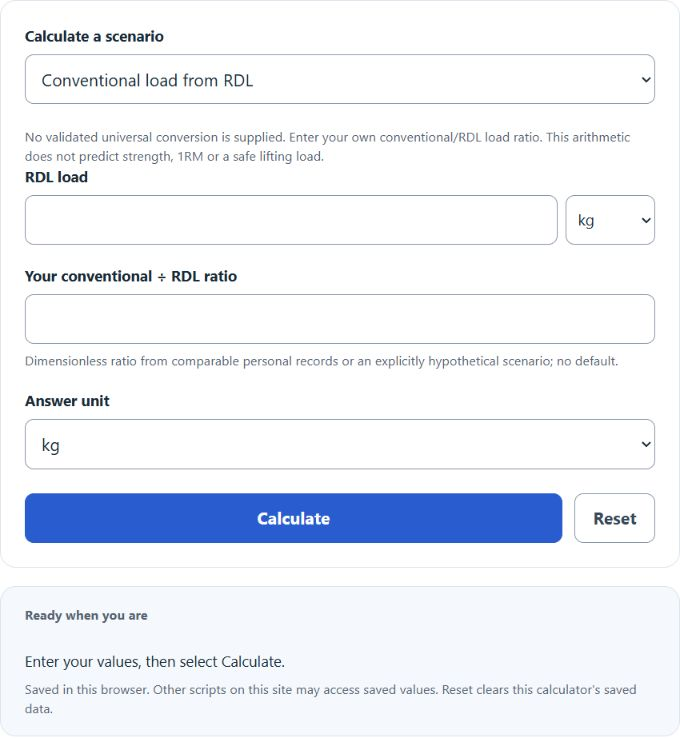
Calculate a conventional or Romanian deadlift load scenario using a ratio you supply, with kg and lb conversion. The result is arithmetic, not a strength prediction.
Romanian Deadlift to Conventional Deadlift Conversion Formula
This tool applies a user-supplied conventional/RDL ratio. It does not predict strength or account for individual mechanics, technique, tempo, range of motion, equipment (e.g., straps), or whether reps are dead-stop vs touch-and-go.
No validated default multiplier or population range is supplied. A comparison study of conventional and Romanian deadlifts used the same absolute load for both movements and assessed muscle activity and joint kinetics, rather than validating a strength conversion (Lee et al., 2018).
Variables:
- CD is the Conventional Deadlift weight
- RDL is the Romanian Deadlift weight
- r is the conventional load divided by the RDL load in the same unit, supplied by you from comparable records or an explicitly hypothetical scenario.
For a conventional load scenario, multiply the RDL load by your ratio. For an RDL scenario, divide the conventional load by that ratio. Neither operation validates the ratio or predicts lifting ability.
Limitations (Why this can differ for you)
- Technique differences (bar path, knee bend, start position, depth/ROM) can change the relationship substantially.
- Tempo and intent (controlled eccentric RDL vs faster reps) affect what you can lift.
- Equipment and setup (straps, belt, bar type, plates/starting height) can shift performance.
- Fatigue, injuries, and training specificity can make one lift disproportionately stronger than the other.
Example only: The table below applies an arbitrarily chosen ratio of 1.30 in kilograms (kg). It is not a default, recommendation or expected relationship.
| RDL (kg) | Scenario output (kg) |
|---|---|
| 20 | 26 |
| 30 | 39 |
| 40 | 52 |
| 50 | 65 |
| 60 | 78 |
| 70 | 91 |
| 80 | 104 |
| 90 | 117 |
| 100 | 130 |
| 110 | 143 |
| 120 | 156 |
| 130 | 169 |
| 140 | 182 |
| 150 | 195 |
| 160 | 208 |
| 170 | 221 |
| 180 | 234 |
| 190 | 247 |
| 200 | 260 |
| 210 | 273 |
| *Hypothetical arithmetic only: output = 1.30 × input. No population conversion or safe load is implied. | |
What is the Romanian Deadlift to Conventional Deadlift Conversion?
This tool compares load scenarios using your stated ratio. Different technique, intent, repetitions and effort prevent a numerical scenario from establishing equivalent strength or a safe load.
How to Calculate the Conventional Deadlift Equivalent?
Follow these steps to calculate a load scenario:
- Determine the weight you use for the Romanian deadlift (RDL) in your chosen units.
- Enter your own positive conventional/RDL ratio; no default is provided.
- Multiply the RDL load by your ratio to calculate the conventional load scenario.
- To explore sensitivity, calculate again with another clearly stated hypothetical ratio.
- For an RDL scenario, divide conventional load by your ratio.
Example Problem:
For an arithmetic example only, suppose an input RDL load is 100 pounds and the user explicitly chooses a hypothetical ratio of 1.30:
Conventional load scenario = 100 lb × 1.30 = 130 lb. This does not establish what the lifter can or should lift.