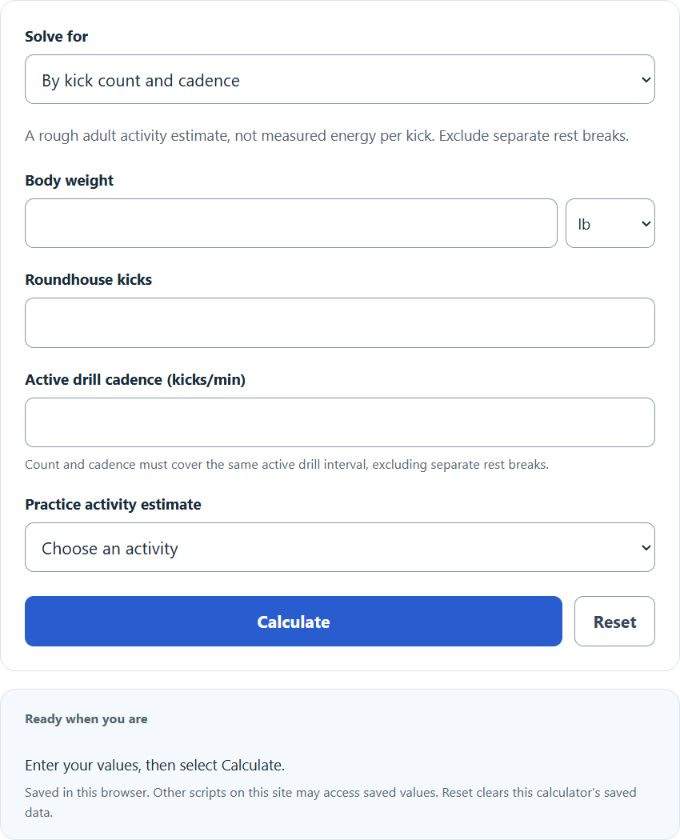
Estimate gross session calories using body weight, an activity MET, and either active practice time or kick count with measured active-drill cadence. These general activity estimates do not measure energy per isolated roundhouse kick.
- Taekwondo Calories Burned Calculator
- Body Combat Calories Calculator
- Punching Bag Calories Burned Calculator
- Bootcamp Calories Burned Calculator
Roundhouse Kick Calories Formula
Choose kick count with average kicks per minute, or enter practice time directly. Count and cadence must cover the same active drill interval; exclude separate rest breaks in both modes. Select the general activity that best matches the whole session; no universal calories-per-kick coefficient is assumed.
- BW = body weight in kilograms (pounds are converted using 1 lb = 0.45359237 kg)
- Kicks = total roundhouse kicks
- Cadence = average kicks per minute over the active drill interval, excluding separate rest breaks
- Minutes = total practice time
- MET = 5.3 for slower-pace novice martial-arts practice
- MET = 7.3 for kickboxing
- MET = 10.3 for martial arts at moderate pace. These 2024 Adult Compendium categories are general session estimates, not roundhouse-specific measurements.
Calories per 100 Roundhouse Kicks
Illustrative arithmetic only: these rounded gross estimates assume 7.3 MET and 15 kicks per active drill minute, excluding separate rest breaks. The cadence is an example, not a recommended pace or measured universal kick rate.
| Body Weight | Calories per 100 Kicks |
|---|---|
| 120 lb | 46 |
| 140 lb | 54 |
| 160 lb | 62 |
| 180 lb | 70 |
| 200 lb | 77 |
| 220 lb | 85 |
At the illustrative 7.3 MET activity level, the conventional gross estimate is about 7.0 kcal/min at 120 lb, 9.3 at 160 lb, and 11.6 at 200 lb. It includes resting energy and can differ materially from an individual’s expenditure. Standard adult METs primarily cover ages 19–59.
What is a Roundhouse Kick?
A roundhouse kick is a rotational striking technique driven by a knee lift, hip turn, and fast extension of the leg. It is common in taekwondo, karate, kickboxing, and MMA, and high-rep drilling turns it into a lower-body and core conditioning movement.
What Changes the Burn?
- Pad and heavy bag work usually costs more energy than air reps.
- Full chamber, hip rotation, and fast retraction raise the work done per kick.
- Alternating legs and adding footwork increases total movement.
- Continuous rounds burn more than stop-start single-rep practice.
- Body-height and head-height kicks usually use more energy than low kicks.
Example
For an illustrative 160 lb session of 150 kicks at an average 15 kicks per active drill minute, duration is 10 active minutes. At 7.3 MET, estimated gross energy is 7.3 × 3.5 × (160 × 0.45359237) × 10 / 200 ≈ 92.7 kcal. Changing cadence or the activity assumption changes the estimate.