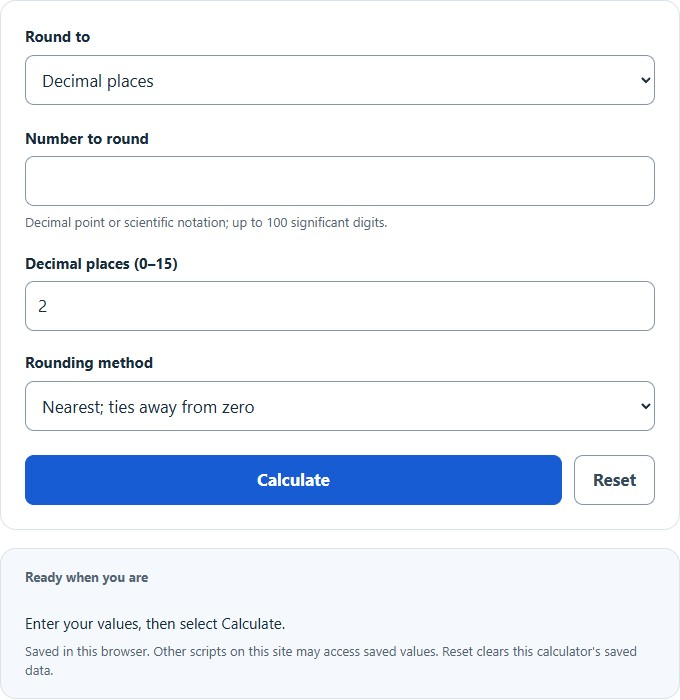
Round numbers to decimal places, significant figures, or any increment using common, half-even, floor, ceiling, or truncation rules with steps.
Rounding Formula
For a positive number such as 5.6 rounded to a whole number, let X be its whole-number part and y its first discarded digit. The common half-away-from-zero rounding rule is:
- If y is 5 or greater, return X+1
- If y is less than 5, return X
Apply the rule at the chosen decimal place. For negative numbers, round the magnitude and retain the negative sign. Half-to-even resolves a tie using the even candidate; floor, ceiling and truncation follow their signed directions. The calculator uses exact decimal arithmetic and shows rule comparisons in Calculation details.
Rounding (math) Definition
Rounding in mathematics is approximating a number to a specified degree of accuracy. It involves adjusting a number to the nearest value that is easier to work with, such as a whole number, a specific decimal place, or a certain significant figure. Rounding is important because it simplifies calculations and provides a more manageable numerical data representation.
Rounding is particularly crucial when dealing with large numerical data sets or when communicating numbers to others. It helps in reducing complexity and making information more accessible.
For example, when presenting statistics or financial figures, rounding can make the numbers more comprehensible and relatable to a wider audience. Additionally, rounded values are often used in everyday life situations, such as when estimating costs, calculating tips, or determining timeframes.
How to round a number?
How to round a number?
- First, determine the decimal value.
For example, in the number 5.6, the decimal is 6.
- Compare the first discarded digit with 5.
In the example above, 6 is greater than 5.
- Finally, round the whole number.
Take the whole number of 5 and increase it to 6.
FAQ
Why is rounding numbers important?
Rounding numbers is important because it simplifies complex calculations, makes numerical data easier to understand and communicate, and helps in making quick estimations in everyday life situations.
Can rounding affect the accuracy of calculations?
Yes, rounding can affect the accuracy of calculations. While it simplifies data and calculations, it can introduce a small error margin. However, in many practical situations, the benefits of simplification outweigh the minor loss in precision.
How do you round numbers to different decimal places?
Choose the decimal places and rounding rule. For common half-away rounding, apply the digit rule to the magnitude: a first discarded digit of 5 or more increases the retained digit, while a smaller digit leaves it unchanged. Retain the negative sign for negative numbers. Half-to-even and directed rounding can produce different answers.
Are there different methods of rounding numbers?
Yes, there are several methods of rounding numbers, including rounding to the nearest whole number, rounding up (ceil), rounding down (floor), and rounding to a specified number of decimal places or significant figures. The method chosen depends on the context and the level of precision required.