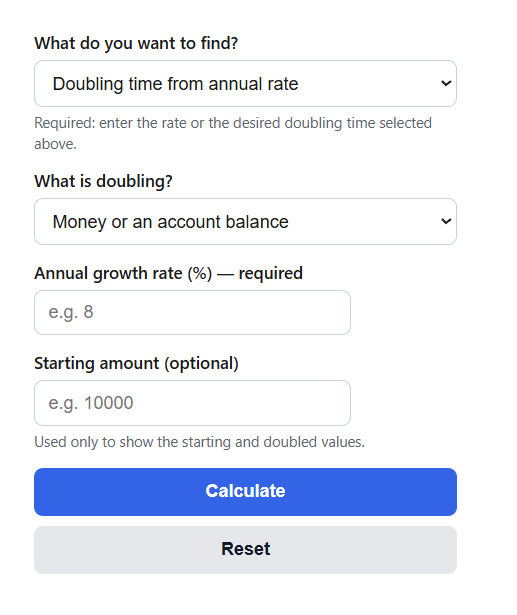
Use the Rule of 72 Calculator to estimate doubling time or the annual return required, then compare the shortcut with exact annual compound growth results.
Rule of 72 Formula
The Rule of 72 estimates how long it takes a value to double at a fixed annual compound growth rate. Divide 72 by the annual rate expressed as a percentage:
T_{72} = 72 / r
You can rearrange the shortcut to estimate the annual return required to double within a chosen number of years:
r_{72} = 72 / T
The calculator also shows the exact annual-compounding result:
T_{exact} = ln(2) / ln(1 + r/100)
Variables:
- T72 is the estimated doubling time in years
- r is the annual compound growth or interest rate as a percentage
- T is the desired doubling time in years
- ln is the natural logarithm
Select whether you know the annual rate or the doubling time. The main result uses the Rule of 72, while the comparison panel shows the Rule of 69.3, the Rule of 70, and the exact annual-compounding answer. Entering a starting amount is optional; when provided, the calculator also shows the corresponding doubled value.
The shortcut assumes a stable positive return and reinvestment of gains. It does not account for deposits, withdrawals, taxes, fees, inflation, or a changing rate. The exact result is therefore the better planning figure when precision matters.
Rule of 72 Doubling-Time Table
This table compares the Rule of 72 estimate with the exact doubling time for annual compounding.
| Annual rate | Rule of 72 | Exact time | Shortcut difference |
|---|---|---|---|
| 2% | 36.0 years | 35.0 years | 1.0 year longer |
| 4% | 18.0 years | 17.7 years | 0.3 year longer |
| 6% | 12.0 years | 11.9 years | 0.1 year longer |
| 8% | 9.0 years | 9.0 years | Nearly exact |
| 10% | 7.2 years | 7.3 years | 0.1 year shorter |
| 12% | 6.0 years | 6.1 years | 0.1 year shorter |
| 15% | 4.8 years | 5.0 years | 0.2 year shorter |
Example Problems
Example 1: Estimate doubling time from a return.
An account grows at 8% per year. Divide 72 by 8:
T = 72 / 8 = 9 years. The exact annual-compounding result is about 9.01 years, so the shortcut is exceptionally close at this rate.
Example 2: Estimate the return needed to double.
You want a balance to double in 12 years. Divide 72 by 12:
r = 72 / 12 = 6% per year. Solving the exact compound formula requires about 5.95% annually.
Frequently Asked Questions
Why does the Rule of 72 work?
Doubling time is based on logarithms. For moderate interest rates, the exact expression can be approximated by a simple constant divided by the percentage rate. The number 72 is convenient because it has many divisors and gives a close estimate across common long-term rates.
When is the Rule of 72 most accurate?
It is especially accurate around 6% to 10% annual growth and remains useful across a wider range as a quick estimate. At very low or very high rates, use the exact result shown by the calculator.
Can I use the Rule of 72 for inflation or debt?
Yes. It can estimate how long prices may take to double at a steady inflation rate or how quickly a debt balance could double when unpaid interest compounds. Real-world rates can change, so treat the answer as a scenario rather than a guarantee.