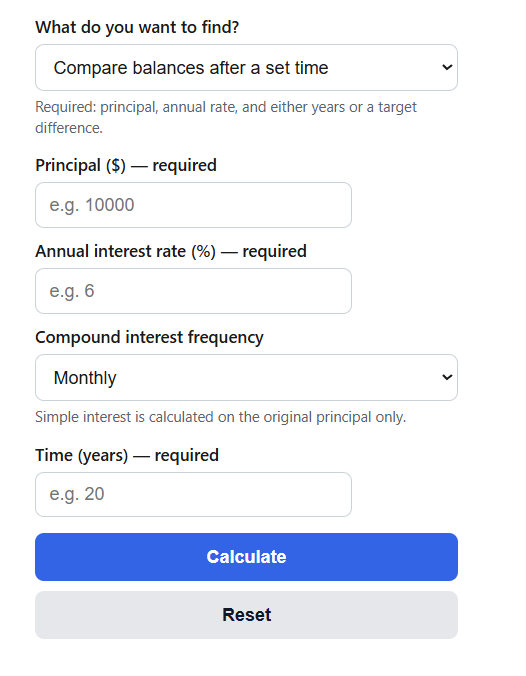
Use the Simple vs Compound Interest Calculator to compare balances, total interest, and interest-on-interest with annual through daily compounding over time.
Simple vs Compound Interest Formulas
Simple interest is calculated only on the original principal:
A_s = P(1 + rt)
Compound interest is calculated on the principal plus previously earned interest:
A_c = P(1 + r/n)^{nt}
The extra amount created by earning interest on prior interest is:
I_{on\ interest} = A_c - A_s
Variables:
- As is the ending balance with simple interest
- Ac is the ending balance with compound interest
- P is the original principal
- r is the annual interest rate as a decimal
- n is the number of compounding periods per year
- t is time in years
Use the comparison mode to see both ending balances, total interest, and the compound advantage. The calculator also creates a year-by-year schedule so you can see when the gap starts to accelerate. In target-gap mode, it estimates how long compound interest takes to exceed simple interest by a dollar amount you choose.
Both methods assume the principal remains invested, the stated rate stays constant, and there are no additional deposits, withdrawals, taxes, or fees. The simple-interest balance grows in a straight line, while the compound balance follows an accelerating curve.
Simple vs Compound Interest Comparison
The table below uses a $10,000 principal at 5% for both methods. Compound interest is calculated monthly.
| Time | Simple balance | Compound balance | Compound advantage |
|---|---|---|---|
| 1 year | $10,500.00 | $10,511.62 | $11.62 |
| 5 years | $12,500.00 | $12,833.59 | $333.59 |
| 10 years | $15,000.00 | $16,470.09 | $1,470.09 |
| 20 years | $20,000.00 | $27,126.40 | $7,126.40 |
| 30 years | $25,000.00 | $44,677.44 | $19,677.44 |
Example Problems
Example 1: Compare balances after 10 years.
You place $10,000 at 5% for 10 years. Simple interest gives:
As = 10,000(1 + 0.05 * 10) = $15,000.00.
Monthly compounding gives Ac = 10,000(1 + 0.05/12)120 = $16,470.09. Compounding adds $1,470.09 beyond the simple-interest balance.
Example 2: See the effect of a longer time horizon.
Using the same $10,000 and 5% rate for 30 years, simple interest reaches $25,000. Monthly compounding reaches $44,677.44, creating a $19,677.44 advantage.
Frequently Asked Questions
What is the main difference between simple and compound interest?
Simple interest is always based on the starting principal. Compound interest periodically adds interest to the balance, so later interest is earned on both the principal and prior interest.
Which method is better for savings?
Compound interest generally produces more growth when the rate and time are the same. For borrowing, that same feature can increase the amount owed, so whether it is favorable depends on which side of the transaction you are on.
Does compounding frequency make a large difference?
More frequent compounding increases the ending balance, but the jump from annual to monthly is usually much larger than the jump from monthly to daily. The rate and time horizon normally have a greater effect than small frequency differences.