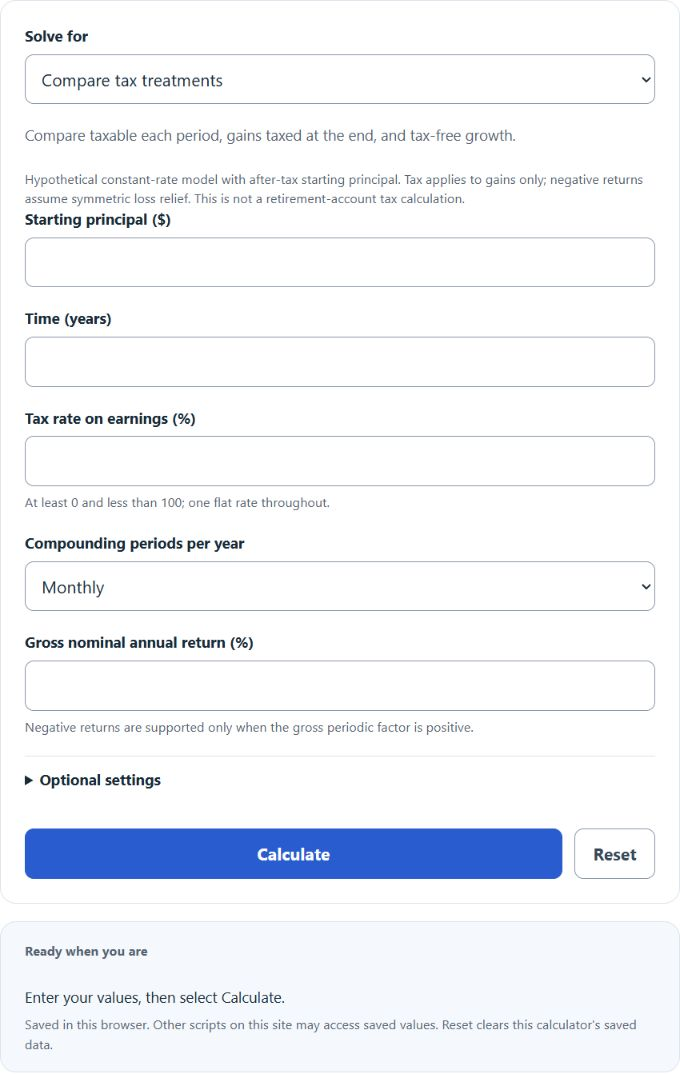
Use the After-Tax Compound Interest Calculator to compare taxable, tax-deferred, and tax-free growth, tax drag, inflation, and required returns over time.
After-Tax Compound Interest Formulas
For an account taxed as interest is earned, the calculator reduces each period's interest by the tax rate before it compounds:
A_{taxable} = P[1 + (r/n)(1 - \tau)]^{nt}
For a tax-deferred account, the full pre-tax balance compounds first and tax is applied to the gain at the end:
A_{deferred} = P + [P(1 + r/n)^{nt} - P](1 - \tau)
A tax-free account keeps the full compound balance. To express any result in today's purchasing power, divide by cumulative inflation:
A_{real} = A/(1 + i)^t
Variables:
- P is the starting principal
- r is the annual pre-tax return as a decimal
- n is the number of compounding periods per year
- t is time in years
- τ is the tax rate on earnings as a decimal
- i is the annual inflation rate as a decimal
Comparison mode shows taxable-as-earned, tax-deferred, and tax-free scenarios side by side. Required-return mode solves for the gross nominal rate a taxable account needs to reach a target after-tax balance. The inflation option adds a real-balance comparison without changing the nominal results.
This hypothetical comparison treats the starting principal as already taxed and taxes only earnings. Negative returns assume full symmetric tax relief for losses at the selected rate. A traditional account funded entirely with pre-tax contributions can instead have tax on the whole withdrawal. Actual tax and loss-deduction rules vary. Use these formulas as model assumptions, not a tax filing calculation.
Tax Drag on Compound Growth
The table below assumes $10,000, a 7% annual return, monthly compounding, a 25% tax rate, 20 years, and 2.5% annual inflation.
| Tax treatment | Nominal ending balance | Balance in today's dollars | Difference vs tax-free |
|---|---|---|---|
| Taxable as earned | $28,511.14 | $17,399.52 | -$11,876.25 |
| Tax-deferred, tax on gain at end | $32,790.54 | $20,011.11 | -$7,596.85 |
| Tax-free | $40,387.39 | $24,647.25 | $0.00 |
Example Problems
Example 1: Measure tax drag.
A $10,000 account earns 7% for 20 years with monthly compounding, and interest is taxed at 25% as earned. The after-tax nominal annual rate is 7% × (1 − 0.25) = 5.25%; the monthly rate is 5.25% ÷ 12. The ending balance is about $28,511.14, compared with $40,387.39 if the same growth were tax-free.
Example 2: Compare tax timing.
If the same 25% tax applies only once to the gain after 20 years, the after-tax balance is $32,790.54. Deferring the tax leaves more money compounding along the way and adds about $4,279.40 compared with taxation each month in this simplified example.
Frequently Asked Questions
What is tax drag?
Tax drag is the reduction in ending wealth caused by taxes on returns. The effect can be larger than the tax paid in any one year because money used to pay tax also loses its future compounding potential.
Why is tax-deferred growth higher than taxable-as-earned growth?
In the deferred scenario, the entire pre-tax gain remains invested until the end. In the taxable-as-earned scenario, part of each period's interest leaves the account before it can earn additional returns.
Does this calculator model capital gains taxes?
It can approximate a flat tax on earnings, but it does not model cost basis, realized versus unrealized gains, qualified dividends, tax brackets, loss harvesting, required distributions, or account contribution rules. Those details may materially change an actual tax result.