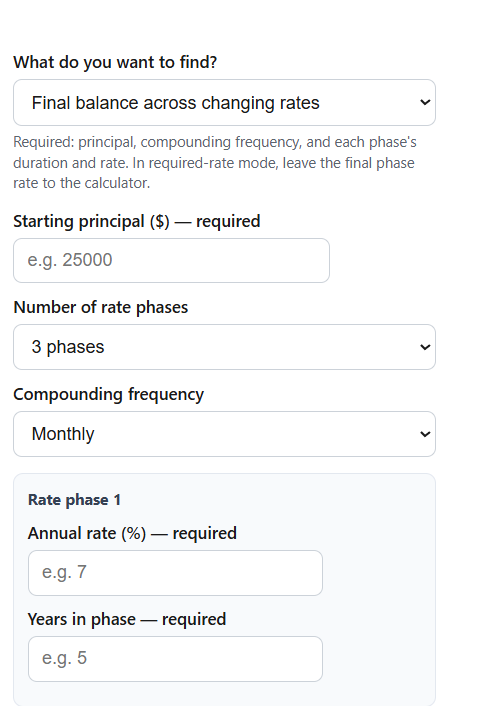
Use the Variable Interest Rate Compound Calculator to model changing rate phases or solve the final phase rate needed to reach a target balance on schedule.
Variable Interest Rate Compound Formula
When the annual rate changes over time, compound each rate phase in sequence. The ending balance from one phase becomes the starting balance for the next:
A = P * \prod_{i=1}^{k}(1 + r_i/n)^{nt_i}
To solve for the annual rate in the final phase, first calculate the balance before that phase and rearrange the compound-interest formula:
r_k = n[(A_{target}/A_{before})^{1/(nt_k)} - 1]
Variables:
- A is the final balance after all phases
- P is the starting principal
- ri is the annual rate for phase i as a decimal
- ti is the length of phase i in years
- n is the number of compounding periods per year
- k is the number of rate phases
Select two, three, or four phases and enter the rate and duration for each one. In final-balance mode, every phase rate is required. In final-phase-rate mode, enter a target balance and leave the last rate for the calculator to solve. The phase table shows exactly how much growth occurred during each period.
The equivalent annual growth rate summarizes the full multi-rate path as one annualized rate. It is useful for comparison, but it does not mean that single rate was actually earned in every year.
Changing-Rate Growth Example
This reference table starts with $25,000 and compounds monthly through three sequential phases.
| Phase | Annual rate | Duration | Starting balance | Ending balance |
|---|---|---|---|---|
| 1 | 4% | 3 years | $25,000.00 | $28,181.80 |
| 2 | 6% | 5 years | $28,181.80 | $38,013.02 |
| 3 | 8% | 4 years | $38,013.02 | $52,293.22 |
The full 12-year path ends at $52,293.22. Its equivalent annual growth rate is about 6.34% even though no individual phase used that exact rate.
Example Problems
Example 1: Calculate a balance across changing rates.
A $25,000 deposit earns 4% for 3 years, 6% for 5 years, and 8% for 4 years with monthly compounding. Compounding each phase in order produces $28,181.80, then $38,013.02, and finally $52,293.22.
Example 2: Solve for the final phase rate.
Suppose $20,000 earns 5% for 4 years and must reach $35,000 after another 6 years. First calculate the phase-one balance. Then solve the rearranged formula for the last six-year phase. The required nominal rate is about 6.02% with monthly compounding.
Frequently Asked Questions
Can I average the rates instead?
A simple arithmetic average can be misleading because each rate acts on a different balance and may last for a different amount of time. Sequential compounding preserves the order and duration of every phase.
Does the order of rates matter?
For a single untouched principal with no deposits or withdrawals, multiplying the same phase growth factors gives the same ending balance regardless of order. Order does matter once cash flows, taxes, fees, or balance-dependent rules occur between phases.
What if the rate changes every year?
Use one phase per rate change, up to the calculator's four phases. For a longer annual series, combine adjacent years that share the same rate or calculate the balance in several passes, carrying the ending balance forward.