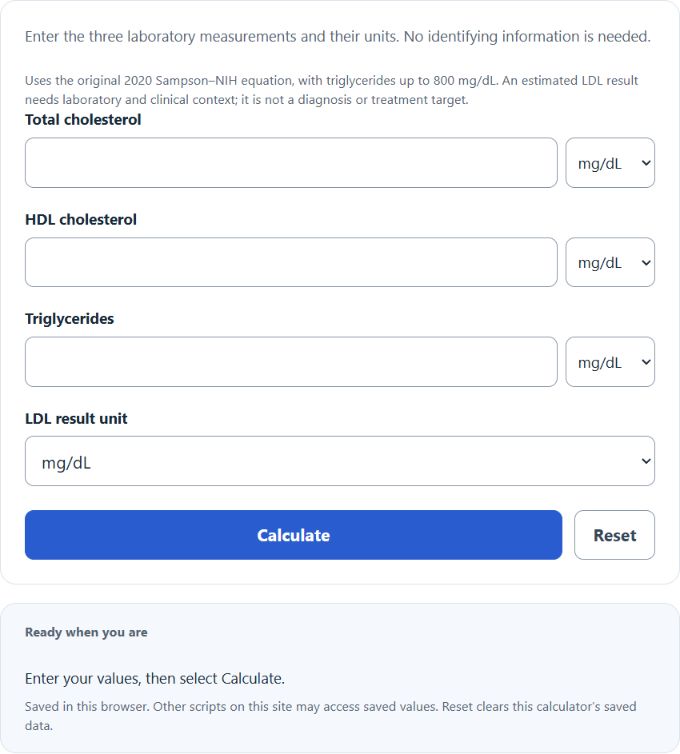
Estimate LDL cholesterol from total cholesterol, HDL cholesterol and triglycerides using the original Sampson–NIH equation published in 2020. Enter laboratory measurements in mg/dL or mmol/L and choose the result unit.
Sampson–NIH 2020 formula
LDL-C = TC/0.948 − HDL-C/0.971 − (TG/8.56 + TG × non-HDL-C/2140 − TG²/16100) − 9.44, with every equation term in mg/dL. Non-HDL-C = TC − HDL-C.
Convert cholesterol mmol/L to mg/dL by multiplying by 38.67; convert triglycerides by multiplying by 88.57. This calculator implements the original equation, rather than a later modified Sampson method.
Worked example
For TC = 200 mg/dL, HDL-C = 50 mg/dL and TG = 150 mg/dL, non-HDL-C is 150 mg/dL. Substitution gives 123.3973 mg/dL estimated LDL-C, equivalent to 3.191 mmol/L.
Frequently asked questions
Can I use triglycerides above 800 mg/dL?
This implementation stops above 800 mg/dL, the stated range for the original method. Ask the laboratory or clinician which measurement or estimation method is appropriate. The original study excluded type III hyperlipidemia, so this equation should not be assumed valid for that condition.
Is estimated LDL the same as a direct assay?
No. The equation estimates LDL from other measurements. Assay results and clinical interpretation can differ.
Why is a negative result rejected?
A negative concentration is not physically interpretable. Check units and measurements rather than treating it as a clinical LDL result.
References: Sampson et al., JAMA Cardiology, 2020; National Center for Health Statistics comparison of LDL equations.