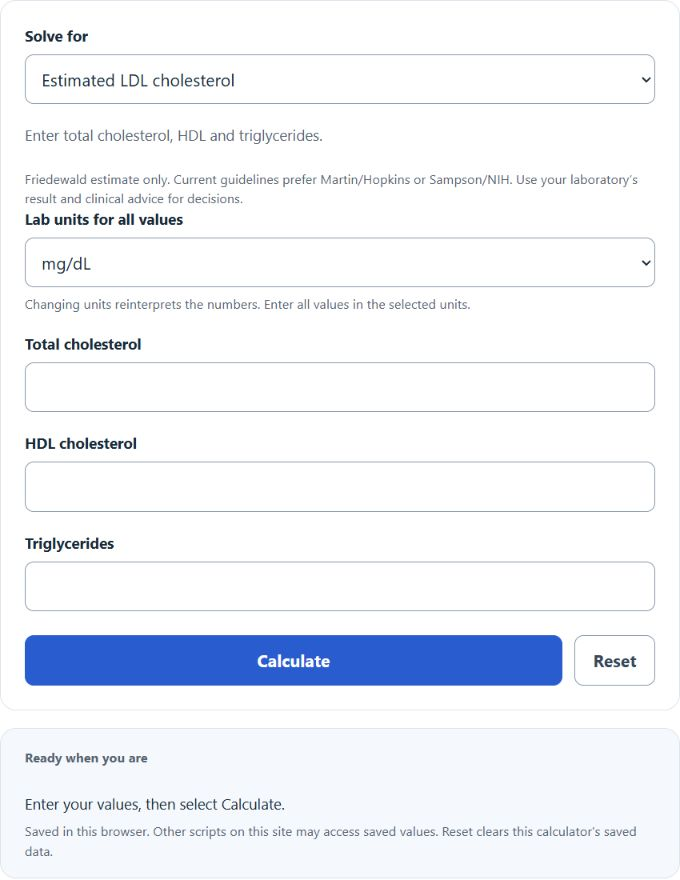
Estimate LDL cholesterol with the Friedewald equation in mg/dL or mmol/L. Total cholesterol and triglyceride modes are algebraic rearrangements, not clinical measurements. Non-HDL and estimated VLDL results are included.
Friedewald Equation Formula
The Friedewald equation is used to estimate the level of LDL cholesterol in the blood when it is not directly measured. The formula is as follows:
Variables:
- LDL is the low-density lipoprotein cholesterol (mg/dL)
- TC is the total cholesterol (mg/dL)
- HDL is the high-density lipoprotein cholesterol (mg/dL)
- TG is the triglycerides (mg/dL)
To estimate LDL cholesterol in mg/dL, subtract HDL and one-fifth of triglycerides from total cholesterol. In mmol/L, use LDL = TC − HDL − TG / 2.2. Use one common unit system; changing the unit selector reinterprets the entered numbers. Do not use Friedewald at triglycerides ≥400 mg/dL or ≥4.5 mmol/L. Rearranged total cholesterol and triglycerides are equation checks, not validated substitutes for measured laboratory values.
What is LDL Cholesterol?
LDL cholesterol, often referred to as "bad" cholesterol, is a type of lipoprotein that carries cholesterol through the bloodstream. High levels of LDL cholesterol can lead to plaque buildup in arteries, increasing the risk of heart disease and stroke. The Friedewald equation provides a historical way to estimate LDL levels when direct measurement is not available. It was widely used in routine lipid panels; newer Martin/Hopkins or Sampson/NIH equations are now preferred.
How to Calculate LDL Cholesterol?
The following steps outline how to estimate LDL cholesterol using the Friedewald equation.
- First, determine the total cholesterol (TC) in milligrams per deciliter (mg/dL).
- Next, determine the HDL cholesterol (HDL) in mg/dL.
- Then, determine the triglycerides (TG) in mg/dL.
- Use the Friedewald equation: LDL = TC - HDL - (TG / 5).
- Finally, calculate the estimated LDL cholesterol (LDL) in mg/dL.
- After inserting the variables and calculating the result, check your answer with the calculator above.
Example Problem:
Use the following variables as an example problem to test your knowledge.
Total Cholesterol (TC) = 200 mg/dL
HDL Cholesterol (HDL) = 50 mg/dL
Triglycerides (TG) = 150 mg/dL