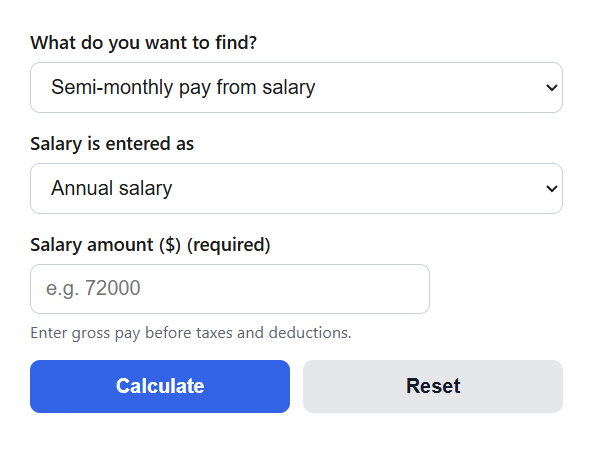
Use this semi-monthly pay calculator to convert an annual salary, monthly salary, or hourly wage into gross pay per semi-monthly paycheck (24 per year).
Semi-Monthly Pay Formula
A semi-monthly schedule pays you twice a month, usually on the 1st and 15th or the 15th and last day of the month, for a total of 24 paychecks per year. To find your gross semi-monthly paycheck, divide your annual salary by 24:
PSM = S / 24
To go the other way and recover an annual salary from a known semi-monthly paycheck, multiply by 24. If you are paid by the hour, first convert your wage to an annual figure, then divide by 24:
S = PSM * 24
  S = R * H * 52
Variables:
- PSM is the gross pay per semi-monthly paycheck (24 checks per year)
- S is the gross annual salary
- R is the hourly rate of pay
- H is the number of hours worked per week (40 is standard full time)
- 24 is the number of semi-monthly pay periods in a year; a biweekly schedule uses 26 instead
Pick what you want to find at the top of the calculator. In “Semi-monthly pay from salary” mode you enter an annual or monthly salary and the tool returns the gross amount of each of your 24 paychecks. In “Semi-monthly pay from hourly wage” mode you enter an hourly rate and hours per week, and the calculator annualizes the wage over 52 weeks before dividing by 24. In “Annual salary from semi-monthly pay” mode you enter one semi-monthly paycheck and the tool multiplies by 24 to rebuild the annual, monthly, and biweekly figures.
Every result also shows the biweekly equivalent (annual salary divided by 26) so you can see how the two schedules compare. On the same salary a semi-monthly check is always a little larger than a biweekly check, because the same annual pay is split into 24 pieces instead of 26. All amounts are gross pay before taxes and deductions.
Semi-Monthly vs Biweekly Pay Reference Tables
This table shows the gross semi-monthly and biweekly paycheck for common annual salaries. Notice that the semi-monthly check is always larger, even though total annual pay is identical.
| Annual salary | Semi-monthly paycheck (24) | Biweekly paycheck (26) | Difference per check |
|---|---|---|---|
| $30,000 | $1,250.00 | $1,153.85 | $96.15 |
| $40,000 | $1,666.67 | $1,538.46 | $128.21 |
| $50,000 | $2,083.33 | $1,923.08 | $160.26 |
| $60,000 | $2,500.00 | $2,307.69 | $192.31 |
| $70,000 | $2,916.67 | $2,692.31 | $224.36 |
| $80,000 | $3,333.33 | $3,076.92 | $256.41 |
| $90,000 | $3,750.00 | $3,461.54 | $288.46 |
| $100,000 | $4,166.67 | $3,846.15 | $320.51 |
| $120,000 | $5,000.00 | $4,615.38 | $384.62 |
| $150,000 | $6,250.00 | $5,769.23 | $480.77 |
If you are paid by the hour, this second table converts common hourly rates at 40 hours per week into an annual salary and the matching gross semi-monthly paycheck.
| Hourly rate | Annual salary (40 h/wk) | Semi-monthly gross |
|---|---|---|
| $15.00 | $31,200 | $1,300.00 |
| $18.00 | $37,440 | $1,560.00 |
| $20.00 | $41,600 | $1,733.33 |
| $22.00 | $45,760 | $1,906.67 |
| $25.00 | $52,000 | $2,166.67 |
| $30.00 | $62,400 | $2,600.00 |
| $35.00 | $72,800 | $3,033.33 |
| $40.00 | $83,200 | $3,466.67 |
| $45.00 | $93,600 | $3,900.00 |
| $50.00 | $104,000 | $4,333.33 |
Example Problems
Example 1: Semi-monthly pay from an annual salary.
You earn $72,000 per year and are paid on the 15th and last day of each month. Divide the salary by the 24 pay periods:
PSM = 72,000 / 24 = $3,000.00 gross per semi-monthly paycheck. For comparison, the same salary on a biweekly schedule would pay 72,000 / 26 = $2,769.23 per check, but with 26 checks per year instead of 24.
Example 2: Semi-monthly pay from an hourly wage.
You make $25.00 per hour and work 40 hours per week. First annualize the wage: S = 25 * 40 * 52 = $52,000 per year. Then divide by 24:
PSM = 52,000 / 24 = $2,166.67 gross per semi-monthly paycheck. Each pay period covers about 86.67 scheduled hours on average (2,080 hours per year divided by 24 periods).
Frequently Asked Questions
What is the difference between semi-monthly and biweekly pay?
Semi-monthly pay arrives twice a month on fixed calendar dates, such as the 1st and 15th, for exactly 24 paychecks per year. Biweekly pay arrives every other week on the same weekday, usually Friday, for 26 paychecks per year. On the same annual salary, each semi-monthly check is larger because the total is split into 24 pieces instead of 26, but the biweekly schedule delivers two extra checks over the course of the year, so annual pay is identical.
How many hours does a semi-monthly pay period cover?
For a full-time employee working 40 hours per week, a year contains 2,080 work hours. Dividing 2,080 by 24 pay periods gives 86.67 hours per semi-monthly period on average. The actual number of work hours in any single period varies with the calendar, from roughly 80 to 96 hours, which is why salaried semi-monthly paychecks stay constant while hourly timesheets fluctuate slightly from period to period.
Why do two months a year have three biweekly paychecks but semi-monthly always has two?
A biweekly schedule pays 26 checks across 12 months. Since two checks per month accounts for only 24, the two extra checks land in whichever months happen to contain three paydays, and those “three-paycheck months” shift from year to year. A semi-monthly schedule is tied to calendar dates rather than a 14-day cycle, so it always delivers exactly two checks in every month with no extra-paycheck months.