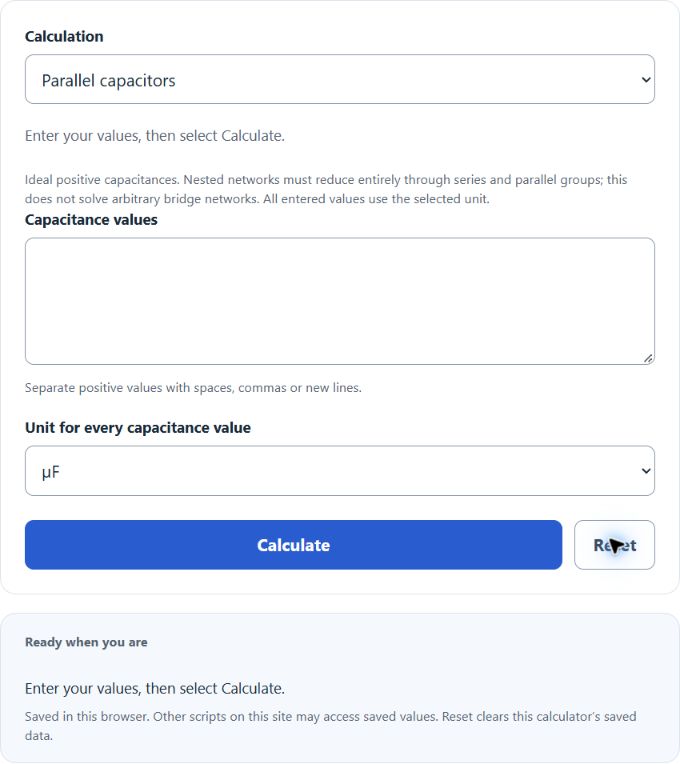
Calculate equivalent capacitance for series, parallel or nested combinations of ideal capacitors. Nested groups are reduced from the inside out, with each intermediate equivalent displayed.
Connection formulas
Parallel: Ceq = C1 + C2 + … . Series: 1/Ceq = 1/C1 + 1/C2 + … . Every value must be positive and use the selected common unit.
| Expression | Meaning |
|---|---|
| P(10,20) | 10 and 20 in parallel |
| S(10,20) | 10 and 20 in series |
| P(10,S(20,20)) | 10 in parallel with a series pair of 20s |
Example
In P(10,S(20,20)), the series group equals 1/(1/20 + 1/20) = 10. Placing that group in parallel with 10 gives 20. If inputs are in µF, the result is 20 µF.
Frequently asked questions
Why does series capacitance decrease?
The reciprocal capacitances add, so a series group’s equivalent is smaller than its smallest member.
Can I enter any circuit?
The expression must reduce fully through series and parallel groups. A bridge or other irreducible network requires a different circuit solution.
Does the result determine a safe voltage rating?
No. Check voltage sharing, tolerances, polarity, ESR and leakage separately before selecting physical capacitors.
Reference: OpenStax capacitor connection formulas.