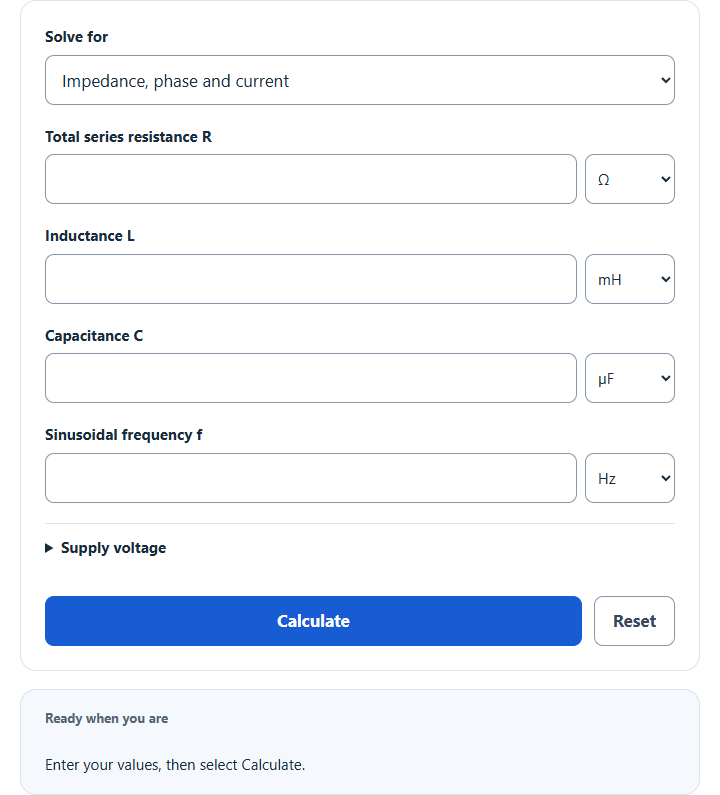
Calculate the impedance, phase angle and current of a series RLC circuit, plus resonant frequency, bandwidth and Q factor, from R, L, C and frequency.
- All Electrical Calculators
- Resonant Frequency Calculator
- Bandpass Filter Calculator
- Eq Q Factor Calculator
Series RLC formulas
With ω = 2πf, XL = ωL, XC = 1/(ωC), Z = R + j(XL − XC), and |Z| = √[R² + (XL − XC)²]. Current is VRMS/|Z|; impedance phase is atan2(XL − XC, R).
f₀ = 1/(2π√LC), Δf = R/(2πL), and Q = f₀/Δf. At the half-power frequencies, |XL − XC| = R. These formulas use total series resistance and the current response, or voltage across that resistor.
Example
With R = 4 Ω, L = 1 H, C = 0.25 F and ω = 4 rad/s, XL = 4 Ω and XC = 1 Ω. Z = 4 + j3 Ω, so |Z| = 5 Ω and phase is 36.8699°. A 10 V RMS supply gives 2 A RMS. Resonance is 1/π ≈ 0.31831 Hz.
Frequently asked questions
Does current lead or lag?
When XL exceeds XC, current lags voltage. When XC exceeds XL, current leads voltage.
Are the edges symmetric around resonance?
Their separation is Δf, but their arithmetic midpoint generally differs from f₀. Their geometric mean equals f₀.
What losses belong in R?
Include resistance acting in series, including relevant winding losses and loading represented by the model. Real frequency-dependent losses and parasitics can shift the response.
References: RLC impedance and AC resonance, OpenStax.