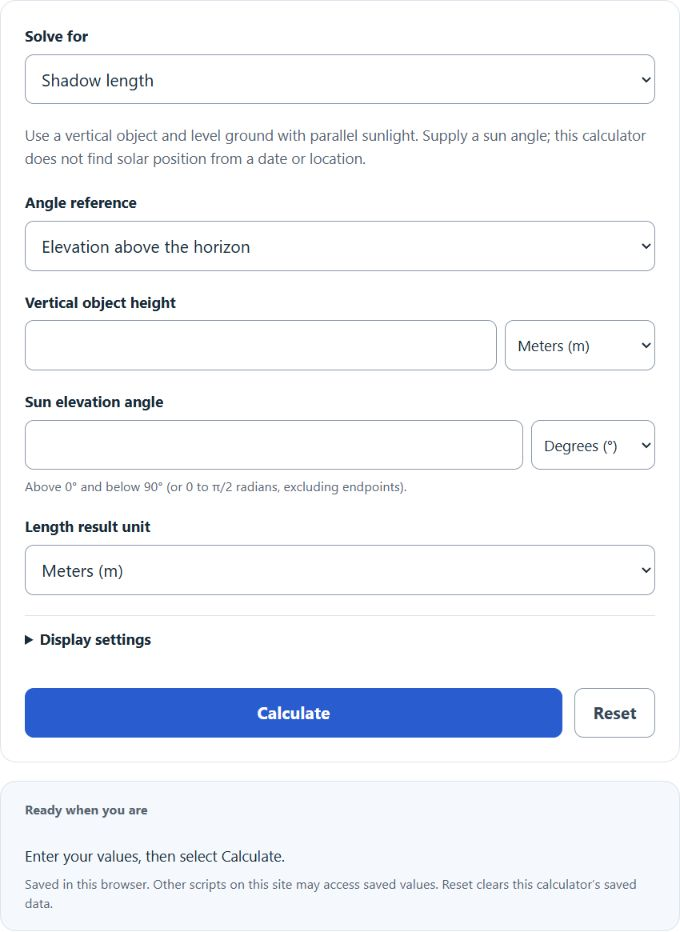
Calculate shadow length, object height, or sun elevation and zenith angles with metric and US units, degree or radian inputs, and shadow ratios.
- All Physics Calculators
- Angle of Elevation Calculator
- Angle of View Calculator
- Angle of Repose Calculator
- Air Mass Calculator
Shadow Length Formula
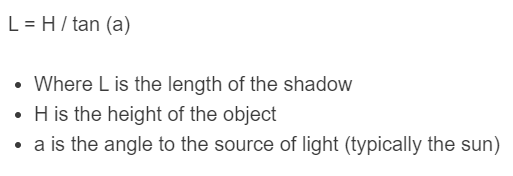
The shadow length formula derives from basic right-triangle trigonometry. A vertical object of height H, the ground surface, and the light ray connecting the top of the object to the tip of the shadow form a right triangle. The shadow length L is the adjacent side, the object height H is the opposite side, and the sun elevation angle a is measured between the ground and the incoming light ray.
Where L is the shadow length, H is the object height, and a is the sun elevation angle (also called solar altitude angle) measured from the horizontal. The formula can be rearranged to solve for height (H = L * tan(a)) or for the sun angle (a = arctan(H / L)).
This formula assumes a flat, level surface and a distant light source like the sun, where rays are effectively parallel. For artificial point-source lighting (such as a streetlamp), the geometry changes because light rays diverge, and the shadow length depends on both the height of the light source and its horizontal distance from the object.
Shadow Ratio Reference Table
The shadow ratio is the multiplier applied to an object’s height to determine its shadow length at a given sun elevation. To find the shadow length, multiply the object’s height by the ratio.
| Sun Elevation | Shadow Ratio (L/H) | Shadow per 1 m Height | Typical Condition |
|---|---|---|---|
| 5 degrees | 11.43 | 11.43 m | Just after sunrise or before sunset |
| 10 degrees | 5.67 | 5.67 m | Early morning or late evening |
| 15 degrees | 3.73 | 3.73 m | Low winter sun at mid-latitudes |
| 20 degrees | 2.75 | 2.75 m | Winter midday at ~47 deg latitude |
| 30 degrees | 1.73 | 1.73 m | Morning/afternoon in temperate zones |
| 45 degrees | 1.00 | 1.00 m | Shadow equals object height |
| 60 degrees | 0.58 | 0.58 m | Summer midday at mid-latitudes |
| 75 degrees | 0.27 | 0.27 m | Near-tropical solar noon |
| 90 degrees | 0.00 | 0.00 m | Sun directly overhead (latitude matches solar declination) |
At 45 degrees elevation, the shadow length exactly equals the object height. This 1:1 ratio serves as a useful mental benchmark. Below 45 degrees, shadows are longer than the object; above 45 degrees, shadows are shorter.
Solar Noon Elevation by Latitude and Season
The sun’s maximum daily elevation (at solar noon) depends on the observer’s latitude and the time of year. The formula is: solar noon elevation = 90 – |latitude – solar declination|. Solar declination ranges from +23.44 degrees at the June solstice to -23.44 degrees at the December solstice, and is 0 degrees at the equinoxes.
| Latitude | Example City | June Solstice Noon | Equinox Noon | Dec Solstice Noon |
|---|---|---|---|---|
| 0 deg (Equator) | Quito | 66.6 deg | 90.0 deg | 66.6 deg |
| 23.4 deg N | Havana | 90.0 deg | 66.6 deg | 43.2 deg |
| 35 deg N | Tokyo / LA | 78.4 deg | 55.0 deg | 31.6 deg |
| 40 deg N | New York / Madrid | 73.4 deg | 50.0 deg | 26.6 deg |
| 48 deg N | Paris / Seattle | 65.4 deg | 42.0 deg | 18.6 deg |
| 56 deg N | Edinburgh / Moscow | 57.4 deg | 34.0 deg | 10.6 deg |
| 64 deg N | Reykjavik | 49.4 deg | 26.0 deg | 2.6 deg |
At 56 deg N latitude (Edinburgh, Moscow), the winter solstice noon sun sits at just 10.6 degrees, producing shadow ratios above 5x. At the same latitude in summer, noon elevation reaches 57.4 degrees and shadows shrink to about 0.64x the object height. This seasonal swing of nearly 47 degrees in peak sun angle is why shadow behavior varies so dramatically between summer and winter at higher latitudes.
The Shadow Rule for UV Safety
The shadow rule is a quick clue that the sun is high: a shadow shorter than your height suggests seeking shade and sun protection. It does not measure UV Index or establish a safe exposure time, and a longer shadow does not guarantee low risk. Check the local UV Index; EPA recommends sun protection when it is 3 or higher.
A higher sun angle generally means a shorter atmospheric path for incoming radiation. Actual UV exposure also depends on ozone, clouds, altitude and reflection from surfaces. Use the UV Index and appropriate protection rather than assigning intense, moderate or safe exposure solely from the shadow-to-height ratio.
Practical Applications of Shadow Length
Architecture and Zoning
Shadow impact studies assess how a proposed structure shades neighboring properties at relevant times and seasons. This calculator estimates one ideal shadow length from a supplied sun angle. A winter-solstice noon calculation is one scenario; it does not determine maximum daily shading, local approval requirements or a setback that guarantees no shading. A complete study also needs solar direction, terrain, building geometry and the applicable local criteria.
Solar Panel Spacing
For ground-mounted or flat-roof solar arrays, shadow calculations can help compare row spacing at selected sun angles. Winter-solstice noon alone does not establish a spacing that prevents shading at other hours. Row design also depends on solar azimuth, panel tilt, orientation, terrain, intended operating hours and acceptable shading losses. The effect of partial shading varies with module and array design; this simple vertical-object model does not predict electrical output.
Photography and Filmmaking
Photographers use shadow length and direction to plan shoots around specific lighting conditions. The “golden hour” near sunrise and sunset produces shadow ratios above 5x, creating long, dramatic shadows favored in landscape and portrait work. Knowing the exact shadow ratio at a planned shoot time lets a photographer predict where shadows will fall in a scene and position subjects accordingly.
Landscaping and Garden Planning
A fence, wall or tree can create changing shade zones. For a vertical 2 m fence on level ground at 40 deg N, ideal solar-noon elevations of 73.44 deg in June and 26.56 deg in December give shadows of about 0.6 m and 4.0 m, respectively, using L = 2 / tan(a). These noon cases differ by about 3.4 m; they are not the minimum and maximum shadow footprint throughout each day. Planting decisions also depend on shadow direction, other obstructions and the duration of sunlight.
Forensics and Geolocation
Open-source intelligence (OSINT) analysts and forensic investigators use shadows in photographs and satellite imagery to estimate the time a photo was taken or to verify the claimed location. By measuring the shadow length of an object with known height in an image, analysts can back-calculate the sun elevation angle, then cross-reference that angle against solar position data for the claimed date and coordinates. A mismatch between the calculated sun angle and the expected angle for that time and place can reveal that an image was taken at a different time or location than stated.
Shadow Length Throughout the Day
Shadow length changes as the sun moves. The table gives ideal estimates for a vertical 1.7 m object on level ground at 40 deg N, using solar declination 0 deg at the equinox and +23.44 deg at the June solstice. Times are local solar time, not civil clock time. Elevations come from the standard solar-angle relation; lengths use L = 1.7 / tan(a), rounded to one decimal. These estimates omit atmospheric refraction and local obstructions.
| Solar Time | Sun Elev. (Equinox) | Shadow (Equinox) | Sun Elev. (June Solstice) | Shadow (June Solstice) |
|---|---|---|---|---|
| 7:00 AM | 11.4 deg | 8.4 m | 26.0 deg | 3.5 m |
| 8:00 AM | 22.5 deg | 4.1 m | 37.4 deg | 2.2 m |
| 9:00 AM | 32.8 deg | 2.6 m | 48.8 deg | 1.5 m |
| 10:00 AM | 41.6 deg | 1.9 m | 59.8 deg | 1.0 m |
| 12:00 PM | 50.0 deg | 1.4 m | 73.4 deg | 0.5 m |
| 2:00 PM | 41.6 deg | 1.9 m | 59.8 deg | 1.0 m |
| 4:00 PM | 22.5 deg | 4.1 m | 37.4 deg | 2.2 m |
| 5:00 PM | 11.4 deg | 8.4 m | 26.0 deg | 3.5 m |
On the equinox at 40 deg N, this model gives a 1.7 m object a shadow of about 8.4 m at 7 AM solar time and 1.4 m at noon, with matching ideal afternoon values. At the June solstice, the noon shadow is about 0.5 m at a solar elevation of 73.44 deg. Civil clock times differ with longitude, the equation of time and time-zone rules.
Limitations and Edge Cases
The standard formula L = H / tan(a) assumes level terrain, a vertical object and parallel sunlight. A slope along the shadow direction changes the geometry. A leaning object also changes the horizontal position of its top, so substituting only its vertical height does not generally reproduce its shadow from the base. Nearby point-source lighting requires another model. At very low sun angles, atmospheric refraction and terrain make ideal shadow estimates less reliable. This calculator uses positive heights and shadows and input angles strictly between the horizon and overhead; zero-length overhead shadows and unbounded horizon shadows are limiting cases outside its supported input range.
For an ideal point-source light above the object, with source height H_L, vertical object height H_O and horizontal separation d on level ground, L = (H_O * d) / (H_L – H_O), provided H_L > H_O and d > 0. As H_L approaches H_O from above, this ideal shadow grows without bound. This calculator does not implement that point-source model; a source at or below the object’s top requires separate geometric treatment.