Analyze a simply supported beam with a point load and full-span UDL for reactions, signed shear, moment, and station values, or reverse-solve the point load.
- All Construction Calculators
- All Force Calculators
- Pin Shear Calculator
- Press Force Calculator
- Riveting Force Calculator
- Maximum Force Calculator
- Shear Area Calculator
Shear Force Formula
The following equation is used to calculate the Shear Force.
- Where Fs is the shear force (N)
- τ is the average shear stress (N/m²)
- A is the cross-sectional area (m²)
To calculate a shear force, multiply the average shear stress by the cross-sectional area.
What is a Shear Force?
Definition:
Shear force is a force that acts parallel (tangential) to a cross-section and tends to cause adjacent parts of a material to slide past one another.
On any cut plane through a body, the internal traction (force per unit area) can be resolved into a normal component (perpendicular to the plane) and a shear component (parallel to the plane). Normal stress is associated with tension/compression (elongation/contraction), while shear stress is associated with sliding/distortion.
How to Calculate Shear Force?
Example Problem:
The following example outlines the steps and information needed to calculate the Shear Force.
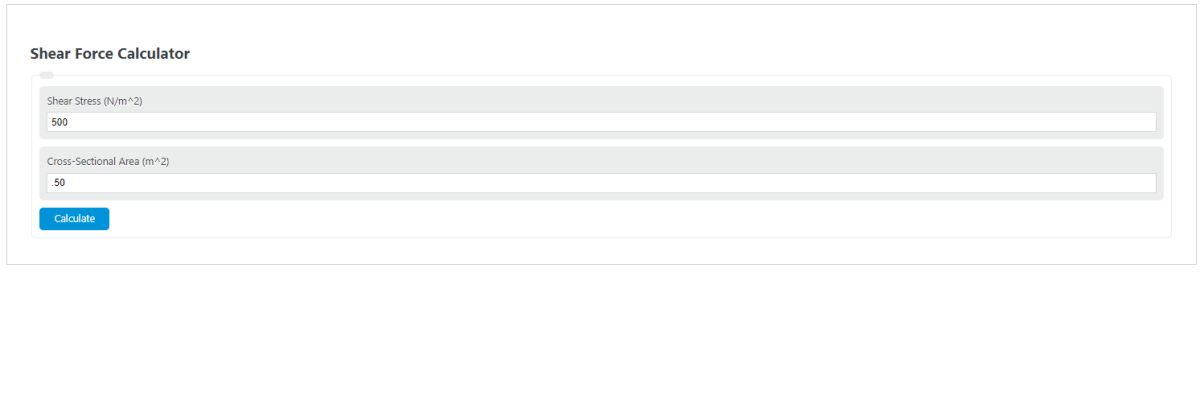
First, determine the average shear stress. For this example problem, the average shear stress is measured to be 500 N/m².
Next, determine the cross-sectional area. In this case, the cross-sectional area is measured to be 0.50 m².
Finally, calculate the shear force using the formula above:
Fs = τ × A
Fs = 500 × 0.50
Fs = 250 N