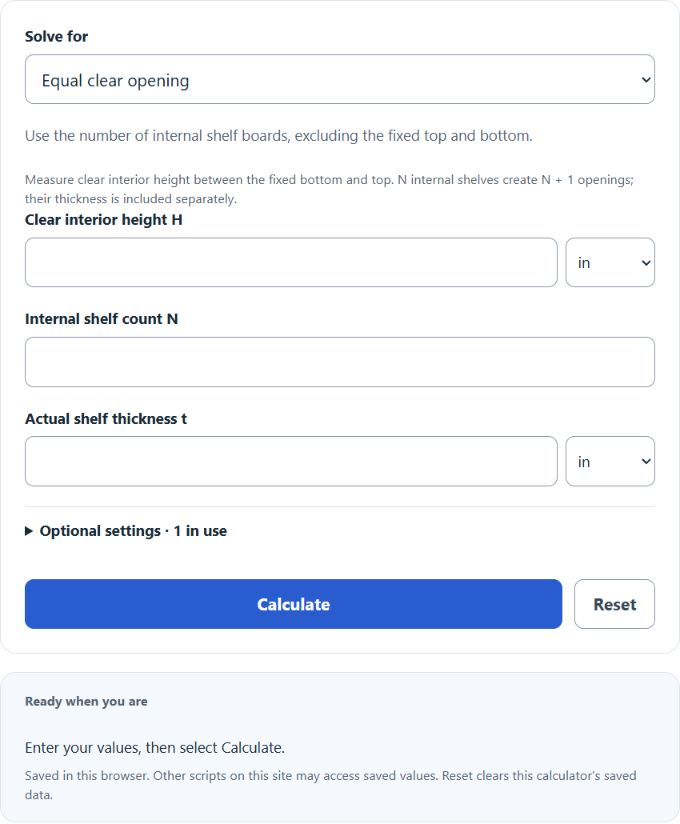
Calculate equal clear openings and shelf positions, find how many shelves fit, or determine required interior height in inches, centimeters, or millimeters.
Related Calculators
- Thread Pull-Out Force Calculator
- Bending Stress Calculator
- Shiplap Calculator
- Manhours Calculator
- All Construction Calculators
Shelf Spacing Formula
For N internal shelf boards with equal clear openings between fixed interior bottom and top boundaries, use:
Variables:
- G is each clear opening between board surfaces or an interior boundary and the adjacent board.
- H is the clear interior height, measured between the fixed bottom and top boundaries; their own thicknesses are outside H.
- t is the actual thickness of each internal shelf board.
- N + 1 is the number of clear openings: one below, one above, and the spaces between internal boards.
- N is the whole number of internal shelf boards, excluding the fixed top and bottom. N = 0 is valid and leaves one opening.
The geometry identity is H = Nt + (N + 1)G. Subtract the total internal-board thickness Nt from the clear interior height H, then divide by N + 1 openings. Use actual thickness, consistent units and H > Nt so every opening is positive. For a desired opening, required interior height is H = Nt + (N + 1)G. For a minimum opening Gmin, the maximum internal count is floor[(H − Gmin)/(t + Gmin)], provided H ≥ Gmin and both t and Gmin are positive. If H < Gmin, even one clear opening does not fit.
What is a Shelf Spacing?
Here shelf spacing means vertical clear opening between shelf-board surfaces, including the openings at the bottom and top of the interior. It differs from nominal center-to-center pitch, G + t. Position measurements start at the interior bottom: shelf i has bottom iG + (i − 1)t, center iG + (i − 1)t + t/2, and top iG + it. These dimensions do not automatically locate shelf-pin or bracket holes; account for the actual support offsets and manufacturing or item-access tolerances. This geometry calculation does not determine load capacity.
How to Calculate Shelf Spacing?
The following steps outline how to calculate the Shelf Spacing.
- First, measure clear interior height H between the fixed bottom and top in inches, centimetres or millimetres.
- Next, count the N internal shelf boards and measure their actual thickness t.
- Use G = (H − Nt)/(N + 1), keeping all dimensions in the same unit.
- Calculate the equal clear opening G, then check that Nt + (N + 1)G reconstructs the measured interior height.
- After inserting the variables and calculating the result, check your answer with the calculator above.
Example Problem :
Use the following variables as an example problem to test your knowledge.
Clear interior height H = 120 inches.
Internal shelf count N = 15, with assumed actual shelf thickness t = 0.75 inch for this geometry example. There are 16 clear openings and the boards occupy 15 × 0.75 = 11.25 inches. Thus G = (120 − 11.25)/16 = 6.796875 inches. The last shelf top is 113.203125 inches above the interior bottom, leaving the same 6.796875-inch opening above it.
The inverse checks agree: 15 × 0.75 + 16 × 6.796875 = 120 inches, and floor[(120 − 6.796875)/(0.75 + 6.796875)] = 15 shelves for that minimum opening. A sixteenth shelf at the same minimum opening would require 16 × 0.75 + 17 × 6.796875 = 127.546875 inches, so it does not fit. For the calculator’s shorter sample of H = 72 inches, N = 4 and t = 0.75 inch, the equal opening is 13.8 inches. Inches convert using NIST’s exact 25.4 millimetres per inch definition.