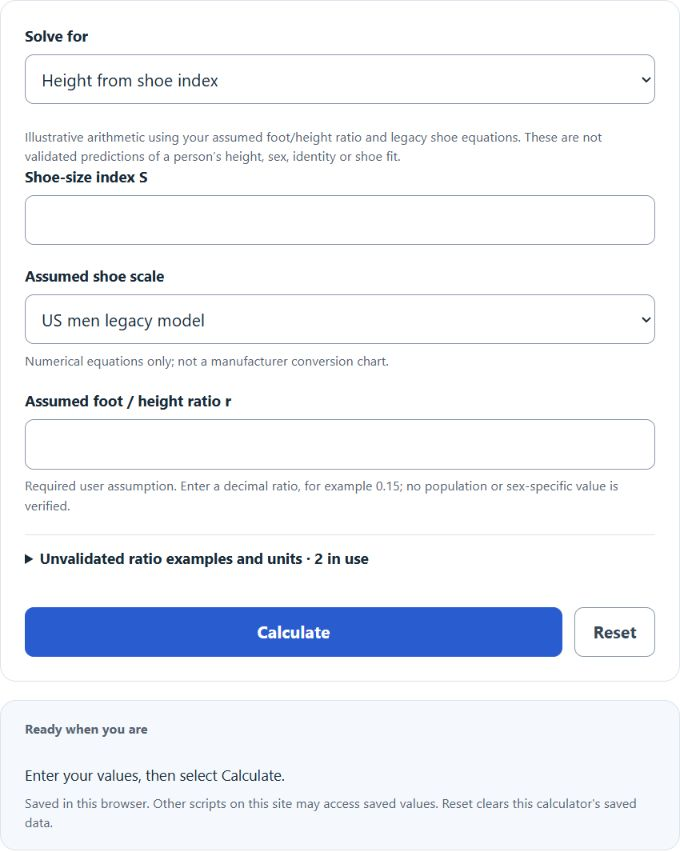
Explore illustrative height or shoe-index arithmetic using an explicit user-entered foot/height ratio and legacy numerical shoe equations. This is not a validated prediction of a person’s height, biological characteristics, identity or shoe fit.
| Index → model height | Height → half index |
|---|---|
| 8 → 65.8 in | 66 in → 8 |
| 8.5 → 66.9 in | 67 in → 8.5 |
| 9 → 68.0 in | 68 in → 9 |
| 9.5 → 69.1 in | 69 in → 9.5 |
| 10 → 70.2 in | 70 in → 10 |
| 10.5 → 71.3 in | 71 in → 10.5 |
| 11 → 72.4 in | 72 in → 11 |
| 11.5 → 73.5 in | 73 in → 11.5 |
| 12 → 74.6 in | 74 in → 11.5 |
| 13 → 76.8 in | 75 in → 12 |
| Index → model height | Height → half index |
|---|---|
| 6 → 57.0 in | 58 in → 6.5 |
| 6.5 → 58.1 in | 60 in → 7.5 |
| 7 → 59.1 in | 62 in → 8.5 |
| 7.5 → 60.2 in | 63 in → 9 |
| 8 → 61.3 in | 64 in → 9.5 |
| 8.5 → 62.4 in | 65 in → 9.5 |
| 9 → 63.4 in | 66 in → 10 |
| 9.5 → 64.5 in | 67 in → 10.5 |
| 10 → 65.6 in | 68 in → 11 |
| 11 → 67.7 in | 70 in → 12 |
- Health Calculators
- Shoe Size Calculator (inches to shoe size)
- Waist to Height Ratio Calculator / WHtR Calculator
- APE Index (Wingspan To Height Ratio) Calculator
Shoe Size to Height Formula
The assumed model works in two directions. It assigns a foot length FL using a legacy shoe-index equation, then calculates H = FL/r using the positive ratio r entered by the user. For the US men legacy equation, with both lengths in inches:
FL = (S + 22) / 3
H = FL / r
The reverse direction uses the same entered ratio and legacy equation before any shoe-index rounding:
FL = H * r
US men index = 3 * FL - 22
Variables:
- S is a positive numerical index in the selected legacy shoe-scale equation, not a verified manufacturer size
- FL is the assumed foot length, in inches in the formulas above
- H is the entered height or conditional model output, in the same unit as FL
- r is a required positive user assumption. Optional examples 0.15, 0.152 and 0.155 are unvalidated numerical choices, not verified averages or ratios assigned to a sex, age or population
Both directions retain US men, US women, UK and EU legacy numerical scales. Enter the ratio separately; a scale label never selects a biological ratio. Height input supports inches, centimetres, metres or mixed feet/inches. A blank mixed component explicitly means 0; negative components reject and combined height must be positive. Displayed feet/inches carry a rounded 12 inches into the next foot. Shoe output can be unrounded, nearest half index or nearest whole index, with positive ties upward. Only the unrounded equations are reciprocal; rounding an index loses information.
The retained legacy assumptions are US men = 3FL(in) − 22, US women = 3FL(in) − 20.5, UK = 3FL(in) − 22.5 and EU = 1.5[FL(cm) + 2]. Their offsets define this numerical exercise; they are not universal brand conversions, shoe-last measurements or fit recommendations. For example, the manufacturer’s own Nike chart uses its own foot measurements and distinguishes foot length from box-label CM sizes. Use the relevant actual chart when fit matters.
Illustrative Height Scenarios
The following table compares two arbitrary scenarios: US men legacy index with r = 0.152, and US women legacy index with r = 0.155. These ratios are numerical assumptions only and may be interchanged or replaced; the labels do not define sex-specific body proportions. Values are point calculations, not predicted heights or population averages.
| Index | US men scale, r = 0.152 | US women scale, r = 0.155 |
|---|---|---|
| 6 | 156.0 cm | 144.8 cm |
| 7 | 161.5 cm | 150.2 cm |
| 8 | 167.1 cm | 155.7 cm |
| 9 | 172.7 cm | 161.1 cm |
| 10 | 178.2 cm | 166.6 cm |
| 11 | 183.8 cm | 172.1 cm |
| 12 | 189.4 cm | 177.5 cm |
| 13 | 195.0 cm | 183.0 cm |
This next table applies the legacy numerical equations to specified assumed foot lengths and rounds the indices to the nearest half, with positive ties upward. No foot/height ratio is used in this table. It is not a manufacturer conversion or fitting chart.
| Assumed foot | US men | US women | UK | EU |
|---|---|---|---|---|
| 22 cm | 4 | 5.5 | 3.5 | 36 |
| 23 cm | 5 | 6.5 | 4.5 | 37.5 |
| 24 cm | 6.5 | 8 | 6 | 39 |
| 25 cm | 7.5 | 9 | 7 | 40.5 |
| 26 cm | 8.5 | 10 | 8 | 42 |
| 27 cm | 10 | 11.5 | 9.5 | 43.5 |
| 28 cm | 11 | 12.5 | 10.5 | 45 |
| 29 cm | 12.5 | 14 | 12 | 46.5 |
Example Problems
Example 1: Estimate height from a shoe size.
Choose the US men legacy index 10 and explicitly assume r = 0.152. FL = (10 + 22)/3 = 10.666666… in = 27.093333… cm. H = FL/0.152 = 178.245614… cm = 70.175438… in, displayed as 5 ft 10.18 in. Changing only the assumed ratio to 0.15 gives 180.622222… cm. Neither number is a verified prediction of the wearer’s height.
Example 2: Estimate a shoe size from height.
Enter 5 ft 4 in = 64 in and explicitly assume r = 0.155. Model FL = 64 × 0.155 = 9.92 in = 25.1968 cm. Under the US women legacy equation, the unrounded index is 3 × 9.92 − 20.5 = 9.26; nearest-half display is 9.5. The ratio is an input assumption, and the rounded index is not a fitted shoe recommendation.
Frequently Asked Questions
Can you tell height from shoe size?
A retail shoe label does not uniquely identify a person’s height. This calculator only evaluates entered assumptions. Original footprint research develops measurement-based regression models for a sampled population; that does not validate these simple ratios or retail shoe equations. No universal correlation, forensic accuracy or identification claim is made here.
How accurate is this estimate?
No predictive accuracy or uncertainty range has been established for this assumed model. The output is a point calculation, not a prediction interval. The numerical examples are not verified population averages, and no age group is assigned a reliability claim. Measure actual height or foot length when those quantities matter; do not use this tool for health, growth, forensic or footwear decisions.
Do shoe-scale labels set a biological ratio?
No. US men and US women here label different assumed numerical scale equations, not biological traits. The ratio is entered independently and has no verified sex assignment. Keeping the same assumed foot length and ratio gives the same calculated height regardless of which legacy scale expresses that foot length.