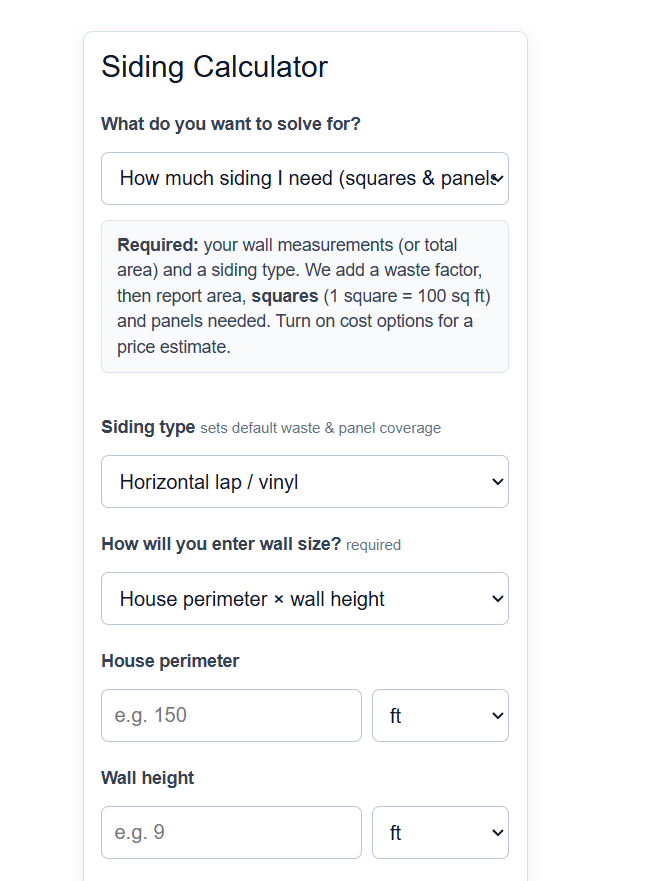
Calculate how much siding you need in squares and panels, plus total material and installation cost, for any wall layout including gables and openings.
Siding Formula
The calculator works in three modes. The core of all of them is finding the net wall area you have to cover, then adding waste.
Gross Area = (Perimeter * Height) + Gable Areas
Net Area = Gross Area - Openings
Total Siding = Net Area * (1 + Waste% / 100)
Squares = Total Siding / 100
Panels = Total Siding / Coverage per Panel
For the cost mode, the project cost adds the material price (priced per square foot, per square, or per panel) to any installation cost per square foot:
Project Cost = (Total Siding * Material Price) + (Net Area * Install Cost)
For the coverage mode, which tells you how far the siding you already own will reach, the calculator multiplies your amount by its coverage:
Area Covered = Amount * Coverage per Unit
The variables are:
- Perimeter: the distance around the outside of the house at the base of the walls.
- Height: the wall height from the foundation to the eave.
- Gable Areas: the triangular sections under a pitched roof, each equal to one half of base times height.
- Openings: the combined area of windows and doors you remove from the gross area.
- Waste%: the extra material added for cuts, overlap, and damaged pieces.
- Squares: the trade unit for siding, where one square covers 100 square feet.
- Coverage per Panel: the exposed area a single panel or box covers, used to turn area into a piece count.
You pick what to solve for at the top: the amount of siding you need, the project cost, or how much wall the siding you already have will cover. You can enter wall size three ways, by total area, by perimeter and height, or by adding up to four individual walls, and you can add gables and subtract openings before the waste factor is applied. Choosing a siding type sets a sensible default waste percentage and panel coverage, which you can override.
Waste Factors and Coverage by Siding Type
The waste factor depends on the siding style and how complex the walls are. These are the common starting points; raise them for homes with many corners, angles, or diagonal courses.
| Siding Type | Typical Waste | Notes |
|---|---|---|
| Horizontal lap / vinyl | 10% | Standard straight runs |
| Dutch lap | 10% | Similar to standard lap |
| Vertical / board & batten | 12% | More trim and cutting |
| Shake / shingle | 15% | High cut and matching loss |
| Complex layout (any type) | up to 20% | Many corners or diagonals |
To convert between units, remember that one square always equals 100 square feet.
| Wall Area | Squares |
|---|---|
| 1,000 sq ft | 10 |
| 1,500 sq ft | 15 |
| 2,000 sq ft | 20 |
| 2,500 sq ft | 25 |
Example Problems
Example 1. A house has a perimeter of 150 ft and a wall height of 9 ft, giving a gross area of 150 times 9, which is 1,350 sq ft. You subtract 120 sq ft of windows and doors for a net area of 1,230 sq ft. With vinyl siding at a 10% waste factor, the total siding needed is 1,230 times 1.10, which is 1,353 sq ft. Divided by 100, that is about 13.5 squares, so you would order 14 squares.
Example 2. You measure 2,000 sq ft of net wall area and plan to use shake siding at a 15% waste factor. The total siding needed is 2,000 times 1.15, which is 2,300 sq ft, or 23 squares. If the material price is $300 per square, the material cost is 23 times $300, which is $6,900, before any installation charge.
Frequently Asked Questions
What is a square of siding?
A square is the standard unit used to order and price siding. One square covers 100 square feet of wall. To find squares, divide your total siding area, including waste, by 100. Most products are sold and quoted in squares even when they ship in boxes of panels.
How much waste should I add?
Add about 10% for straight horizontal lap or vinyl, 12% for vertical and board and batten, and 15% for shake or shingle. Increase the figure toward 20% if the house has many corners, gables, dormers, or diagonal courses, since each cut and direction change creates offcuts you cannot reuse.
Should I subtract windows and doors?
Yes. Measure the total area of the openings and remove it from the gross wall area before applying the waste factor. The waste percentage already covers the small trimming losses around each opening, so you do not need to add the openings back in.