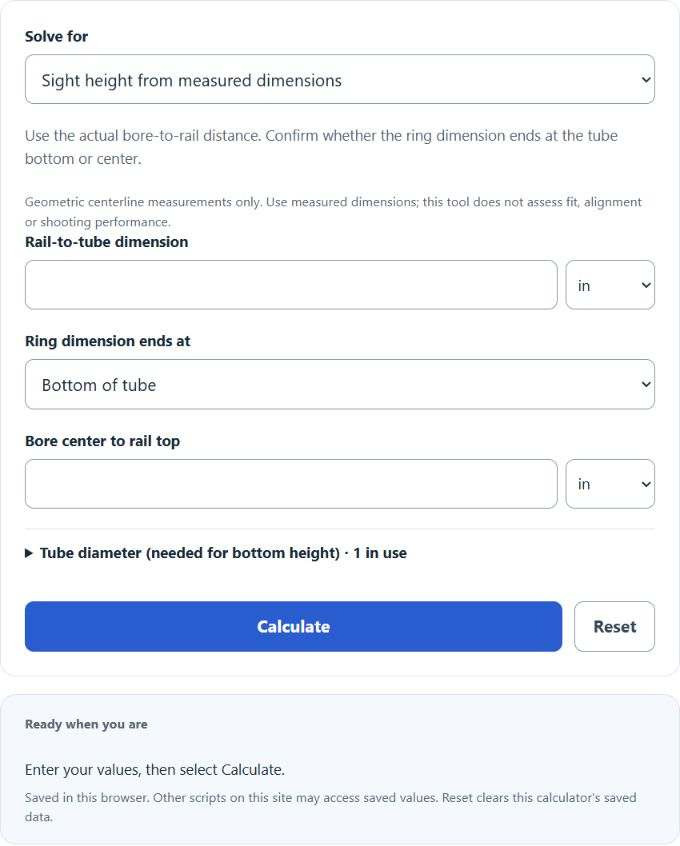
Calculate vertical sight height from measured ring and bore-to-rail dimensions, common-reference centerline heights, or a direct measurement in inches, mm, or cm.
Related Calculators
- Vertical Exaggeration Calculator
- Fall Per Foot Calculator
- Backoff Set Calculator
- Scallop Height Calculator
- All Construction Calculators
Sight Height Formula
Sight height is the vertical distance between the bore centerline and the optic’s line of sight. If both measurements are taken from the same reference plane, the calculator uses this relationship:
If you already know the sight height and need to solve for one of the other inputs, the same relationship can be rearranged as follows:
Variable Definitions
| Variable | Meaning | What to Measure |
|---|---|---|
| SH | Sight height | The final vertical distance from the bore centerline to the optic centerline. |
| LOS | Line of sight height | The vertical height of the optic centerline above a chosen reference plane. |
| OC | Bore centerline height | The vertical height of the bore centerline above that same reference plane. |
What Sight Height Tells You
Sight height describes the geometric offset between the sighting system and the bore. It is one of the core inputs used when modeling the relationship between the line of sight and the projectile path. If this value is off, other calculations that depend on it can also be off, even when the rest of the inputs are correct.
- It is a centerline measurement. Measure from the center of the optic to the center of the bore, not from outer edges.
- It is a vertical measurement. The value should represent straight up-and-down distance, not diagonal spacing.
- It depends on a common reference. If you use a table, bench, rail, or flat support surface as your reference, both heights must be measured from that same plane.
- Unit consistency matters. Inches, centimeters, and meters all work as long as every input uses the same unit.
How to Use the Calculator
- Measure the optic centerline height above a reference plane and enter it as LOS.
- Measure the bore centerline height above that same reference plane and enter it as OC.
- Select the quantity to solve for, then enter the displayed known measurements.
- Select the correct unit for each entry; the calculator converts them before calculation.
- Review the result to confirm it is reasonable for your setup.
In the reference-plane modes, enter LOS and OC to solve for SH, or select the inverse mode and enter SH with one known height. For ring dimensions, confirm the endpoint: add half the tube diameter only when the dimension ends at the tube bottom. Use an actual measured bore-to-rail distance rather than a model-name estimate.
Measurement Methods
Reference-Plane Method
This is the most reliable method when direct center-to-center measurement is difficult.
- Choose a flat, repeatable reference plane.
- Measure vertically from that plane to the optic centerline.
- Measure vertically from that same plane to the bore centerline.
- Subtract the bore-centerline height from the optic-centerline height.
Direct Center-to-Center Method
If you can directly determine the center of the optic and the center of the bore, that center-to-center distance is the sight height itself. In that case, no subtraction step is necessary.
Example Calculation
If the optic centerline is 2.50 inches above the reference plane and the bore centerline is 1.50 inches above that same plane, then the sight height is:
That result means the optic’s line of sight sits 1.00 inch above the bore centerline.
Common Input Errors
- Mixing units. Entering LOS in inches and OC in centimeters will produce the wrong result unless one value is converted first.
- Using different reference planes. The subtraction only works when both heights are measured from the same baseline.
- Measuring to the outside of the optic or barrel. Sight height is based on centerlines, not exterior diameters.
- Confusing mount height with sight height. A mount specification may not equal the actual centerline-to-centerline distance used in calculations.
- Reversing the inputs. In a typical setup, the optic centerline is above the bore centerline, so SH is usually a positive number.
Practical Interpretation of the Result
A larger sight height means there is a larger initial offset between the line of sight and the bore axis. A smaller sight height means those two lines start closer together. The calculator does not judge whether a setup is “good” or “bad”; it simply gives the correct geometric distance so you can use accurate inputs in other calculations or records.
Frequently Asked Questions
Is sight height the same as height over bore?
Yes. In this context, both terms refer to the same centerline-to-centerline vertical distance.
Can I use any reference plane?
Yes. The actual reference plane does not matter as long as both measurements are taken from that same plane.
What if I get a negative value?
A negative result usually means the inputs were reversed or the measurements were not taken from a common reference. Recheck LOS and OC before using the output.
What unit should I use?
Use whichever unit matches your measurement tools or the rest of your calculations. The key rule is consistency across all entries.