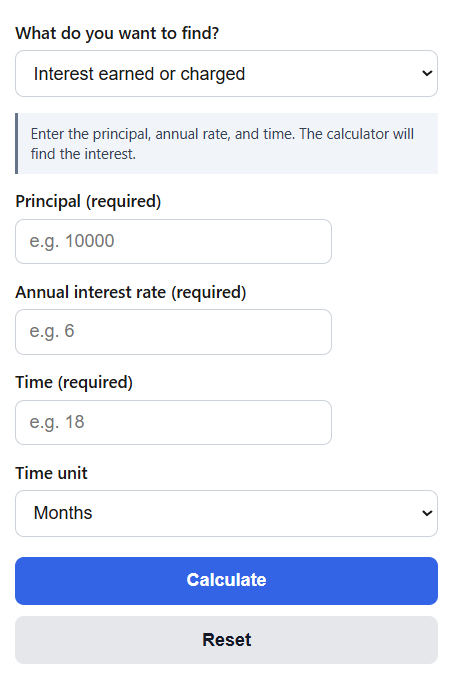
Use the Simple Interest Calculator to solve for interest, principal, annual rate, or time with years, months, and 360- or 365-day options.
Simple Interest Formula
Simple interest is calculated only on the original principal. It does not add prior interest to the balance before the next period is calculated. The basic formula is:
I = P * r * t
The same relationship can be rearranged to solve for any missing variable:
P = I / (r * t)
 r = I / (P * t)
 t = I / (P * r)
Variables:
- I is the simple interest earned or charged
- P is the original principal
- r is the annual interest rate written as a decimal
- t is time in years
Enter the three values you know and select the value you want to find. Rates entered as percentages are divided by 100 before the formula is applied. Months are divided by 12. Days are divided by either 365 or 360, depending on the selected day-count basis.
The total amount after simple interest is the original principal plus the calculated interest:
A = P + I
Simple Interest Reference Table
The table below shows one year of simple interest at several principal and rate combinations. These examples assume no compounding, deposits, withdrawals, or fees.
| Principal | Annual rate | Time | Interest | Total amount |
|---|---|---|---|---|
| $1,000 | 3% | 1 year | $30 | $1,030 |
| $5,000 | 4% | 1 year | $200 | $5,200 |
| $10,000 | 5% | 1 year | $500 | $10,500 |
| $25,000 | 6% | 18 months | $2,250 | $27,250 |
| $100,000 | 7% | 90 days, Actual/365 | $1,726.03 | $101,726.03 |
Simple interest is common in short-term notes, some auto loans, certain installment contracts, and basic interest estimates. Savings accounts and many investments usually compound instead, so their actual results may differ from this table.
Example Problems
Example 1: Find the interest on a loan.
A $12,000 principal carries a 6.5% simple annual rate for 9 months. Convert 6.5% to 0.065 and 9 months to 0.75 year:
I = $12,000 * 0.065 * 0.75 = $585. The total amount due before any fees is $12,585.
Example 2: Find the annual rate.
An account earns $450 of simple interest on a $15,000 principal over 18 months. Convert 18 months to 1.5 years and rearrange the formula:
r = $450 / ($15,000 * 1.5) = 0.02, or 2% per year.
Frequently Asked Questions
What is the difference between simple and compound interest?
Simple interest is calculated only on the original principal. Compound interest is calculated on the principal plus previously credited interest. The gap grows as the rate, balance, compounding frequency, and time increase.
Should I use 360 or 365 days?
Use the convention stated in the contract or account disclosure. Actual/365 divides the annual rate by 365. A 360-day convention divides by 360 and is common in some commercial and banking calculations. Using 360 generally produces slightly more interest for the same number of days.
Can simple interest be negative?
The formula can mathematically accept a negative rate, but most ordinary lending and savings calculations use a nonnegative stated rate. For investment gains and losses, an annualized-return calculation is often more informative than simple interest.