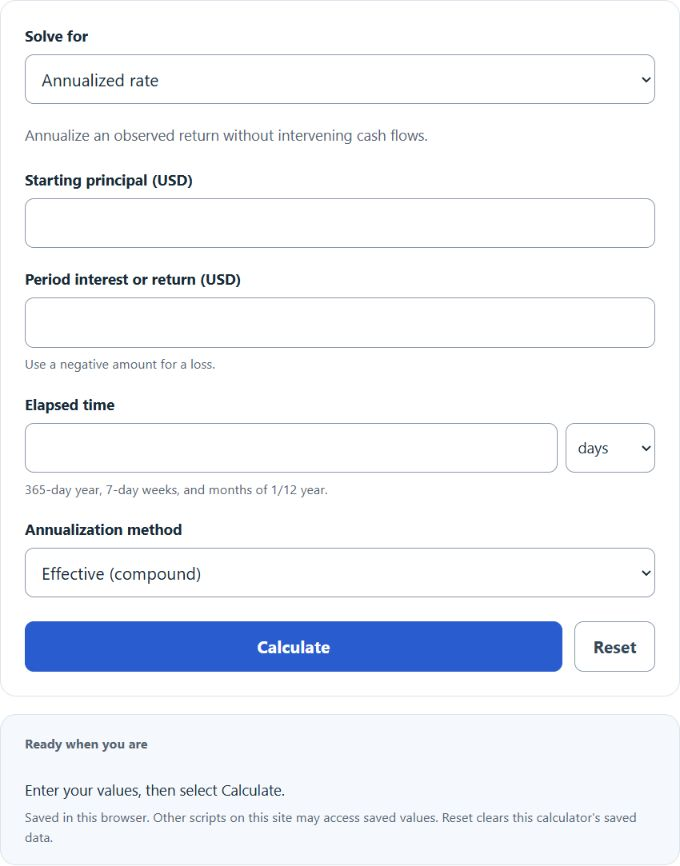
Use the Annualized Interest Rate Calculator to convert a return over days, weeks, months, or years into a simple or effective annual rate.
Annualized Interest Rate Formula
An annualized rate converts a return observed over part of a year into a one-year rate. The effective method assumes the observed growth compounds at the same pace:
Annualized Rate = (1 + I / P)^(1 / t) - 1
The simple method scales the period return in direct proportion to time:
Simple Annualized Rate = (I / P) / t
To find the interest amount from a known annualized rate, reverse the selected method:
Effective: I = P * ((1 + r)^t - 1)
 Simple: I = P * r * t
Variables:
- P is the starting principal
- I is the interest or return over the observed period
- t is elapsed time measured in years
- r is the annualized rate as a decimal
Days are divided by 365, weeks are multiplied by 7 and divided by 365, and months are divided by 12. Changing the time unit converts the entered quantity. The effective method is usually better when returns can compound. The simple method is useful for linear interest, quick comparisons, and conventions that do not reinvest interim returns.
Annualized Rate Reference Table
The following table annualizes a 2% observed return over different time spans. It shows how strongly the result depends on the assumption that a short-period return can be repeated.
| Observed period | Period return | Simple annualized rate | Effective annualized rate |
|---|---|---|---|
| 30 days | 2.00% | 24.33% | 27.24% |
| 90 days | 2.00% | 8.11% | 8.36% |
| 180 days | 2.00% | 4.06% | 4.10% |
| 365 days | 2.00% | 2.00% | 2.00% |
A very high annualized result from a short period does not mean the same return is likely to continue. Annualization standardizes the time scale; it does not forecast future performance.
Example Problems
Example 1: Annualize a 90-day return.
A $10,000 principal earns $250 in 90 days, a period return of 2.5%. Using 90 / 365 year, the effective annualized rate is (1.025)365/90 - 1 = about 10.53%. The simple annualized rate is 2.5% * 365 / 90 = about 10.14%.
Example 2: Find six-month interest from an annualized rate.
A $20,000 balance has a 6% effective annualized rate for six months. Interest is $20,000 * ((1.06)0.5 - 1) = about $591.26.
Frequently Asked Questions
Is annualized rate the same as APR?
Not always. An annualized rate is a mathematical conversion to a one-year scale. APR is a regulated or contractual measure that can follow specific fee and compounding rules. The terms may coincide in a simple case but should not be assumed identical.
Why are effective and simple annualized rates different?
The effective method compounds the observed return when projecting it to one year. The simple method multiplies the return by the number of equivalent periods. The difference is larger for high returns and short observation periods.
Can I annualize a loss?
Yes, provided the ending value remains positive for the effective method. Annualizing a short-term loss can produce a dramatic negative rate, so interpret it as a standardized comparison rather than a prediction.