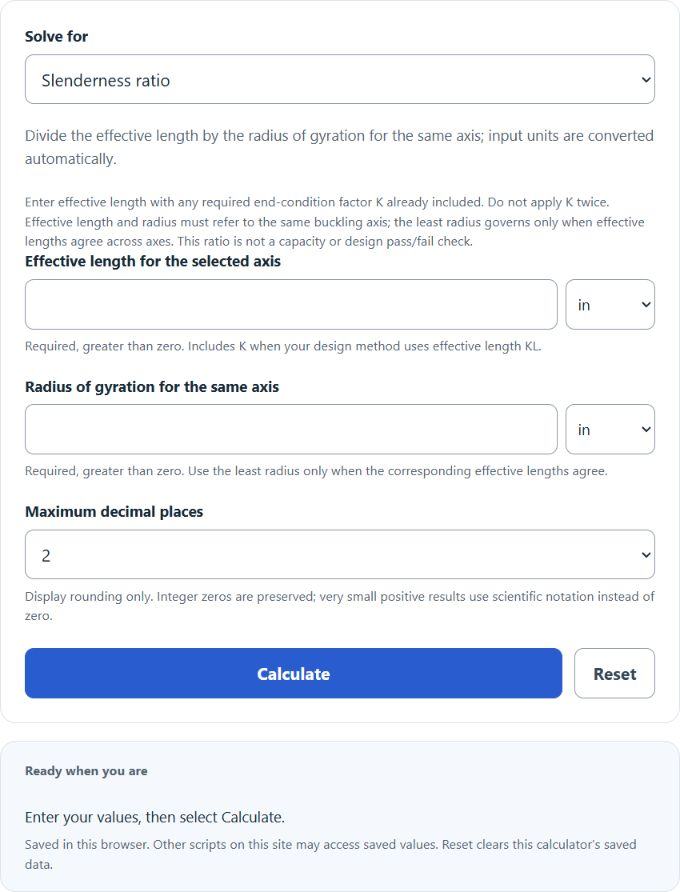
Select slenderness ratio, effective length, or radius of gyration as the output, then enter the two required source values. Input length units are converted automatically; inverse modes let you choose inches, feet, millimeters, centimeters, or meters for the result.
- All Construction Calculators
- All Ratio Calculators
- Bending Strength Ratio Calculator
- Yield Strength Calculator
- Maximum Force Calculator
- Radius of Gyration Calculator
Slenderness Ratio Formula
The slenderness ratio measures how long a member is relative to the way its area is distributed about its centroid. In structural and mechanical design, it is commonly used to judge whether a compression member behaves like a short, stocky member or a long, buckle-prone member.
This same relationship is often written with the symbol λ and radius of gyration r.
| Variable | Description | Typical Unit |
|---|---|---|
| SLNR | Slenderness ratio | Unitless |
| L | Effective length for the selected axis, including K when the design expression is KL/r | in, ft, mm, cm, m |
| RG | Radius of gyration of the cross-section about that same axis | in, ft, mm, cm, m |
The ratio describes effective length relative to the selected-axis radius of gyration. Other conditions being comparable, a larger ratio represents a more slender member. The ratio itself is not a stiffness, strength or capacity value, and this calculator supplies no pass/fail limit.
How to Calculate Slenderness Ratio
- Select the output task. For ratio or inverse-radius calculations, determine the effective length for the axis being checked; include K already if your method requires KL/r.
- Determine the radius of gyration about that same axis. The least radius alone governs only when the corresponding effective lengths agree.
- Choose the unit for each length input; the calculator converts the quantities to a common unit. In an inverse mode, also choose the result length unit.
- Divide effective length by radius for the dimensionless ratio. Inverse effective length is ratio × radius; inverse radius is effective length ÷ ratio. Choose 0–6 maximum decimal places for displayed answers only.
After converting both lengths to a common unit, their units cancel and the ratio is dimensionless.
What Radius of Gyration Means
Radius of gyration describes how far the area of a cross-section is distributed from its centroidal axis. A larger radius of gyration usually means better resistance to buckling for the same area.
Where I is the second moment of area about the selected axis and A is the cross-sectional area. For equal effective lengths, a larger radius about the axis gives a lower ratio.
Using Effective Length Instead of Actual Length
In many design methods, compression members are checked using an effective length rather than the raw physical length. That is commonly expressed as:
Here, K is the effective length factor used by the applicable design method for end restraint and bracing. Enter the already-combined K × L as effective length and the corresponding axis radius. The calculator does not select K or multiply it again. Inverse effective-length mode returns KL, not physical length L.
How to Interpret the Result
- Small ratio: the member is relatively stocky and less sensitive to buckling.
- Large ratio: the member is relatively slender and more sensitive to instability.
- Same material, same area, longer length: higher slenderness ratio.
- Same length, larger radius of gyration: lower slenderness ratio.
For design work, the acceptable limit depends on the material, end conditions, bracing, load type, and the design standard being used.
Example Calculations
If effective length for the selected axis is 500 in and its radius of gyration is 30 in:
If effective length for the selected axis is 600 in and its radius of gyration is 10 in:
The second member is much more slender because the length is large relative to its radius of gyration.
Common Mistakes
- Mixing units: using feet for length and inches for radius of gyration without converting first.
- Using the wrong length: entering actual length when the design check requires effective or unbraced length.
- Confusing radius with radius of gyration: these are not the same property.
- Treating the ratio as a direct capacity value: slenderness ratio is an indicator, not the complete design check.
Practical Notes
- Pair effective length and radius of gyration for the same buckling axis, and check all relevant axes.
- The least radius gives the largest ratio only when the corresponding effective lengths are equal. If effective lengths differ, compare each effective-length/radius pair.
- If bracing changes along the member, the relevant unbraced segment may govern rather than the full physical length.
- The calculator is best for quick geometry-based comparisons between members or for preparing inputs to a larger design process.
Frequently Asked Questions
Is slenderness ratio unitless?
Yes. The calculator converts each length input to a common unit before dividing, so the units cancel. For example, 50 ft divided by 10 in gives the same ratio of 60 as 600 in divided by 10 in.
Why does a larger radius of gyration reduce slenderness?
A larger radius of gyration means the cross-sectional area is distributed farther from the centroidal axis, which improves resistance to buckling and lowers the ratio.
Can this calculator be used for steel, wood, aluminum, or other materials?
Yes. The geometric ratio can be calculated for any material, but the allowable limits and design implications depend on the material and design code.
What if I only know area and moment of inertia?
First compute the radius of gyration using the relationship between I and A, then use that value in the slenderness ratio formula.