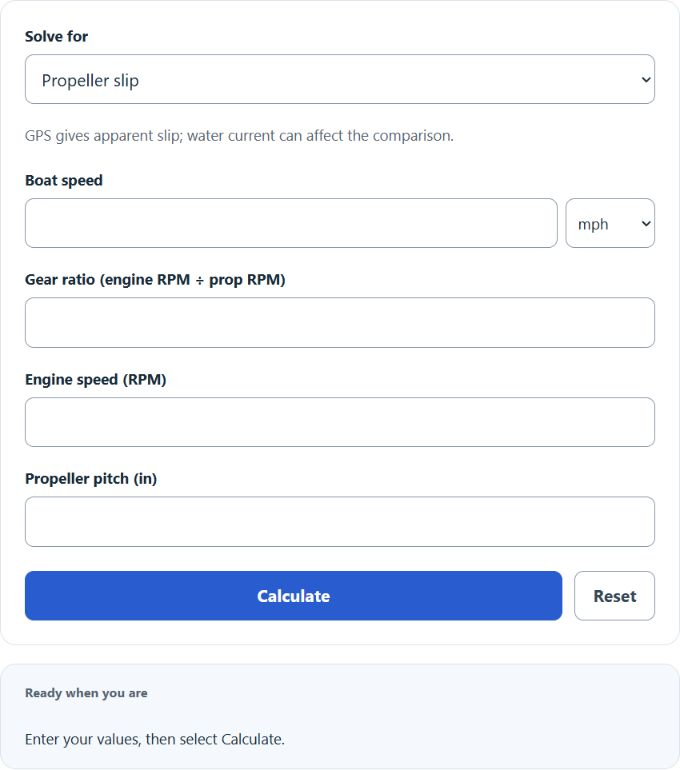
Calculate propeller slip, estimate propeller pitch, or determine motor slip from GPS speed, gear ratio, RPM, frequency, and poles.
Related Calculators
- Relative Velocity Calculator
- Linear Speed Calculator
- Displacement to Velocity Calculator
- Tangential Velocity Calculator
- All Physics Calculators
Slip Rate Formula
This calculator runs three modes. Each mode uses a different formula.
Prop Slip mode:
- Slip % = propeller slip, percent
- Vt = theoretical no-slip speed, MPH
- Va = actual GPS speed, MPH
- RPM = engine RPM
- Pitch = propeller pitch, inches
- Gear = drive gear ratio (engine RPM divided by prop RPM)
- 1056 = unit constant that converts inches per minute to miles per hour
The constant 1056 comes from 63360 inches per mile divided by 60 minutes per hour. The formula assumes a fixed-pitch propeller, steady-state speed, and a GPS speed measured over ground. Speeds in KPH or knots are converted to MPH before the calculation.
Desired Pitch mode:
- Pitch = required propeller pitch, inches
- V = target GPS speed, MPH
- RPM = target engine RPM at WOT
- Gear = drive gear ratio
- Slip = expected slip, percent
This rearranges the prop-slip formula to solve for pitch given an assumed slip. The unrounded estimate is shown with arithmetic half-inch and whole-inch comparisons. These comparisons do not establish available sizes or a suitable propeller. The 5–20% slip sensitivity interval is an assumption, not a specification.
Motor Slip mode:
- Ns = synchronous speed, RPM
- Nr = measured rotor speed, RPM
- f = supply frequency, Hz
- P = number of stator poles
This applies to AC induction motors. In normal motoring operation the rotor turns below synchronous speed. A same-direction rotor driven above synchronous speed has negative slip and can operate in the generating region. Rotor current frequency magnitude equals supply frequency times the absolute fractional slip.
Reference Tables
The boat and full-load RPM ranges below are illustrative comparisons, not manufacturer specifications or diagnostic thresholds. Use measured data and the equipment manufacturer’s ratings. The synchronous-speed columns follow Ns = 120f/P exactly.
| Boat Setup | Illustrative Slip Range |
|---|---|
| Bass boat, light load, well-tuned | 7 to 10% |
| Performance V-bottom | 8 to 12% |
| Runabout or bowrider | 10 to 15% |
| Pontoon | 12 to 18% |
| Heavy cruiser or loaded boat | 15 to 25% |
| Displacement hull | 25 to 40% |
| Poles | Sync RPM at 60 Hz | Sync RPM at 50 Hz | Illustrative Full-Load RPM (60 Hz) |
|---|---|---|---|
| 2 | 3600 | 3000 | 3450 to 3550 |
| 4 | 1800 | 1500 | 1725 to 1760 |
| 6 | 1200 | 1000 | 1140 to 1175 |
| 8 | 900 | 750 | 850 to 880 |
| 10 | 720 | 600 | 680 to 705 |
| 12 | 600 | 500 | 560 to 585 |
Worked Examples and Notes
Example 1: prop slip. A boat runs 68 MPH on GPS at 6000 RPM through a 1.75:1 lower with a 24-inch prop. Theoretical speed is 6000 × 24 / (1.75 × 1056) = 77.92 MPH. Slip is (77.92 – 68) / 77.92 × 100 = 12.7%. This is an apparent slip calculation, not a propeller efficiency or condition rating.
Example 2: pitch selection. You want 75 MPH at 6000 RPM with a 1.75:1 gear and assume 12% slip. Pitch = 75 × 1.75 × 1056 / 6000 / 0.88 = 26.25 inches. Whole-inch rounding gives 26 inches; suitability and available sizes require manufacturer confirmation.
Example 3: motor slip. A 4-pole motor on 60 Hz spins at 1750 RPM under load. Sync speed is 120 × 60 / 4 = 1800 RPM. Slip = (1800 – 1750) / 1800 × 100 = 2.78%. Rotor current frequency is 60 × 0.0278 = 1.67 Hz.
What slip means. Slip is a relative speed comparison, not a direct efficiency measure. In steady induction motoring, nonzero slip is needed for induced rotor current and torque. Apparent propeller slip based on GPS also reflects water current, effective pitch and measurement accuracy, so a zero or negative computed value is not a thrust measurement.
If your prop slip looks wrong. Verify gear ratio, pitch, RPM and speed measurements and account for current. An unusual value alone cannot identify a propeller or setup fault. Mercury explains why slip is distinct from propeller efficiency.
If your motor slip looks wrong. Compare the result with nameplate operating conditions and measured load. Slip alone does not diagnose voltage, wear or overload. Negative slip is retained when the rotor exceeds synchronous speed; the reported rotor frequency remains a nonnegative magnitude.