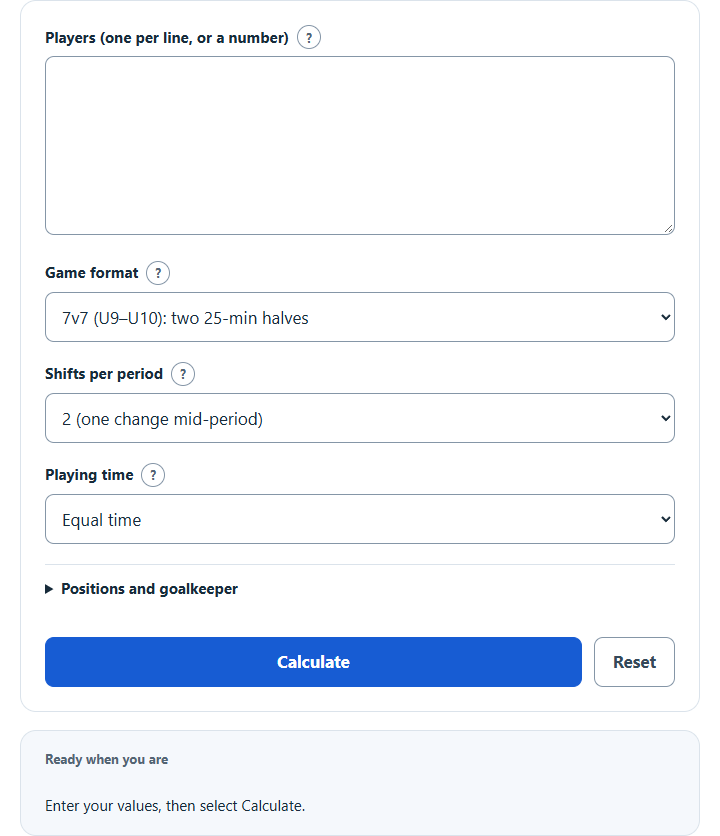
Generate a soccer rotation from your roster: a lineup for every shift with goalkeeper, positions and bench, plus each player’s minutes.
- All Soccer Calculators
- Game Time Calculator
- Playing Time Calculator
- Soccer Ball Size by Age Calculator
- Soccer League Points Calculator
- Goals Per Game Calculator
Calculator Functions
The generator turns a roster into a lineup for every shift of a soccer game: who is in goal, who plays in each line of the formation and who sits out, followed by each player's minutes. A shift is the stretch of play between planned substitutions.
| Function | Use it when | You enter |
|---|---|---|
| Equal time | Every player should get about the same minutes | Players, game format and shifts per period |
| Half-game minimum, starters play more | Your first-choice players stay on longer, but everyone plays at least half the game | The same, with the players listed from most to least playing time |
| Positions and goalkeeper | You want a set formation, a goalkeeper plan or players kept in one line | Formation, goalkeeper plan and field positions, plus a position tag after any name |
| Custom format | Your league plays a different team size or game length | Players on the field, number of periods and minutes per period |
Type a number instead of names to plan with Player 1, Player 2 and so on. Add (GK), (D), (M) or (F) after a name to keep that player in goal, defense, midfield or forward. For a quick count of equal minutes per player in any sport, use the Game Time Calculator.
Soccer Rotation Formulas
L = M ÷ C
A = F × N ÷ R
| N | Shifts in the game |
| P | Periods: 2 halves or 4 quarters |
| C | Shifts per period |
| L | Length of one shift, minutes |
| M | Minutes in one period |
| A | Average shifts each player is on the field |
| F | Players on the field, goalkeeper included |
| R | Players on the roster |
A 7v7 game of two 25-minute halves with one change midway through each half has 2 × 2 = 4 shifts of 25 ÷ 2 = 12.5 minutes, or 12:30. With 10 players, the average is 7 × 4 ÷ 10 = 2.8 shifts each. Shifts can't be split, so eight players get 3 shifts (37:30) and two get 2 shifts (25:00). With Equal time, the extra shifts go to the players nearest the top of your list.
How the lineups are built
For each shift, the generator fills the goal first and then gives the field spots to the players who still have the most shifts left to play. Ties go to whoever has waited on the bench longest, which spreads bench turns through the game. Players tagged (GK) share the goal in list order; with no tags, the first players on the list take the goalkeeper turns, changing each period, each shift or not at all.
Formations are written from defense to attack without the goalkeeper, so 2-3-1 is two defenders, three midfielders and one forward. The shapes in the list are common ones for each format, and a custom formation works as long as its numbers add up to the field players. Rotate players through the lines sends each player to the line they have played least. Keep each player in one line leaves a player where they first played, and a (D), (M) or (F) tag holds a player in that line whenever it has room.
Half-game minimum
U.S. Soccer's standards for 7v7 and 9v9 say every player should play at least 50% of each game [1]. With Half-game minimum, starters play more, each player first gets half the shifts, rounded up when the number of shifts is odd. The shifts left over go down your list, with each player in turn taking as many as a full game allows. In the 7v7 game above, ten players get 2 shifts each, which uses 20 of the 28 player-shifts, and the remaining 8 let the first four players stay on for all 4.
A roster of more than twice the players on the field can't give everyone half the game. The plan then shares the time equally and says so.
Game formats
| Format | Age group | On the field | Game length |
|---|---|---|---|
| 4v4 | U6 to U8 | 4, no goalkeeper | Four 10-minute quarters |
| 7v7 | U9 to U10 | 6 and a goalkeeper | Two 25-minute halves |
| 9v9 | U11 to U12 | 8 and a goalkeeper | Two 30-minute halves |
| 11v11 | U13 to U14 | 10 and a goalkeeper | Two 35-minute halves |
| 11v11 | U15 to U16 | 10 and a goalkeeper | Two 40-minute halves |
| 11v11 | U17 and older | 10 and a goalkeeper | Two 45-minute halves |
The full game under the Laws of the Game is eleven players a side, one of them the goalkeeper [3], over two 45-minute halves [4]. Leagues and tournaments often shorten games or change team sizes, so check yours and use Custom format when it differs.
Limits of This Estimate
- The plan assumes every listed player is there for the whole game. If someone is late, hurt or sent off, run it again with the players you have.
- Shifts divide each period evenly by the clock. Where substitutions wait for a stoppage in play [1], the change comes a little early or late and real minutes shift with it.
- Bringing a player back on after a substitution is allowed in youth, veterans, disability and grassroots soccer where the national association agrees [3]. Most adult competitions limit substitutions and don't allow it, so a rotation like this won't fit their rules.
- The generator balances minutes and positions only. It doesn't weigh skill, fitness or matchups, so reorder the list or add position tags to steer it.
Sources
- U.S. Soccer, Player Development Initiatives (small-sided game standards): the 4v4, 7v7 and 9v9 team sizes and game lengths, the 50% playing-time minimum and substitutions at stoppages
- Cal South, U.S. Soccer Player Development Initiatives chart, 2024-2025: 11v11 game lengths for 13U to 14U, 15U to 16U and 17U to 19U
- The IFAB, Laws of the Game, Law 3: The Players: eleven players a side including the goalkeeper, and where return substitutions are allowed
- The IFAB, Laws of the Game, Law 7: The Duration of the Match: two 45-minute halves