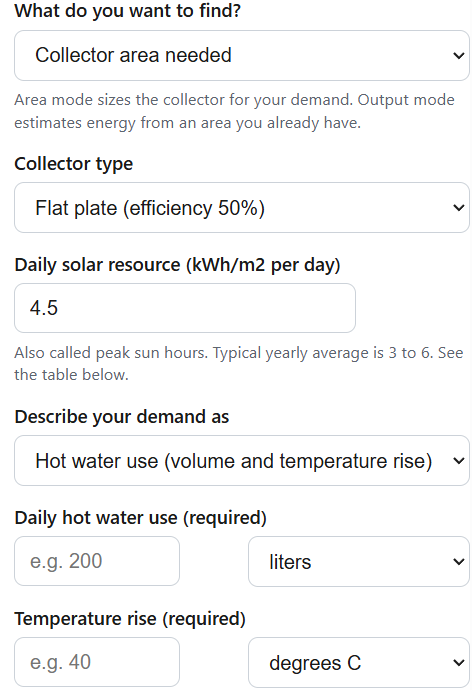
Calculate the solar thermal collector area in square meters needed to meet your hot water demand from your daily use, local sun hours, and collector efficiency.
- All Everyday Life & Education Calculators
- Solar Lease Calculator
- Solar Battery Bank Size Calculator
- Solar Panel Series and Parallel Array Calculator
Solar Thermal Collector Area Formula
The collector area needed is the solar share of your energy demand divided by how much energy one square meter of collector gathers in a day:
A = (SF * Q) / (H * E)
When you describe the demand as hot water, the daily energy demand comes from the volume and the temperature rise:
Q = V * dT * 0.001163
In output mode the tool works the other way, estimating the daily energy a fixed area delivers:
Q_out = A * H * E
Variables:
- A is the collector area, in square meters
- SF is the target solar fraction as a decimal (70% is 0.70), the share of yearly demand you want solar to cover
- Q is the daily thermal energy demand, in kWh per day
- H is the daily solar resource on the collector, in kWh per square meter per day, numerically the same as peak sun hours
- E is the system efficiency as a decimal (50% is 0.50), covering the collector plus tank and pipe losses
- V is the daily hot water volume, in liters
- dT is the temperature rise, the hot target minus the cold supply, in degrees C
- 0.001163 is the energy in kWh needed to heat one liter of water by one degree C
- Q_out is the daily energy a set area delivers, in kWh per day
Pick a mode at the top. In area mode you enter your demand and the tool returns the square meters of collector required. In output mode you enter an area you already have and it returns the daily and yearly energy that area should produce. The collector type sets the efficiency for you, with flat plate lower and evacuated tube higher, or you can switch to Custom and type your own value from a test report. The solar fraction controls how much of the demand solar should carry, since sizing for 100% would leave a large summer surplus. Turn on More options to enter the area of a single panel and see how many panels the total works out to, and to add an oversize margin for pipe and tank losses. Every area result also suggests a storage tank volume, which the crude area formulas on most competing pages leave out.
Solar Resource and Collector Efficiency Reference
The area you need depends almost entirely on two inputs: how much sun reaches the collector and how efficiently the collector turns that sun into heat. Use the first table to pick a daily solar resource for your climate, and the second to pick an efficiency and sanity check the area against a per person rule of thumb.
| Climate | Example regions | Daily solar resource (kWh/m2/day) |
|---|---|---|
| Cloudy maritime | UK, Pacific Northwest | 2.5 to 3.0 |
| Cool temperate | Northern US, Central Europe | 3.5 to 4.0 |
| Warm temperate | Southern US, Mediterranean | 4.5 to 5.5 |
| Sunny arid | US Southwest, North Africa | 5.5 to 6.5 |
| Collector type | Typical system efficiency | Rough area per person* |
|---|---|---|
| Flat plate (glazed) | 45 to 55% | 1.0 to 1.5 m2 |
| Evacuated tube | 60 to 75% | 0.8 to 1.2 m2 |
| Unglazed (pool) | 80 to 90% | Sized to pool surface, not people |
*For domestic hot water at about a 70% solar fraction in a temperate climate. Unglazed collectors reach high efficiency only because they run near air temperature, which suits pools but not hot water.
Example Problems
Example 1: Size a collector for a household.
A family uses 200 liters of hot water a day and heats it by 40 degrees C. Using flat plate collectors at 50% efficiency, a solar resource of 4.5 kWh/m2/day, and a 70% solar fraction, first find the demand: Q = 200 * 40 * 0.001163 = 9.30 kWh per day. Then the area: A = (0.70 * 9.30) / (4.5 * 0.50) = 2.89 m2, or about 31 square feet.
Example 2: Find the output of a set area.
You already have 4 m2 of evacuated tube collector at 65% efficiency in a spot that gets 5.0 kWh/m2/day. The daily output is Q_out = 4 * 5.0 * 0.65 = 13.0 kWh per day, which is about 4,745 kWh over a full year before seasonal losses.
Frequently Asked Questions
How much collector area do I need per person?
As a rough guide, plan for about 1 square meter of flat plate collector per person to cover roughly 70% of hot water demand in a temperate climate. Evacuated tubes need a little less area for the same output, and sunnier regions need 10 to 20% less while cloudy regions need more. Use the calculator with your real water use and local sun figure for a tighter number.
What efficiency value should I enter?
If you do not have a data sheet, use the presets: about 50% for a glazed flat plate system and about 65% for evacuated tubes, both measured after tank and pipe losses. If you have a certified rating, such as an SRCC number, switch to Custom and enter that value as a percent. Higher efficiency lowers the area you need for the same demand.
Should I size the collector to cover 100% of my demand?
Usually not. Sizing for a full year at 100% means the collector is far too large in summer, when it overheats and wastes heat, and only just enough in winter. Most systems target a 50 to 70% annual solar fraction so the collector runs efficiently most of the year, with a backup heater covering the rest. That is why the solar fraction is an input rather than a fixed 100%.