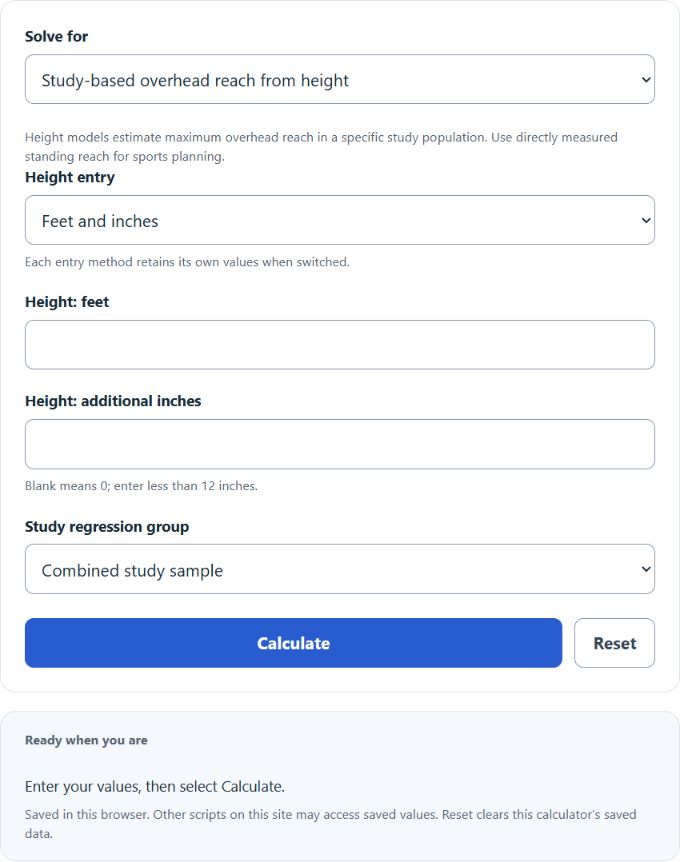
Estimate study-based maximum overhead reach from height, or use measured standing reach to calculate maximum fingertip reach and the vertical rise needed for a target. Touching a target does not guarantee a dunk.
Standing Reach Formula
The following study regressions estimate maximum overhead reach (SR) from height (H), with both in centimeters. They are not established basketball standing-reach predictions; use directly measured, feet-flat reach for sports planning.
| Sex | Equation (cm) |
|---|---|
| Male | SR = 1.40 x H + 11.22 |
| Female | SR = 1.22 x H + 33.34 |
| Combined study sample | SR = 1.46 x H + 0.02 |
Where SR = estimated maximum overhead reach in cm and H = height in cm. Sikary et al. (2019) reported these equations for North Indian adults aged 21–30. Their applicability to children, other populations or basketball measurement protocols is not established. The calculator converts units internally; the pooled equation is not the arithmetic average of the two sex-specific equations.
Standing Reach by Height Reference Table
The table illustrates the combined study equation, using exact inch-to-centimeter conversion before rounding. Values outside the study population are arithmetic illustrations, not validated personal predictions. Select a study group in the calculator for its corresponding regression.
| Height | Height (cm) | Est. Maximum Overhead Reach | Reach-to-Height Ratio |
|---|---|---|---|
| 5'0" (60 in) | 152.4 | 222.5 cm / 7'3.6" | 1.46 |
| 5'4" (64 in) | 162.6 | 237.4 cm / 7'9.4" | 1.46 |
| 5'6" (66 in) | 167.6 | 244.8 cm / 8'0.4" | 1.46 |
| 5'8" (68 in) | 172.7 | 252.2 cm / 8'3.3" | 1.46 |
| 5'10" (70 in) | 177.8 | 259.6 cm / 8'6.2" | 1.46 |
| 6'0" (72 in) | 182.9 | 267.0 cm / 8'9.1" | 1.46 |
| 6'2" (74 in) | 188.0 | 274.4 cm / 9'0.0" | 1.46 |
| 6'4" (76 in) | 193.0 | 281.9 cm / 9'3.0" | 1.46 |
| 6'6" (78 in) | 198.1 | 289.3 cm / 9'5.9" | 1.46 |
| 6'8" (80 in) | 203.2 | 296.7 cm / 9'8.8" | 1.46 |
| 6'10" (82 in) | 208.3 | 304.1 cm / 9'11.7" | 1.46 |
Reach-to-Height Ratio
The reach-to-height ratio is reach divided by height, using matching units. Ratios depend on measurement protocol, arm proportions and shoulder mobility. A height-only regression cannot determine an individual athlete's measured standing reach.
The combined study regression produces a ratio close to 1.46. Its outcome is maximum overhead reach in the study population; the accessible primary report does not establish equivalence to flat-foot basketball standing reach. Do not treat this model as an NBA norm.
How to Measure Standing Reach
To measure standing reach directly rather than estimating from height:
- Stand sideways next to a wall with feet flat on the floor, shoulder-width apart.
- Extend the arm closest to the wall straight overhead as high as possible. Keep the shoulder pressed down and the opposite arm at your side.
- Mark the wall at the highest point your fingertips touch (chalk or tape works well).
- Measure the vertical distance from the floor to the mark. That distance is your standing reach.
Common sources of measurement error include rising onto the toes, tilting the torso, or not fully extending the fingers. The NBA Draft Combine uses a standardized protocol with a Vertec device to ensure consistency.
Factors That Affect Standing Reach
Height is the strongest predictor, but several other variables cause individual standing reach to deviate from regression estimates:
| Factor | Effect on Standing Reach |
|---|---|
| Arm length relative to torso | Longer arms increase reach beyond what height alone predicts. Two people at the same height can differ by 3 to 5 inches in reach. |
| Shoulder width and position | Broader, higher-set shoulders raise the starting point of the arm, adding to overhead reach. |
| Hand and finger length | Longer fingers add directly to the measured value. NBA combine records include hand measurements for this reason. |
| Shoulder and thoracic mobility | Greater overhead flexibility allows fuller arm extension. Tight shoulders can reduce measured reach by 1 to 2 inches. |
| Sex | Males tend to have proportionally longer arms and broader shoulders relative to height, producing a higher reach-to-height ratio on average. |
Standing Reach in Basketball
Standing reach is one of the core anthropometric measurements recorded at the NBA Draft Combine each year. It matters because a longer standing reach at the same height means a player can contest shots, finish at the rim, and rebound more effectively without needing as much vertical leap.
| NBA Combine Record / Benchmark | Value |
|---|---|
| Tacko Fall, 2019 combine standing reach | 10 ft 2.5 in (Tacko Fall, 2019) |
| Typical NBA center standing reach | ~9 ft 0 in to 9 ft 6 in |
| Typical NBA point guard standing reach | ~8 ft 0 in to 8 ft 4 in |
| Median combine reach-to-height ratio | 1.335 |
Scouts compare a player's actual standing reach against the expected value for their height and position. A player who exceeds expectations, like a 6'4" guard with an 8'9" reach, is considered to play bigger than their listed height. A below-average ratio can flag a player as undersized for their position despite adequate height.
Standing Reach in Volleyball
Volleyball uses three related reach measurements, each building on the previous one:
| Measurement | Description | Typical HS Range |
|---|---|---|
| Standing reach | Both arms overhead, feet flat on floor (blocking stance) | ~7 ft 0 in |
| Block jump reach | Two-foot jump from blocking stance, both arms up | ~8 ft 6 in |
| Spike approach reach | Full approach jump, one arm extended at peak | ~9 ft 0 in+ |
For middle blockers, standing reach is particularly important because it determines how much of the net they cover before they even leave the ground. A middle blocker at 6'0" with a 7'6" standing reach already has their hands above the standard 7'4" women's net height while flat-footed, giving them a timing advantage on quick sets.
Standing Reach vs. Wingspan
Standing reach and wingspan are related but measure different things. Wingspan (arm span) is the horizontal distance from fingertip to fingertip with both arms extended to the sides. Standing reach is the vertical distance from the floor to the fingertips with one arm extended overhead. A person with a 6'6" wingspan does not necessarily have a proportionally high standing reach because reach also depends on shoulder height, torso length, and overhead mobility. In the NBA combine dataset, wingspan and standing reach correlate strongly (r > 0.90), but individual deviations of 2 to 4 inches from the expected value are common.
Example Calculation
A male athlete measures 180 cm (5'11") tall. Using the male equation:
SR = 1.40 x 180 + 11.22 = 263.22 cm (103.6 in, or about 8'7.6")
This gives a reach-to-height ratio of 263.22 / 180 = 1.46, consistent with the regression model. If this athlete's measured standing reach were 258 cm (about 8'5.6"), use that measurement for jump planning. A difference from this study estimate does not diagnose arm proportions or mobility, especially when protocols differ.