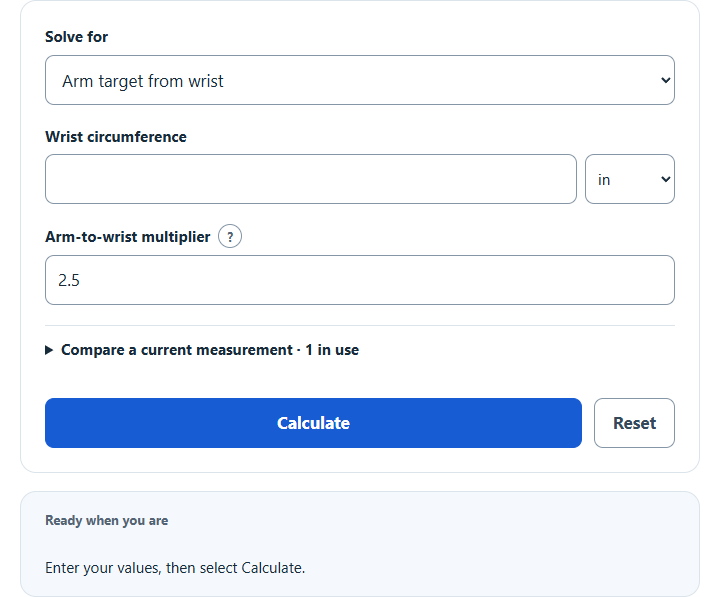
Estimate your maximum bicep (upper-arm) size from wrist circumference using a 2.5× wrist ratio, or find your own arm-to-wrist ratio, in inches or cm.
Maximum Bicep Size Formula
This calculator uses a transparent arm-to-wrist proportion model. It multiplies wrist circumference by the user-selected multiplier to estimate a flexed upper-arm circumference. The default multiplier of 2.5 is a disclosed illustrative proportion, not a validated maximum. The calculator preserves the earlier 2.3×, 2.5× and 2.8× scenarios as arithmetic examples rather than a biological or population range.
Estimated arm circumference = wrist circumference × selected multiplier
The inverse modes rearrange that same equation. Implied wrist circumference equals target arm circumference divided by the multiplier. The observed arm-to-wrist ratio equals measured arm circumference divided by wrist circumference. A current-to-target percentage compares circumferences and is not progress toward a genetic limit.
| Multiplier | Estimated arm | How to read it |
|---|---|---|
| 2.3 | 16.1 in | Illustrative chosen ratio; not a biological lower limit |
| 2.5 | 17.5 in | Illustrative default proportional rule |
| 2.8 | 19.6 in | Illustrative chosen ratio; not a biological upper limit |
How to Measure Consistently
Measure the wrist at the same narrow point each time. For the upper arm, select one condition—flexed and unpumped, relaxed and unpumped, or flexed and pumped—and use that condition for every comparison. Each measurement has its own unit control. Inches, centimeters, and millimeters convert exactly; changing a unit converts the entered quantity. The optional current measurement may be left blank to omit the comparison.
What the Result Does and Does Not Mean
The output is an aesthetic proportion estimate, not a prediction of genetic potential, a biceps-only measurement, or a health standard. Total upper-arm circumference includes muscle, fat, bone, skin, and other tissue. Training history, body-fat level, measurement technique, hydration, pump, and anatomy can shift the observed circumference independently of wrist size.
Use the result to compare consistent measurements or explore a ratio you chose. Do not treat a gap to the estimate as a requirement to gain or lose tissue, and do not use it to set a rapid weight-change target.
Relaxed Arm Circumference Reference
For an adult circumference chart, choose Relaxed arm reference. Enter a relaxed right mid-upper-arm measurement in centimeters or inches and select the published sex and age group. The result shows a percentile band and a table of reference circumferences. It uses NCHS NHANES data for the United States, August 2021–August 2023, Table 16, published in June 2025. Female reference data exclude pregnant participants.
Measure at the midpoint between the shoulder and elbow with the right arm hanging loosely. Keep the tape level and snug without compressing the skin. These population measurements are different from a flexed bicep measurement; there is no conversion between them. The chart does not measure muscle alone or estimate a maximum arm size.
The comparison finds the two published percentile thresholds surrounding the entered circumference. It does not interpolate an exact percentile or extrapolate beyond the 5th and 95th percentiles. A measurement matching a published threshold is labeled approximately, since the source values are rounded. The median is the 50th percentile, not a training target, an ideal size or a health cutoff.