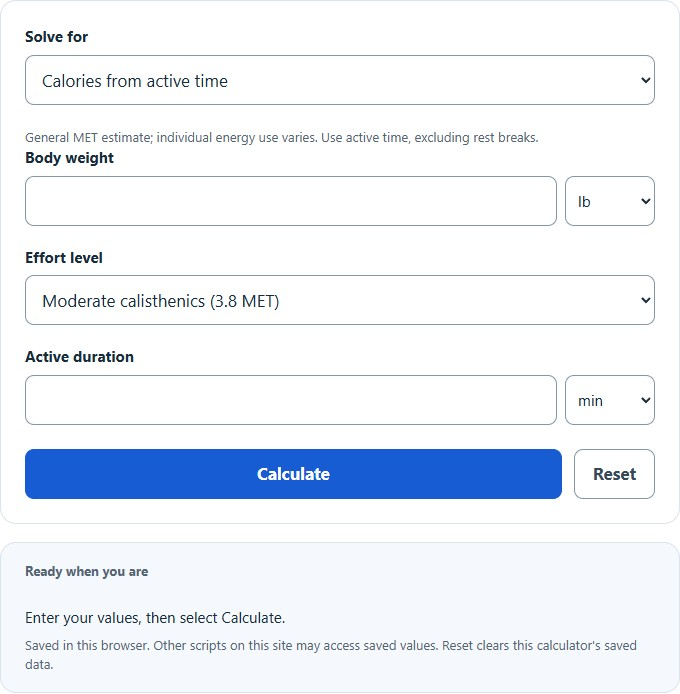
Estimate calories burned doing pull-ups from body weight, effort level, and active time or repetitions and cadence, or calculate time for a calorie target.
Pull Up Calories Formula
This is an estimate of gross energy during active exercise, including the resting component. The 2024 Adult Compendium lists 3.8 MET for moderate calisthenics and 7.5 MET for vigorous calisthenics, including pull-ups. Individual energy use varies; these values do not measure a specific person’s expenditure.
Variables:
- EstimatedCalories = estimated gross energy in kilocalories (kcal)
- MET = selected general effort estimate, or your custom MET value
- bodyMasskg = body weight converted to kilograms
- activeMinutes = active duration, or repetitions divided by active cadence in repetitions per minute; exclude rest breaks
How to Calculate Pull-Up Calories
- Enter your body weight and select pounds or kilograms.
- Choose an effort estimate and either active time or repetitions with active cadence.
- For a calorie target, choose the active-time solve mode and enter the target energy. Added weight and assistance are outside this estimate.
- Select Calculate for the estimate. After changing inputs, calculate again to update it.
Example: With the moderate 3.8 MET estimate, 180 lb (81.6466 kg) and 20 pull-ups at an active cadence of 10 repetitions/minute give 2 active minutes and approximately 10.859 kcal. This is an estimate, not a universal calorie value per pull-up.
Calories Per Pull-Up by Body Weight
| Body Weight | Calories Per Pull-Up |
|---|---|
| 120 lb | 0.362 |
| 150 lb | 0.4525 |
| 180 lb | 0.543 |
| 210 lb | 0.6334 |
| 240 lb | 0.7239 |
Pull-Up Facts
- Pull-ups primarily train the lats, biceps, forearms, mid-back, and core.
- Added load and assistance can affect energy use, but this general MET estimator does not quantify those effects.
- Higher total reps usually come from sets of 3 to 15, depending on strength level and rest time.
- Technique, range of motion, cadence and individual physiology affect energy use; matching repetitions alone does not establish the calories expended.
Frequently Asked Questions
Do weighted pull-ups burn more calories?
Added weight changes the task, but this estimator cannot quantify that effect. Do not add external load to the body-weight field.
How do assisted pull-ups change the result?
Assistance changes the task and is outside this model. There is no assistance-load input; choose a suitable supported MET value only when you have evidence for it.
Do chin-ups count the same as pull-ups?
The general calisthenics presets do not distinguish chin-ups from pull-ups. Equal repetitions and body weight do not guarantee equal energy use; active time and effort matter.
What rep range is common for pull-up workouts?
Many workouts use 10 to 50 total reps, while high-volume sessions can go well above 100 total reps.