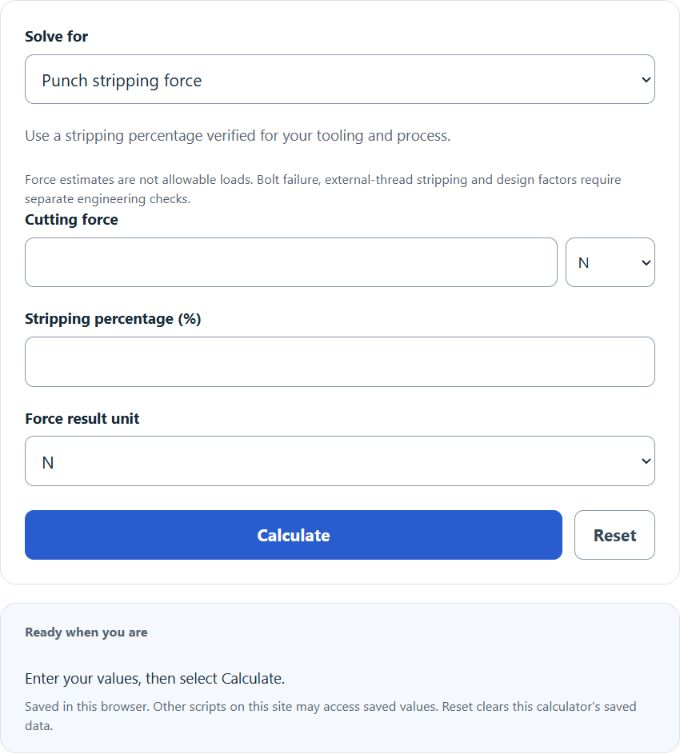
Calculate punch stripping force from cutting force and a process-specific percentage, or estimate tapped-hole pullout using pitch diameter, effective thread engagement and tapped-material shear strength. The simplified NASA model uses F = πdLτ/3. For another validated thread model, enter its effective shear area directly. These nominal estimates require separate bolt failure, external-thread stripping and design-factor checks.
Stripping Force Formula
The following equation is used to calculate the Stripping Force.
- Where SF is the stripping force (N)
- CF is the cutting force (N)
- PF is the percentage of cutting force that is involved in stripping (%)
- Use a process-specific percentage. Material, thickness, clearance, lubrication and tooling condition affect stripping force; unverified material presets are not used.
To calculate the stripping force, multiply the cutting force by the percentage of the cutting force that is involved in stripping, then divide by 100.
What is a Stripping Force?
Definition:
In sheet-metal punching/blanking (stamping), stripping force is the force required to pull the punch (or tool) back out of the workpiece after the cut. It is largely due to friction/adhesion and elastic recovery of the material around the punch and may be estimated as a process-specific fraction of cutting force.
How to Calculate Stripping Force?
Example Problem:
The following example outlines the steps and information needed to calculate the Stripping Force.
First, determine the cutting force. In this example, the cutting force is found to be 30 N with the help of the calculator linked above.
Next, determine the percentage of cutting force that is involved in stripping. For this problem, the percentage of cutting force involved in stripping is found to be 15%.
Finally, calculate the Stripping Force using the formula above:
SF = CF × (PF/100)
SF = 30 × (15/100) = 30 × 0.15
SF = 4.5 N
FAQ
What factors can affect the cutting force during machining operations?
The cutting force can be influenced by several factors including the material hardness of the workpiece, the sharpness of the cutting tool, the speed of the cutting operation, the depth of the cut, and the feed rate. Different materials and cutting conditions can significantly alter the required force.
Why is it important to calculate the stripping force in punching/blanking operations?
Calculating the stripping force helps ensure the punch can be withdrawn reliably and the press/stripper system is sized correctly. If the required stripping force is high, it can increase tool wear and press loading; if the available stripping force is too low (for example, insufficient stripper pressure), the punch may stick or gall and parts can be damaged.
Can the stripping force formula be applied to all types of machining operations?
The formula shown (SF = CF × PF/100) is primarily a rule of thumb used for sheet-metal punching/blanking/stamping where stripping occurs after shearing. The percentage (PF) can vary widely with material, thickness, clearance, lubrication, surface finish, and tooling condition, so use process-specific references when you need higher accuracy.