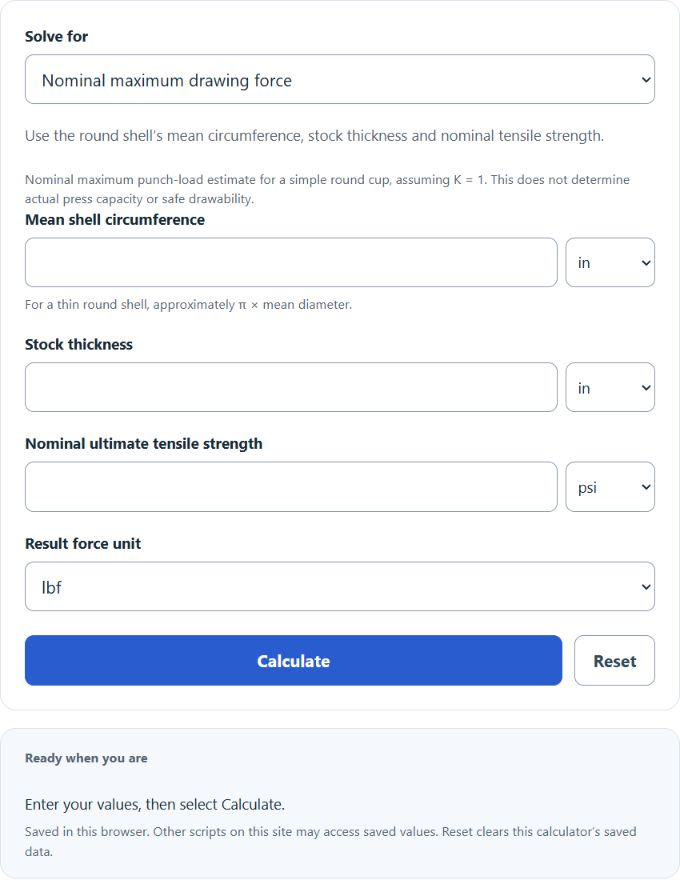
Estimate nominal maximum simple round-cup punch load or rearrange that model for mean circumference, thickness or effective tensile stress. The model assumes K = 1 and does not determine actual press capacity or safe drawability.
- All Physics Calculators
- All Force Calculators
- Press Force Calculator
- Punching Force Calculator
- Stripping Force Calculator
- Extrusion Force Calculator
Drawing Force Formula
For a thin round cup, the calculator uses nominal maximum wall/punch load F = C × t × S with K = 1. Actual process force depends on draw ratio, tooling, friction and blank-holder conditions; this approximation does not establish safe drawing or total press capacity. Inputs are converted consistently before calculation.
- F = nominal maximum punch load in the K = 1 model, in pounds-force (lbf)
- C = mean round-shell circumference, approximately π × mean diameter, in inches (in)
- t = thickness, in inches (in)
- S = tensile strength, in pounds per square inch (psi)
Select the value to solve for and enter the three relevant quantities. Inverse stress is an effective model stress, not a material-property measurement.
The calculator functions as follows:
- Nominal maximum load: multiplies mean circumference, thickness, and tensile strength under K = 1.
- Mean circumference: divides drawing force by thickness times tensile strength.
- Thickness: divides drawing force by mean circumference times tensile strength.
- Effective model stress: divides nominal maximum load by mean circumference times thickness; it is not a tensile test.
Common Unit Conversions for Drawing Force Calculations
Use these conversions to check how entered values are converted before the formula is applied.
| Quantity | Unit | Base-unit conversion |
|---|---|---|
| Length | 1 ft | 12 in |
| Length | 1 cm | 0.393701 in |
| Length | 1 m | 39.3701 in |
| Pressure | 1 MPa | 145.038 psi |
| Force | 1 N | 0.224809 lbf |
| Input change | Effect on drawing force |
|---|---|
| Double the mean circumference | Drawing force doubles |
| Double the thickness | Drawing force doubles |
| Double the tensile strength | Drawing force doubles |
| Reduce thickness by 25% | Drawing force is reduced by 25%, if other values stay the same |
Example Problems
Example 1: Calculate drawing force
You have a mean circumference of 10 in, a thickness of 0.05 in, and a tensile strength of 60,000 psi.
The nominal maximum punch load in this assumed model is 30,000 lbf.
Example 2: Calculate thickness
Assume the K = 1 nominal maximum load is 18,000 lbf, the mean round-shell circumference is 12 in, and the nominal tensile strength is 50,000 psi.
The thickness is 0.03 in.
FAQ
What is mean circumference in a drawing force calculation?
Use the mean circumference of a thin round shell, approximately π times its mean diameter. This is a simple cup-wall load approximation, not a model for arbitrary drawn sections.
Why does tensile strength affect drawing force?
Nominal ultimate tensile strength sets the wall-load scale in this K = 1 approximation. Actual process force also depends on drawing conditions. Inverse model stress does not independently measure a material property.
How do I choose the unknown?
Choose the unknown in Solve for, then fill the three relevant quantities. The calculator shows its answer separately and preserves your entered values. Positive physical dimensions and material strength are required; a zero supplied model load returns a zero inverse output.