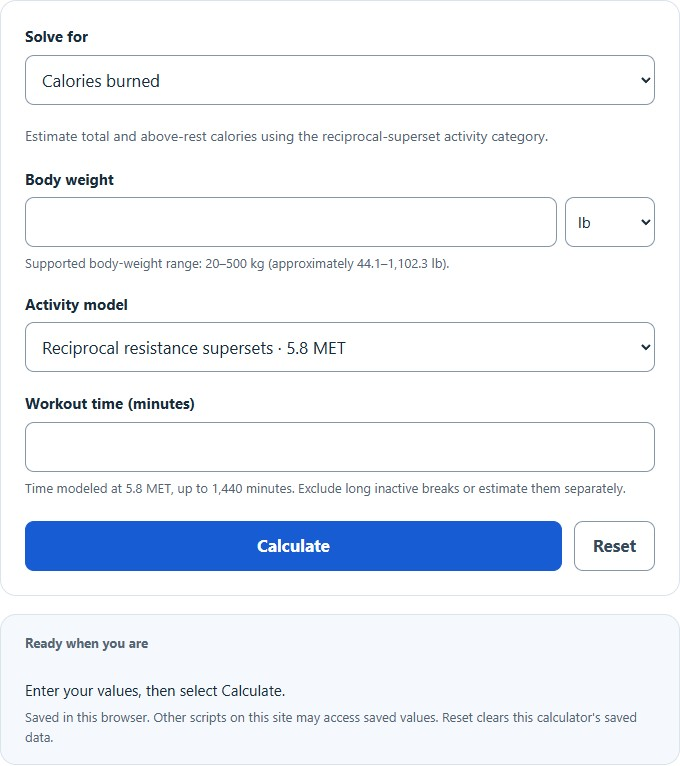
Estimate calories burned in a superset workout from your body weight and workout time, or find how long to train to burn a target number of calories.
How the Superset Workout Calorie Calculator Works
The calculator uses the 2024 Adult Compendium’s 5.8-MET reciprocal-superset resistance-circuit category (code 02055). The Adult Compendium covers ages 19–59. Target mode rearranges the same gross-energy rate equation to solve for modeled time; the result is not a recommended workout duration.
Formula: gross kcal = 5.8 x 3.5 x body weight in kg / 200 x minutes
What the Results Show
The primary result is the gross calorie estimate or modeled time for a gross-energy target. Supporting results show calories above standardized rest, calorie rate, the selected activity value, and calculation steps. Above-rest calories subtract one standardized MET for the same time; they are not measured personal resting expenditure or the calories used during between-set breaks.
Calculator-Specific Detail
A same-time 3.5-MET varied-resistance comparison is shown as a model comparison rather than an invented superset multiplier.
Assumptions and Limitations
All entered minutes are modeled at 5.8 MET. Long inactive breaks or unrelated activities may lower the session-average intensity and need separate estimates; no universal work/rest split is assumed. Other superset styles may differ. MET estimates describe typical group energy cost, so individual results vary with body composition, technique, conditioning and equipment. The 3.5-MET same-time comparison is a separate activity model, not proof of a guaranteed personal calorie advantage.
Browse the complete Strength Training calorie calculator collection or return to the Sports & Fitness Calculators hub.
Sources
2024 Adult Compendium of Physical Activities: Conditioning Exercise activity codes (02055: 5.8 MET; 02054: 3.5 MET), official MET-to-kcal unit conversions, adult population scope, and standardized versus personal resting metabolism.
Herrmann, Willis, Ainsworth, et al. 2024 Adult Compendium of Physical Activities: A third update of the energy costs of human activities. Journal of Sport and Health Science, 2024.