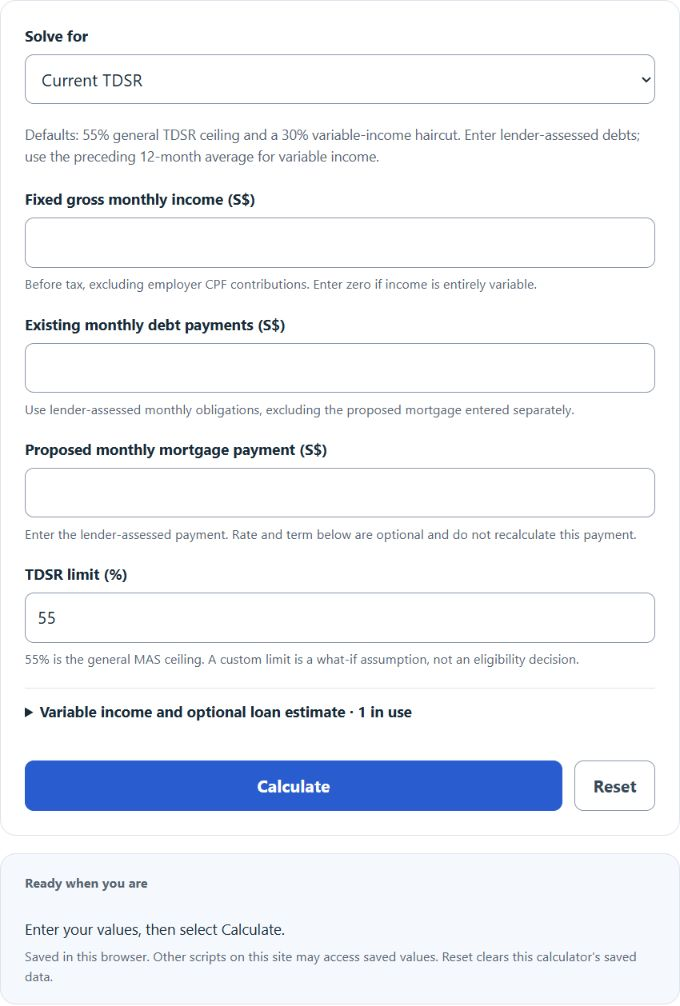
Calculate your Singapore TDSR (total debt servicing ratio) from monthly income and debt payments, check it against the 55% limit, or find mortgage headroom.
Total Debt Servicing Ratio Formula
Variables:
- TDSR is the Total Debt Servicing Ratio (%)
- D is total lender-assessed monthly debt payments, including the proposed mortgage (S$).
- GI is assessed gross monthly income after applicable income haircuts (S$), before tax and excluding employer CPF contributions.
To calculate TDSR, divide total assessed monthly debt payments by assessed gross monthly income, then multiply by 100. In this calculator, assessed income equals fixed gross monthly income plus average variable gross monthly income multiplied by one minus the entered haircut.
How to Calculate Total Debt Servicing Ratio?
The following steps outline how to calculate the Total Debt Servicing Ratio.
- First, total existing lender-assessed monthly debt payments and the proposed lender-assessed mortgage payment (S$).
- Next, determine assessed gross monthly income (S$), applying the appropriate haircut to recognized variable income.
- Next, gather the formula from above = TDSR = D / GI * 100.
- Finally, calculate the Total Debt Servicing Ratio.
- After inserting the variables and calculating the result, check your answer with the calculator above.
Example Problem :
Use the following variables as an example problem to test your knowledge.
Total lender-assessed monthly debt payments (S$) = 500.
Assessed gross monthly income after any applicable haircuts (S$) = 1,000. TDSR = 500 ÷ 1,000 × 100 = 50%.
The general Singapore TDSR ceiling is 55%. Variable income generally uses the preceding 12-month average and at least a 30% haircut; the calculator discloses 55% and 30% as editable defaults. Blank variable income means zero, and a blank haircut uses 30%. Custom assumptions do not establish compliance. See MAS guidance on calculating TDSR and TDSR thresholds.
Mortgage-payment headroom is max(0, assessed income × limit ÷ 100 − existing debt). Existing debts above that ceiling leave zero headroom and a reported deficit. Required assessed income is total monthly debt ÷ (limit ÷ 100); zero debt can require zero income, but its 0 ÷ 0 TDSR is undefined. Capacity is displayed rounded down to whole cents and required income rounded up; status uses exact decimal inputs before display rounding.
For the optional loan estimate, enter both an assessment rate and term, or leave both blank. Principal is the present value of level end-of-month payments using exact available payment capacity before display rounding, a constant nominal annual rate and no fees. Zero rate uses payment × modeled monthly periods. Fractional years can produce fractional modeled periods; this is an estimate, not an installment schedule. These inputs do not recalculate the lender-assessed proposed mortgage payment. For a new residential property loan, MAS uses the higher of 4% or the applicable thereafter rate; obtain the lender’s applicable assessment rather than using only a promotional rate.
This tool does not determine loan approval, LTV, age or tenure eligibility, recognized assets, joint-borrower treatment or exemptions. A separate 30% MSR can apply to FI loans for HDB flats, and for executive condominiums bought directly from developers. See MAS macroprudential policies and who TDSR applies to; confirm your circumstances with the lender.
Frequently Asked Questions
What factors can affect my Total Debt Servicing Ratio (TDSR)?
Changes in assessed monthly debt payments, recognized gross income and applicable income haircuts can affect TDSR. A cash payment or a promotional loan rate may differ from the lender-assessed amount required for the framework.
How can I improve my Total Debt Servicing Ratio?
Improving your TDSR can involve increasing your gross income, reducing your monthly debts, or a combination of both.
Why is the Total Debt Servicing Ratio important for lenders?
Lenders use TDSR to assess a borrower's ability to manage monthly payments and determine their risk level.
Can the Total Debt Servicing Ratio affect my ability to get a loan?
TDSR can affect eligibility, but a result below an entered limit is not loan approval. Lenders also apply other applicable requirements, and exceptions or exemptions cannot be determined from these inputs alone.