Calculate a tennis player’s ace percentage from aces and total service points, or estimate aces or service points from a known ace rate.
Tennis Ace Percentage Formula or Method
Ace percentage here measures aces as a share of all service points played by the same server in the selected match, event or season sample. An ace is a legal serve that wins the point without the receiver touching it; a touched return error is not automatically an ace. Count each service point once, including first-serve points, second-serve points and double-fault points, rather than counting individual serve strokes.
How the Calculation Works
The three solves use the same definition: ace percentage = 100 × aces ÷ all service points; estimated aces = all service points × percentage ÷ 100; estimated service points = 100 × aces ÷ percentage. The last two are algebraic estimates implied by the entered values. They may be fractional and do not establish an official observed count or predict future aces.
How to Use This Calculator
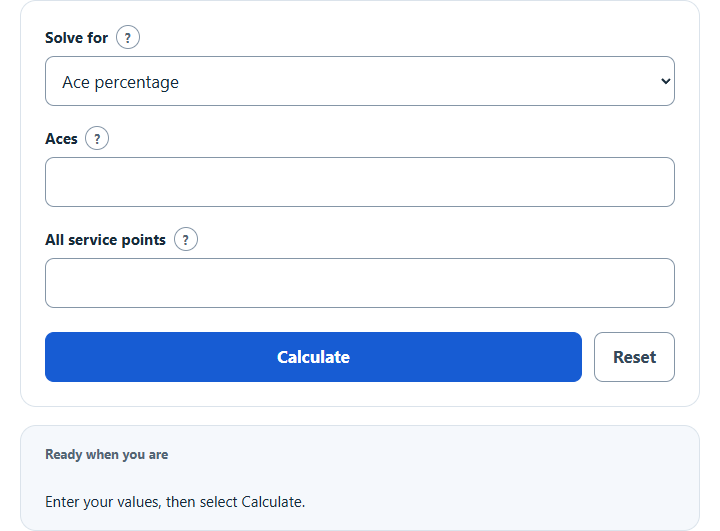
- Select the result you want in the Solve for menu.
- Enter the visible source values from one consistent sample. Input counts must be whole numbers no greater than 1,000,000. Service-point inputs must be positive, and recorded aces cannot exceed service points. Estimated aces accepts 0–100%; estimated service points requires positive aces and a percentage from 0.0001% to 100%.
- Select Calculate and review the answer and substituted steps.
- Use Reset before starting a different sample.
Worked Example
Nine aces over 72 service points gives 9 ÷ 72 × 100 = 12.50%.
Input and Result Guide
| Item | How to use it |
|---|---|
| Aces | Use officially recorded aces for the server. |
| Service points | Include every point played while that player served. |
| Percentage | Keep the same denominator when comparing players or periods. |
Interpreting the Result
Keep the server, event or time window and source definitions consistent when comparing results. This is a description of the selected sample, not a comprehensive serve-quality score or next-point probability. Surface, opponents and sample size can affect comparisons. For a combined sample, divide total aces by total service points rather than taking an unweighted average of match percentages.
Assumptions and Limitations
Some data providers publish aces per service game instead. That is a different denominator and should not be mixed with this rate. Check the chosen dataset’s complete service-point scope, including its tiebreak treatment. This calculator explicitly uses all service points; it does not claim that every provider uses one universal ace-rate definition.
Actual aces and service points are whole counts. A fractional inverse has no exact whole-number solution for the entered values; rounding it up or down changes the implied rate. Even a whole inverse may not recover original counts if the published percentage was rounded. Decimal results use up to six places or scientific notation; exact fractions are retained in the calculation details. A derived service-point estimate may exceed the input-count limit. Zero aces with positive service points gives 0%; zero service points is undefined. The positive-aces, positive-percentage service-point solve avoids dividing by zero or inferring a unique denominator from zero aces at 0%.
Common Questions
Why did an input disappear when I changed Solve for?
The hidden field is the requested output. Enter the remaining visible values and the calculator will solve for that target.
Will my last successful calculation be restored?
Yes. The calculator saves the source inputs in this browser and recomputes the result when restored. Changing an input marks the displayed result as needing recalculation. Reset clears this calculator’s saved data. Other scripts on this site may access values saved in this browser.
Sources
The WTA’s tennis explainer defines aces and double faults. Tennis Abstract’s point-by-point glossary illustrates point-based ace percentages on court-side subsets, while Tennis Insight’s match-stat guide illustrates a separate per-service-game convention. The three displayed equations follow algebraically from this calculator’s explicit all-service-points definition.