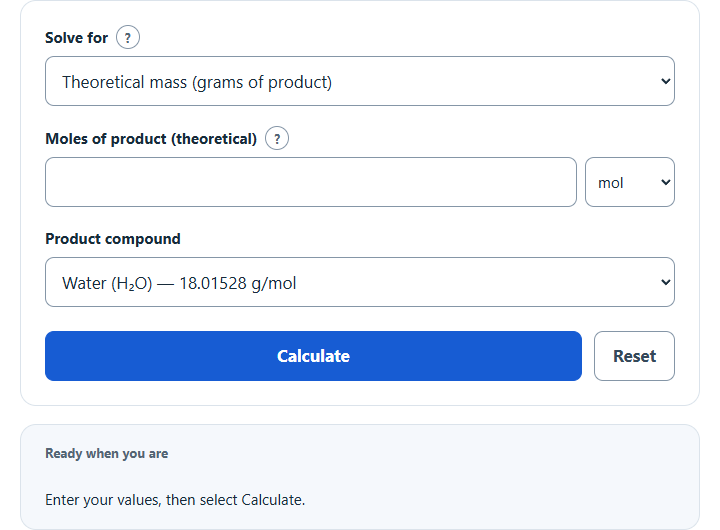
Calculate theoretical mass from moles and molar mass for common compounds, or find percent yield from actual and theoretical mass values.
Starting with a reactant mass? Use the Chemical Yield Calculator to find theoretical yield from reactant grams. Enter the limiting reactant’s mass and molar mass, the product-to-reactant mole ratio from the balanced equation, and the product molar mass. Identify the limiting reactant first; this conversion assumes the other reactants are in excess.
Calculator Functions
| Function | What it does | What it requires |
|---|---|---|
| Theoretical mass (grams of product) | Converts the theoretical moles of product to grams | Requires the moles of product and its molar mass, picked from the compound list or entered |
| Percent yield | Compares the mass actually collected with the theoretical mass | Requires the actual product mass and the theoretical product mass |
Moles can be entered in mol, mmol or kmol and masses in g, mg or kg. The compound list holds twelve common products, from water (18.01528 g/mol) to calcium carbonate (100.087 g/mol), plus a custom molar mass in g/mol or kg/mol.
Theoretical Mass Formulas
| m | Theoretical mass of product (g) |
| n | Theoretical moles of product (mol) |
| M | Molar mass of the product (g/mol) |
Theoretical mass is the most product a reaction can make, reached only if every bit of the limiting reactant ends up as product [2]. The formula is the definition of molar mass, M = m ÷ n, solved for mass [1].
Theoretical mass (grams of product)
A reaction that can form 2 mol of water has a theoretical mass of 2 × 18.01528 = 36.0306 g. With a custom molar mass of 70 g/mol, 5 mol of product is 350 g.
Percent yield
× 100 [2]
Collecting 30 g of water when 36.0306 g was possible is a yield of 30 ÷ 36.0306 × 100 = 83.26%. Percent yield is defined on moles of product obtained against the most possible [2]. For one product the ratio of masses is the same number, as long as both masses are in the same unit.
How to Calculate Theoretical Mass
Write the balanced equation and find the limiting reactant, the one that runs out first. Convert its amount to moles, then multiply by the product-to-reactant ratio from the equation to get the moles of product. Multiply those moles by the molar mass of the product. In 2 H2 + O2 → 2 H2O with 2 mol of hydrogen as the limiting reactant, the ratio is 2 to 2, so 2 mol of water can form and the theoretical mass is 36.0306 g.
Limits of This Estimate
- The calculator does not balance the equation or pick the limiting reactant. The moles of product must already come from the reaction stoichiometry.
- A yield above 100% is not a real gain. It points to wet or impure product, a weighing error or a theoretical mass that is too low.
- Listed molar masses are rounded reference values. Use the custom field for a different precision or isotope mix.
Sources
- NIST Special Publication 811, Guide for the Use of the SI, Chapter 8, Section 8.6.4: molar mass as mass divided by amount of substance
- Reed College, Chemistry 201-202 Lab Manual, % Yield: percent yield, and the theoretical maximum set by the limiting reactant