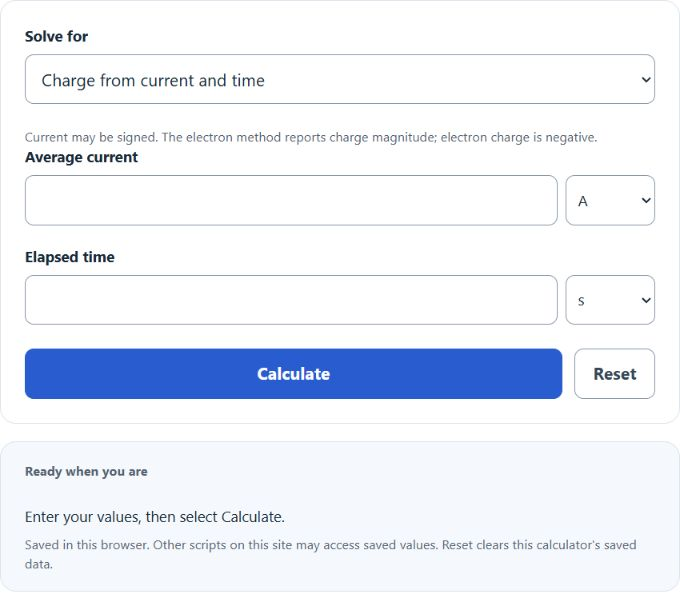
Calculate total electric charge Q from current and time or from number of electrons, with unit conversions and electron-based results.
- All Business Calculators
- All Charge Calculators
- Net Charge Calculator
- Formal Charge Calculator
- Amps To Electrons Per Second Calculator
Total Charge Formula
The following formula is used to calculate the Total Charge.
- Where |Qtotal| is the charge magnitude in coulombs; Q = I × t uses average signed current and elapsed time
- N is the total number of electrons
- e is the elementary charge magnitude, exactly 1.602176634 × 10⁻¹⁹ C; each electron has charge −e
To calculate charge magnitude from electrons, multiply the electron count by e. The signed charge of those electrons is −N × e. From average current, use Q = I × t.
How to Calculate Total Charge?
The following two example problems outline how to calculate the Total Charge.
Example Problem #1:
- First, determine the total number of electrons. In this example, the total number of electrons is given as 15,000.
- Next, determine the electron charge (C). For this problem, the elementary charge magnitude is exactly 1.602176634 × 10⁻¹⁹ C.
- Finally, calculate the Total Charge using the equation above:
|Qtotal| = N × e
Inserting the values from above and solving the equation:
|Qtotal| = 15000 × 1.602176634 × 10⁻¹⁹ ≈ 2.40326 × 10⁻¹⁵ C; signed electron charge is negative
Example Problem #2:
Using the same process as above, first define the variables required by the formula. In this case, these values are provided as the following:
total number of electrons = 200,000
elementary charge magnitude e = 1.602176634 × 10⁻¹⁹ C
Entering these values gives:
|Qtotal| = N × e ≈ 3.20435 × 10⁻¹⁴ C; signed electron charge is negative