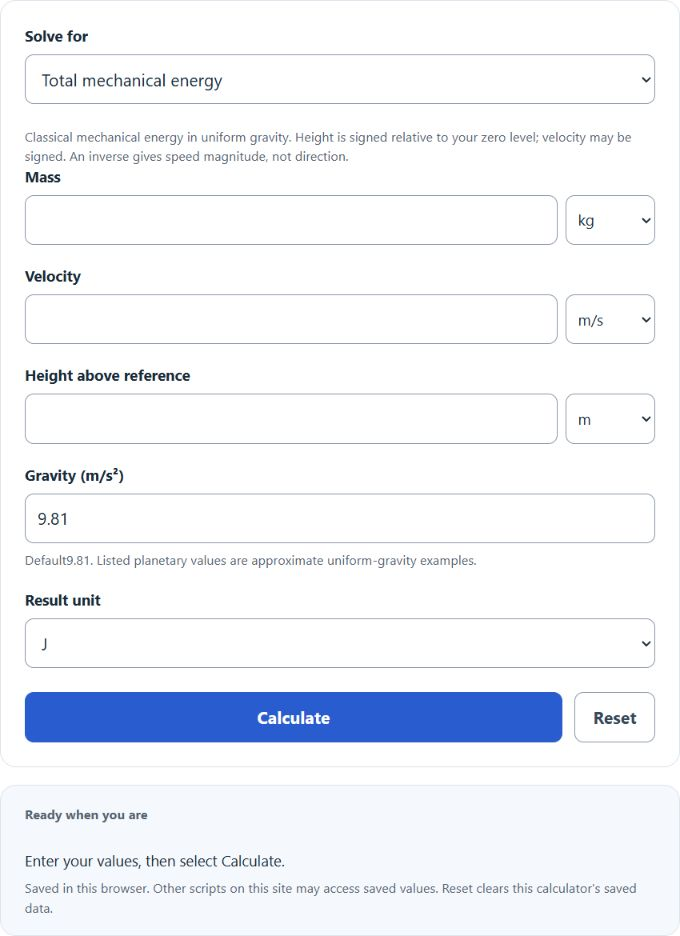
Choose total mechanical, kinetic, or gravitational potential energy, or an explicit inverse solve for mass, speed or height. Select the input and result units; height is relative to your chosen zero level.
- All Physics Calculators
- All Energy Calculators
- Mechanical Energy Calculator
- Energy Calculator
- Energy Efficiency Factor Calculator
Total Energy Formula
The following equation gives classical translational kinetic plus gravitational potential energy in approximately uniform gravity. It excludes thermal, rotational, rest and other forms of energy.
- Where TE is the Total Energy (joules)
- m is the mass (kg)
- V is signed velocity (m/s); its square contributes kinetic energy. An inverse returns speed magnitude, not direction.
- H is signed height relative to the chosen zero-potential reference (m)
- g is positive uniform gravitational acceleration (default 9.81 m/s²; planetary examples are approximate)
To calculate total energy, first calculate the kinetic and potential energy, then sum the results to get the total.
What are the units for Total Energy?
The default energy unit is joules. The calculator also supports thermochemical kcal (4184 J) and International Table BTU (1055.05585262 J). Inputs and results use matching conventions.
How to Calculate Total Energy?
Example Problem:
The following example problem outlines the steps and information needed to calculate the Total Energy.
First, determine the mass. In this example, the mass is determined to be 500 (kg).
Next, determine the velocity. For this problem, the velocity is measured to be 123 (m/s).
Next, determine the height. In this case, the height is found to be 52 (m).
Finally, calculate the Total Energy using the formula above:
TE = 1/2*m*V^2 + m*g*H
Inserting the values from above and solving the equation with the imputed values gives:
TE = 1/2*500*123^2 + 500*9.81*52 = 4037310 (joules)