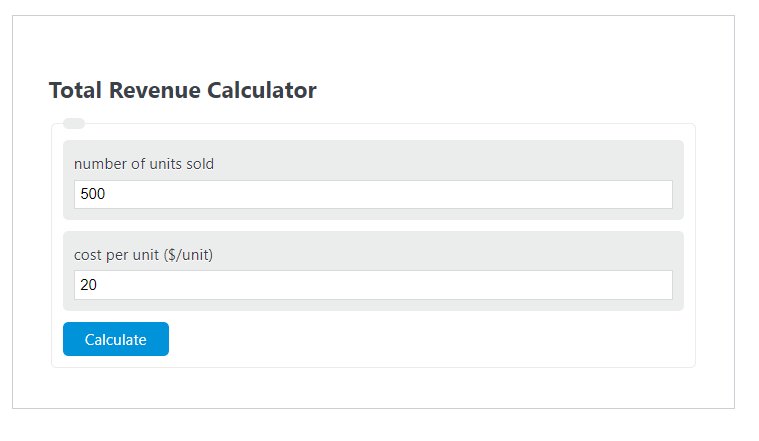
Calculate total revenue, units sold, or cost per unit by entering any two values and finding the missing sales variable for business planning.
Related Calculators
- Average Ticket Value Calculator
- Percentage of Revenue Calculator
- Wages to Sales Ratio Calculator
- Cost Recovery Ratio Calculator
- All Business Calculators
Total Revenue Formula
Total revenue measures the total money generated from sales before subtracting expenses. In the simplest case, it is found by multiplying the number of units sold by the amount earned per unit. For revenue calculations, the per-unit input should represent the selling price or revenue collected per unit, not your internal production cost.
Where:
- TR = total revenue
- U = units sold
- P = selling price or revenue earned per unit
If you know any two values, you can solve for the third:
How to Calculate Total Revenue
- Determine how many units were sold during the period you are analyzing.
- Identify the amount earned per unit sold.
- Multiply units sold by the per-unit revenue.
- Make sure both values use the same time period, such as per day, month, quarter, or year.
This calculator is useful for pricing analysis, sales forecasting, budgeting, product comparisons, and quick business performance checks.
Example Calculations
Example 1: A business sells 500 units at 6 dollars per unit.
Total revenue is 3,000 dollars.
Example 2: A company generates 225 dollars per sale and closes 18 sales.
Total revenue is 4,050 dollars.
What the Result Tells You
Total revenue shows the top-line income produced by sales activity. It does not show whether the business is profitable. A company can have high revenue and still lose money if its costs are too high.
| Metric | Meaning | Formula |
|---|---|---|
| Total Revenue | Total money generated from sales | TR = U × P |
| Average Revenue | Revenue earned per unit sold | AR = TR / U |
| Profit | Revenue remaining after total costs are subtracted | π = TR - TC |
Total Revenue vs. Profit
Revenue and profit are often confused, but they measure different things:
- Total revenue is the money brought in from sales.
- Total cost is the amount spent to produce, market, deliver, and support those sales.
- Profit is what remains after costs are subtracted from revenue.
If your goal is to evaluate business health, total revenue is a starting point, not the final answer.
When to Use a Total Revenue Calculator
- Estimating income from expected unit sales
- Comparing pricing strategies
- Forecasting monthly or annual sales
- Checking sales targets
- Measuring the revenue impact of promotions or volume changes
- Converting service volume and rate into total earnings
Common Input Mistakes
- Using cost instead of selling price: revenue uses the amount collected from the customer.
- Mixing time periods: monthly units should be paired with monthly price assumptions.
- Ignoring discounts or refunds: use the actual realized amount per unit if you want a more accurate figure.
- Using produced units instead of sold units: revenue is based on sales, not output.
- Combining products with different prices into one average without checking accuracy: this can distort the result.
Multiple Products or Different Price Levels
If a business sells more than one product, or the same product at different price points, total revenue is the sum of each quantity-price pair.
This is useful for product mixes, tiered pricing, wholesale and retail channels, or seasonal promotions.
Practical Interpretation
Total revenue increases when:
- more units are sold,
- the price per unit rises, or
- both happen at the same time.
However, raising price does not always increase revenue if the higher price reduces the number of units sold too much. That is why businesses often review revenue together with demand, conversion rate, margin, and profit.
Frequently Asked Questions
Is total revenue the same as sales?
In many basic business and economics contexts, yes. Total revenue is the total sales value generated from units sold.
Does total revenue include expenses?
No. Revenue is measured before subtracting costs such as materials, labor, rent, or advertising.
What if I sell services instead of physical products?
The same concept applies. Replace units sold with jobs completed, subscriptions sold, hours billed, or customers served, and multiply by the amount earned per unit of service.
Can I use this formula for forecasting?
Yes. If you have an estimated number of future sales and an expected price per unit, the formula provides a quick revenue forecast.
What if each unit is sold at a different price?
Calculate revenue for each group separately and add the results together, or use the multi-product summation formula above.