Find missing triangle sides and angles for right, SAS, ASA/AAS, SSA, or SSS cases, including ambiguous solutions, area, perimeter, validity checks, and unit conversions.
- All Math & Numbers Calculators
- Law Of Cosines Calculator
- Law Of Sines Calculator
- SOH CAH TOA Calculator – Find Missing Sides & Angles
- Triangle Calculator
- 45 45 90 Triangle Calculator – Sides, Area & Perimeter
- Isosceles Triangle Calculator
Triangle Side Formula
The formula the calculator uses depends on what you already know about the triangle. Each solve-for mode targets a different combination of sides and angles.
For a right triangle, the missing side comes from the Pythagorean theorem:
c^2 = a^2 + b^2
When you know two sides and the angle between them (SAS), the third side comes from the law of cosines:
c = sqrt( a^2 + b^2 - 2*a*b*cos(C) )
When you know one side with two angles (ASA or AAS) or two sides and a non-included angle (SSA), the remaining sides come from the law of sines:
a / sin(A) = b / sin(B) = c / sin(C)
When you know all three sides (SSS), the angles come from the rearranged law of cosines:
cos(A) = (b^2 + c^2 - a^2) / (2*b*c)
- a, b, c: the three side lengths. Each side is opposite the angle named with the matching capital letter.
- A, B, C: the three interior angles, entered in degrees or radians. They always add up to 180 degrees.
- c (right triangle): the hypotenuse, the longest side and the one opposite the 90-degree angle.
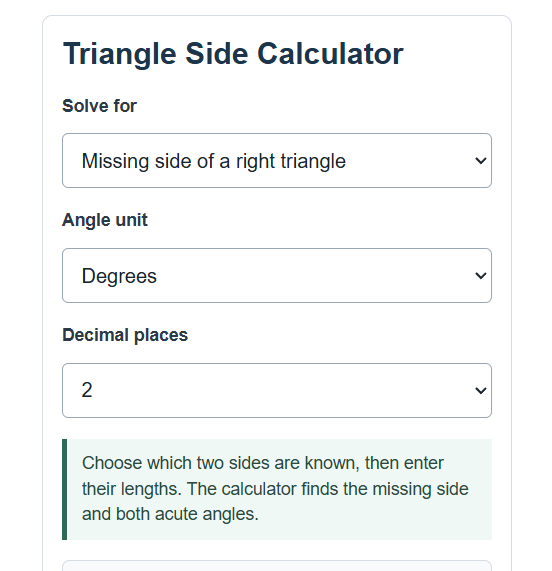
The solve-for selector decides which formula runs and which inputs you see. The right triangle mode uses the Pythagorean theorem and accepts either both legs or the hypotenuse and one leg. The SAS mode finds the side opposite the angle you enter. The ASA/AAS mode scales the one known side to find the other two. The SSA mode is the ambiguous case and may return two triangles, one, or none. The SSS mode takes three sides and returns the angles plus the area, perimeter, and triangle type. The angle unit selector sets whether angles are read as degrees or radians, and the decimal-places field sets the precision of the results.
Which Inputs Solve for a Side
You can only find a missing side from certain combinations of three measurements. Use this to know what to enter and which method applies.
| You know | Case | Method | Result |
|---|---|---|---|
| 2 sides of a right triangle | Right | Pythagorean theorem | One missing side |
| 2 sides + included angle | SAS | Law of cosines | Third side |
| 1 side + 2 angles | ASA / AAS | Law of sines | Both other sides |
| 2 sides + non-included angle | SSA | Law of sines | 0, 1, or 2 triangles |
| 3 sides | SSS | Law of cosines | All three angles |
Any set of three sides must also satisfy the triangle inequality: the two shorter sides must add up to more than the longest side, or no triangle exists.
| Common right triangle | Sides (a, b, c) | Check |
|---|---|---|
| 3-4-5 | 3, 4, 5 | 9 + 16 = 25 |
| 5-12-13 | 5, 12, 13 | 25 + 144 = 169 |
| 8-15-17 | 8, 15, 17 | 64 + 225 = 289 |
| 7-24-25 | 7, 24, 25 | 49 + 576 = 625 |
Examples
Example 1: missing side of a right triangle. A right triangle has legs a = 6 and b = 8. The hypotenuse is c = sqrt(6^2 + 8^2) = sqrt(36 + 64) = sqrt(100) = 10. If instead you knew the hypotenuse c = 10 and one leg a = 6, the other leg would be b = sqrt(10^2 – 6^2) = sqrt(64) = 8.
Example 2: third side from two sides and the included angle (SAS). A triangle has a = 5, b = 7, and the included angle C = 60 degrees. Then c = sqrt(5^2 + 7^2 – 2 times 5 times 7 times cos(60)) = sqrt(25 + 49 – 70 times 0.5) = sqrt(74 – 35) = sqrt(39), which is about 6.24.
Frequently Asked Questions
How many measurements do I need to find a side? You need three measurements, and at least one of them must be a side. Three angles alone fix the shape but not the size, so the calculator cannot return a side length from angles only. Valid combinations are two sides, two sides and an angle, or one side and two angles.
Why did the SSA mode give me two answers? When you enter two sides and an angle that is not between them, the law of sines can produce two valid triangles, one with an acute angle and one with an obtuse angle. This is the ambiguous case. The calculator reports every triangle that satisfies the triangle inequality so you can choose the one that matches your problem.
Do I have to use degrees? No. Set the angle unit selector to degrees or radians before you calculate, and enter every angle in that same unit. Results follow the unit you picked, and the decimal-places field controls how many digits the side lengths show.