Estimate turf surface temperature and heat risk from air temperature, sun exposure, wind, moisture, turf type, and color for synthetic turf or grass.

Turf Temperature Calculator

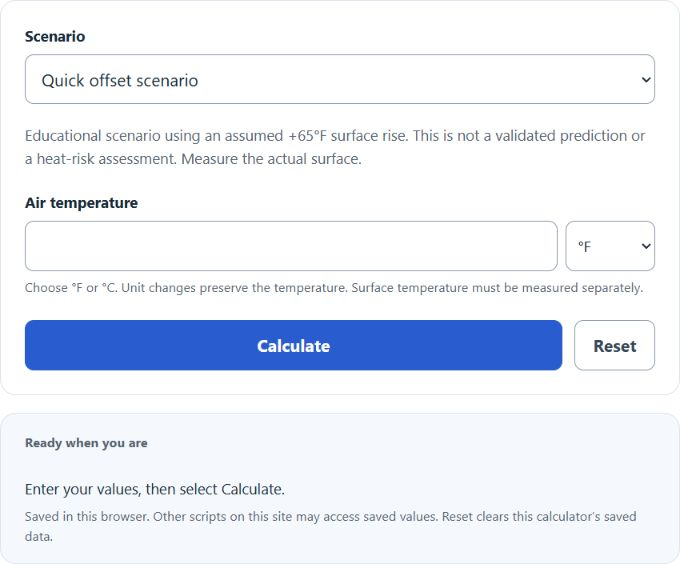
Enter air temperature to estimate turf surface temperature and heat risk.
Quick estimate
Field conditions
Uses the common synthetic turf rule: turf ≈ air + 65°F.
Estimated turf temperature
Air temperature
Surface heat gain
Equivalent
Model used

Turf Temperature Formula

The calculator runs in two modes. The Quick estimate uses the widely cited synthetic turf rule of thumb. The Field conditions mode adjusts a base heat gain for sun, surface type, wind, moisture, and color.

T_turf = T_air + 65°F   (Quick estimate)
T_turf = T_air + ΔT_sun + ΔT_moisture + ΔT_wind + ΔT_color   (Field conditions)
  • T_turf — estimated surface temperature of the turf
  • T_air — measured air temperature
  • ΔT_sun — heat gain from sun exposure (largest factor)
  • ΔT_moisture — cooling from damp or wet surface (negative)
  • ΔT_wind — convective cooling from wind (negative)
  • ΔT_color — adjustment for light or dark fibers and infill

The Quick estimate is for synthetic turf in full sun and gives a fast worst-case number. The Field conditions mode swaps in a smaller base for natural grass, scales the sun term down for clouds or shade, subtracts cooling for wind and moisture, and shifts the result up or down based on turf color.

Typical Surface Heat Gain and Risk Levels

Use these tables to sanity check the calculator output and to understand what the result means for activity.

Surface and conditions Typical heat gain over air
Synthetic turf, full sun, dry+50 to +70 °F
Synthetic turf, full sun, recently watered+25 to +45 °F
Synthetic turf, overcast+10 to +20 °F
Synthetic turf, shade+0 to +10 °F
Natural grass, full sun+5 to +15 °F
Natural grass, overcast or shade+0 to +5 °F
Turf surface temp Risk level Action
Below 120 °FLowerNormal play, monitor athletes in sun.
120–140 °FCautionAdd water breaks, avoid bare skin contact.
140–160 °FDangerousWater the field, shorten sessions, no pets.
Above 160 °FExtremeDelay or move activity until surface cools.

Examples and Common Questions

Example 1. Air temperature is 85 °F on a sunny day. Using the Quick estimate, T_turf = 85 + 65 = 150 °F. That falls in the dangerous range, so you would water the field or shift practice to early morning.

Example 2. Air is 90 °F, synthetic turf, partial sun, 10 mph wind, damp surface, dark infill. Base sun gain is about +35, damp moisture subtracts 12, wind subtracts about 7, dark color adds 6. Net delta is roughly +22, so T_turf is about 112 °F. Caution range, but workable.

Why is synthetic turf so much hotter than grass? Plastic fibers and rubber infill absorb solar radiation and have no evapotranspiration. Natural grass cools itself by releasing water vapor, which caps its surface temperature near air temperature.

Does watering the field actually help? Yes, but only briefly. Watering can drop synthetic turf surface temperature 20 to 40 °F, with most of the cooling lost within 20 to 30 minutes as the water evaporates.

How accurate is the result? These are estimates based on field measurements published by turf manufacturers and university studies. Real surface temperature depends on infill type, fiber age, humidity, and cloud cover, so use an infrared thermometer for confirmation before high-risk activity.

Can I use air temperature in the shade for the input? Use the air temperature reported by a standard weather station, which is measured in shade. The sun exposure setting in Field conditions handles solar heating of the turf itself.