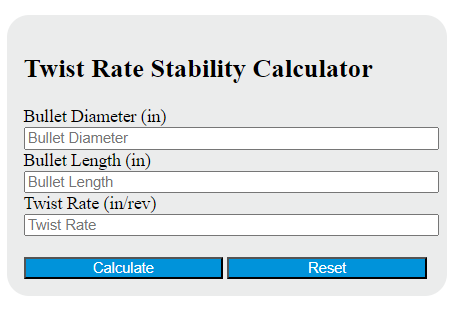
Calculate bullet gyroscopic stability or required barrel twist using the Miller rule, with bullet dimensions, velocity, atmospheric conditions, and metric or imperial units.
Twist Rate Stability Formula
This calculator uses the Greenhill rule to estimate the rifling twist rate needed to give a bullet enough spin for stable flight. Despite the page title, the tool is really estimating the required twist rate for stability, not a full gyroscopic stability factor.
Where:
| Variable | Meaning | Practical note |
|---|---|---|
| Twist rate | Barrel pitch, measured as distance per one full rotation | Often written as 1:7, 1:9, 1:10, etc. |
| Bullet diameter | Projectile diameter | Use the same length unit as bullet length |
| Bullet length | Projectile overall length | Longer bullets generally need faster twist |
| Greenhill constant | Empirical constant used in the rule | This calculator uses 150 |
Important interpretation: a smaller twist number means a faster twist. For example, 1:7 spins a bullet faster than 1:10 because the bullet completes one revolution in less barrel travel.
Rearranged Forms
If you already know two values, the equation can be rearranged to solve for the third:
How to Use the Calculator
- Enter the bullet diameter.
- Enter the bullet length.
- Keep both inputs in the same unit system before interpreting the result.
- Read the output as distance per revolution, such as inches per turn or millimeters per turn.
- Convert that value mentally into common barrel notation if needed. A result of 9 means roughly a 1:9 twist.
How to Interpret the Result
| If this changes | Required twist tends to | Reason |
|---|---|---|
| Bullet length increases | Get faster | Longer bullets are harder to stabilize |
| Bullet diameter increases | Get slower | Diameter appears squared in the Greenhill equation |
| Twist number decreases | Spin rate increases | The bullet makes a full turn over a shorter distance |
In practical terms, this means:
- Long, slender bullets usually require faster-twist barrels.
- Shorter bullets can often be stabilized with slower twist rates.
- Two bullets of the same caliber may need different twists if their lengths differ significantly.
Example
For a bullet with diameter 0.308 in and length 1.5 in, using the calculator’s default Greenhill constant of 150:
That result corresponds to an estimated twist of about 1:9.5. In real barrel offerings, that usually means choosing the nearest practical twist specification.
Units and Conversion Notes
- Diameter and length must match units. If diameter is entered in millimeters, length should also be in millimeters.
- The output twist rate will be in the same base length unit per revolution.
- If you switch from inches to millimeters or centimeters, the numeric twist value changes, but the underlying barrel requirement does not.
What the Greenhill Rule Captures Well
- Fast estimates for typical rifle projectiles
- Reasonable first-pass barrel twist selection
- The strong influence of bullet length relative to diameter
Limitations of This Method
- It is a rule of thumb, not a full aerodynamic model.
- It does not directly account for exact bullet shape, center of mass, center of pressure, jacket/core construction, or atmospheric conditions.
- Very high-velocity, low-drag, monolithic, or unusually shaped bullets may need more refined stability analysis.
- Because the calculator uses C = 150, it should be treated as an estimation tool rather than a final barrel-selection authority.
Common Mistakes
- Using bullet weight instead of bullet length. Greenhill is driven by diameter and length.
- Mixing units, such as entering diameter in inches and length in millimeters.
- Assuming a larger twist number is faster. It is actually slower.
- Ignoring that similar calibers can require different twists because bullet profiles and lengths vary.
Quick Reference
| Result style | Meaning |
|---|---|
| 1:7 | Fast twist; one full bullet rotation every 7 inches |
| 1:9 | Moderately fast twist; common for many rifle applications |
| 1:12 | Slower twist; generally better suited to shorter bullets |
Frequently Asked Questions
Does a faster twist always mean better accuracy?
Not necessarily. The goal is adequate stability for the bullet being used. Too little twist can cause instability, while excess twist is usually less harmful than insufficient twist but is not automatically optimal for every setup.
Why does bullet length matter more than bullet weight here?
Because stability is tied heavily to the bullet’s geometry. Heavier bullets are often longer, which is why weight is sometimes used as a shortcut, but length is the more direct variable in this formula.
What does inches per revolution mean?
It is the distance the bullet travels down the barrel to complete one full spin. A barrel marked 1:8 means one revolution in 8 inches of travel.