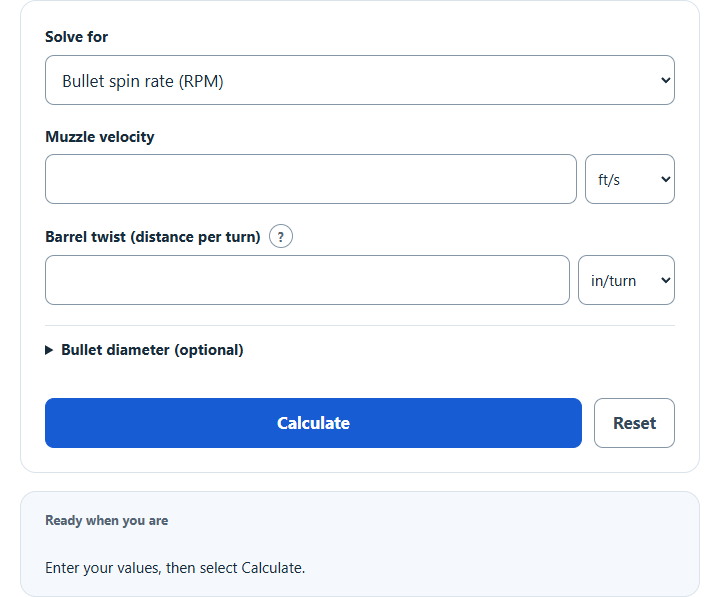
Calculate bullet spin rate in RPM from muzzle velocity and barrel twist, or find the velocity or twist rate needed for a target spin.
Related Calculators
- RPM to Acceleration Calculator
- Gravity Correction Calculator
- Air Density Calculator
- Kinetic Energy to Force Calculator
- All Physics Calculators
Calculator Functions
| Function | What it does | What it requires |
|---|---|---|
| Bullet spin rate (RPM) | Finds how fast a bullet is spinning as it leaves the muzzle | Requires the muzzle velocity and the barrel twist as distance per turn |
| Muzzle velocity for a target spin | Finds the muzzle velocity that gives a chosen spin rate in a barrel of known twist | Requires the target spin rate and the barrel twist |
| Barrel twist for a target spin | Finds the barrel twist that gives a chosen spin rate at a known muzzle velocity | Requires the muzzle velocity and the target spin rate |
Muzzle velocity goes in as ft/s, m/s, km/h or mph, twist as inches, millimeters or centimeters per turn, and spin as RPM or revolutions per second. A 1:10 twist is entered as 10. Every result lists the spin rate, velocity and twist in US and metric units and the time for one revolution. An optional bullet diameter adds the speed and acceleration at the bullet’s surface.
Bullet Spin Rate Formulas
| RPM | Bullet spin rate at the muzzle (revolutions per minute) |
| MV | Muzzle velocity (ft/s) |
| T | Barrel twist, the inches of barrel for one full turn of the rifling. A 1:8 twist is T = 8 |
The 720 is 12 inches per foot times 60 seconds per minute: a bullet in a 1:12 barrel turns once for every foot it travels [1]. In metric units the same relationship is RPM = velocity (m/s) × 60 ÷ twist (m per turn), which is how other unit choices are worked out.
Bullet spin rate (RPM)
The main formula applies directly. At 3,000 ft/s a 1:12 barrel gives 3,000 × 720 ÷ 12 = 180,000 RPM, and a 1:8 barrel gives 270,000 RPM [1]. At 2,800 ft/s a 1:8 barrel gives 252,000 RPM. The result also shows the spin at 5% below and 5% above the entered velocity, because spin changes in step with velocity.
Muzzle velocity for a target spin
This is the main formula solved for velocity. A target of 252,000 RPM in a 1:8 barrel needs 252,000 × 8 ÷ 720 = 2,800 ft/s.
Barrel twist for a target spin
This is the main formula solved for twist. Reaching 270,000 RPM at 3,000 ft/s takes 3,000 × 720 ÷ 270,000 = 8, a 1:8 barrel. A smaller answer is a faster twist.
Surface speed and acceleration
arim = 4π² × RPS² × d ÷ 2
With a bullet diameter d entered, these give the speed of the bullet’s outer surface and the centripetal acceleration there, where RPS = RPM ÷ 60. The acceleration is shown in g, dividing by 9.80665 m/s². A 0.308 in bullet at 180,000 RPM has a surface speed of 73.7 m/s (241.9 ft/s) and a surface acceleration of about 141,722 g.
Limits of This Estimate
- The result is the spin at the muzzle, taken from velocity and twist alone. It assumes the bullet follows the rifling exactly and that the twist is constant along the barrel.
- Spin rate by itself does not show that a bullet is stable. Longer bullets of the same caliber generally need more RPM, and other factors add to gyroscopic stability [1].
- Published muzzle velocities vary with barrel length, load and temperature, so a measured velocity gives a better figure than a catalog one.
Sources
- AccurateShooter.com Daily Bulletin, How to Calculate Bullet RPM: Spin Rates and Stability (2019): RPM formula, worked examples, and the limits of RPM as a measure of stability