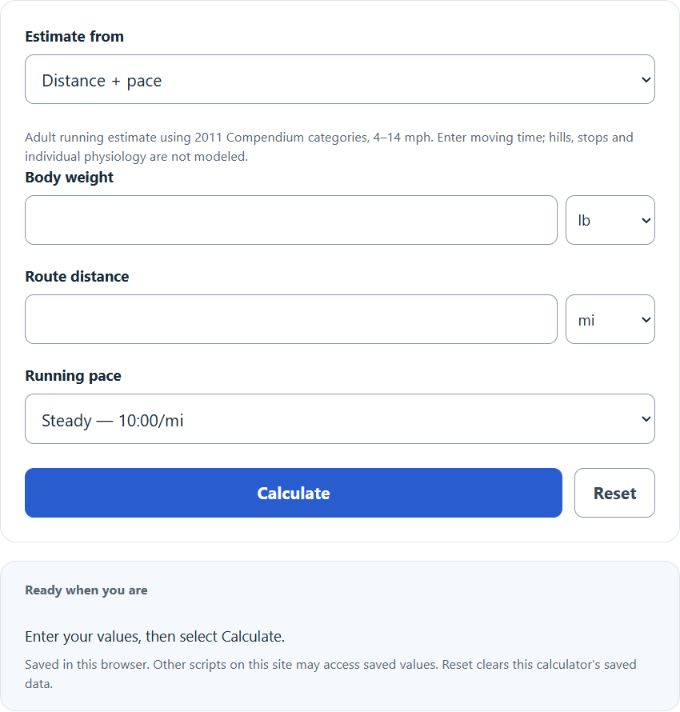
Estimate calories burned running by weight, distance, pace, or time, and see estimated mileage, speed, MET, and active calories burned.
Urban Running Calories Burned Formula
- MET: metabolic equivalent for the running speed (compendium-based)
- WeightKg: body weight in kilograms (1 lb = 0.45359237 kg)
- Minutes: time spent running
In Distance mode, time is derived from Minutes = Distance / Speed × 60 using the selected pace. In Time + Pace mode, the pace or speed input selects the nearest published 2011 Adult Compendium running-speed category from 4 to 14 mph, with midpoint ties selecting the lower speed. The category MET is unchanged; values are not interpolated or extrapolated. "Active calories above rest" subtract 1 MET to remove the energy you would burn sitting still. Use moving time rather than elapsed time including stops. Stoplights, turns, hills and individual physiology are not modeled, so this population estimate does not have a guaranteed individual accuracy range.
Reference Tables
Selected 2011 Adult Compendium running MET categories (nearest category used by the calculator):
| Pace (min/mi) | Speed (mph) | MET | Effort |
|---|---|---|---|
| 15:00 | 4.0 | 6.0 | Slow jog |
| 12:00 | 5.0 | 8.3 | Easy |
| 10:00 | 6.0 | 9.8 | Steady |
| 8:30 | 7.1 | 11.0 | Brisk |
| 7:00 | 8.6 | 12.3 | Fast |
| 6:00 | 10.0 | 14.5 | Race pace |
Approximate calories burned per mile by body weight at a steady 10:00/mi pace:
| Weight | kcal/mile | kcal/5K | kcal/30 min |
|---|---|---|---|
| 130 lb | 96 | 300 | 290 |
| 160 lb | 119 | 370 | 355 |
| 190 lb | 141 | 439 | 422 |
| 220 lb | 163 | 508 | 488 |
Example and FAQ
Example: A 170 lb runner covers 3 miles at a 10:00/mi pace. Weight in kg is 77.1. At 6 mph the run takes 30 minutes at MET 9.8. Calories = 9.8 × 3.5 × 77.1 / 200 × 30 = 397 kcal, or about 132 kcal per mile.
Why does urban running burn more than a treadmill? Urban running does not always burn more than treadmill running. Terrain, pace, wind, stops and treadmill incline affect the comparison. This calculator does not apply an urban calorie premium.
Should I trust my GPS distance? Buildings can block or reflect GPS signals, affecting recorded distance and pace. The size and direction of the error vary; use a reliably measured route when available.
Pace vs. speed input: Use min/mi or min/km for pace (format like 9:30). Use mph or km/h if you only know average speed. Both produce the same calorie estimate.
Active calories vs. total calories: Total calories include the energy you would have burned at rest during that time. Active calories subtract that baseline and reflect the extra burn from running.