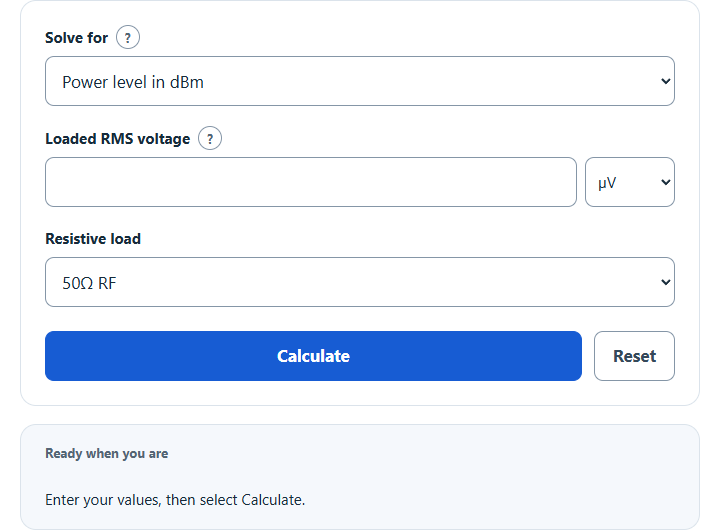
Convert microvolts (µV RMS) to dBm for a 50, 75 or 600 Ω load or your own resistance, or convert dBm back to µV, with dBµV and power shown too.
- All Unit Converters
- Decibel Calculator
- dB Gain Calculator
- dB to Watts Calculator
- dB to Voltage Calculator
- dBm to Volts Calculator
- dBm to RMS Voltage Calculator
- dBm to Current Calculator
µV to dBm Formula
The following formula is used to calculate the dBm from µV.
dBm = 20 × log10(µV RMS) − 10 × log10(R in Ω) − 90
- Where dBm is the decibel-milliwatts
- µV is RMS microvolts measured across the resistive load
- R (or Z in the original notation) is the resistive load in ohms; a reactive load needs its real-power relationship
To calculate dBm from uV, take the log base 10 of the uV and multiply by 20. Next, take the log base 10 of the impedance and multiply by 10. Subtract the second result from the first result, then subtract 90 again.
| Microvolts (uV) | dBm (50 Ω) |
|---|---|
| 0.1 | -126.990 |
| 0.2 | -120.969 |
| 0.5 | -113.010 |
| 1 | -106.990 |
| 2 | -100.969 |
| 5 | -93.010 |
| 10 | -86.990 |
| 20 | -80.969 |
| 50 | -73.010 |
| 100 | -66.990 |
| 200 | -60.969 |
| 316 | -56.996 |
| 500 | -53.010 |
| 1,000 | -46.990 |
| 2,000 | -40.969 |
| 5,000 | -33.010 |
| 10,000 | -26.990 |
| 20,000 | -20.969 |
| 50,000 | -13.010 |
| 100,000 | -6.990 |
| * Rounded to 3 decimals. Assumes Vrms into 50 Ω. Approximate shortcut: dBm ≈ 20·log10(uV) − 106.990 (uV in RMS microvolts). | |
What is dBm?
Definition:
dBm expresses power relative to 1 milliwatt: dBm = 10 × log10(P / 1 mW). Thus 0 dBm is 1 mW and 30 dBm is 1 W. For this calculator, P = VRMS² / R, using voltage across a resistive load.
How to convert uV to dBm?
Example Problem:
The following example problem outlines the steps required to calculate dBm from uV.
First, determine the total amount of microvolts. In this example, the uV has a value of 10,000.
Next, determine the impedance of the system in ohms. For this case, the impedance is measured to be 50 ohms. This is a fairly standard amount of impedance for a system.
Finally, calculate the decibel-milliwatts using the formula above:
dBm = 20 * log10 (uV) – 10 * log 10 (Z) -90
dBm = 20 * log10 (10000) – 10 * log 10 (50) -90
dBm ≈ −26.989700, or −26.990 dBm. The loaded voltage is 0.01 V RMS, so P = 0.01² / 50 = 0.000002 W = 2 µW.